



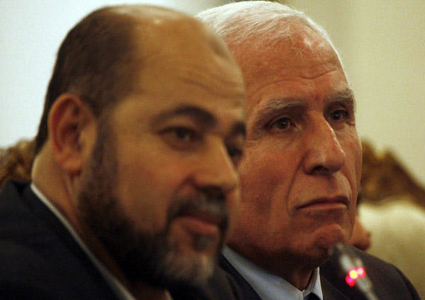
As the Palestinian Authority (PA) begins to suffer from a shortfall in foreign aid, it seems increasingly clear that the PA's efforts to forge a more assertive diplomatic approach to Israel — namely, through entering into a reconciliation agreement with Hamas and its intention to pursue recognition of statehood at the UN this September — may well prove disastrous. In the case of the Fatah-Hamas reconciliation agreement, which has partially informed the US Congress' recent threat to withdraw the $500 million in US aid promised to the to the Palestinian Authority, the Palestinian Authority stands to lose not only critical sources of aid, but the international credibility they have earned as a result of PM Salam Fayyad's state building efforts since Fatah took control of the PA in 2007. Ironically, the Palestinians appear to have fallen victim to a very familiar trick by interested regional powers — Egypt and Syria — which have orchestrated and supported the deal as a means of exerting leverage against the West amidst the maelstrom of the Arab Spring. For all the change shaking the Middle East, some practices die hard: with this unity deal, the Palestinians have once again been used as a political football by the same regional power players who have historically manipulated the Palestinian cause to suit their own strategic needs.
Egypt's intimate involvement in forging the unity deal was consistent with its longstanding involvement in Palestinian issues. Prior to making peace with Israel in 1979, Egypt participated in the first four Arab-Israeli wars and orchestrated the founding of the PLO in 1964. Since committing to the Camp David Accords, Egypt has situated itself as the lynchpin of Israeli security, and a crucial brokering power for Israeli-Palestinian negotiations. This has been the source of its security guarantee from the United States and the substantial military aid which has become crucial to Egypt's economic and political stability.
Following the collapse of the Mubarak regime, Egypt's reliability as an Israeli ally has been called into question. This ambiguity has been exploited by the Egypt's transitional government — controlled by the Supreme Military Council — which has used it as a source of leverage over the US. In a series of provocative measures, including indications of a public thaw in relations with Iran, the opening of the Rafah border with Gaza and culminating in their orchestration of the Fatah-Hamas unity deal, the transitional government has sent a message to the world that their allegiances are very much in flux.
The intimate involvement of Egypt in the Fatah-Hamas reconciliation is a perfect example of this strategy. Egypt has exploited the uncertainties and sense of insecurity of the Arab Spring to put former allies like Israel and the US on notice, using Fatah (unnerved by the downfall of former patron Mubarak) and Hamas (fearful of the potential collapse of their patrons in the Assad regime) as tools to exert this leverage. As Lee Smith has argued, given the dire state of the Egyptian economy, these tactics appear designed to extract increased aid and concessions from the US. This argument is supported by the fact that, despite embracing a more ambiguous stance towards Israel, the transitional government has stopped short of openly confronting Israel; as has been shown in their forceful actions against "Nakba Day" protestors outside the Israeli Embassy, as well as the tightening of restrictions on the Rafah border.
Like Egypt, Syria has consistently involved itself in the Palestinian struggle since the founding of Israel, participating in the Arab-Israeli wars and allowing Fatah to operate as a virtual extension of the Syrian military intelligence for many years. Following their humiliating defeats in the 1967 and 1973 wars, Syria changed its strategy from direct military confrontation with Israel to the use of Palestinian proxy organisations-most importantly, Hamas — to wage asymmetric warfare. This has enabled the Assad regime to both continue to threaten Israeli security and to project a disproportionate amount of strategic influence in the region by using the threat of violence against Israel as leverage.
On the one hand, the unity deal can be viewed as a sign of Syrian weakness, as Hamas only accepted the principle of a unity government because of its fear of losing its patrons in Syria. However, by granting Hamas permission to enter into the deal, Assad has been able to both demonstrate his continued power over the Palestinians, and has employed the reliable tactic of deflecting attention from his brutal repression of the Syrian uprising towards the supposed source of all regional ills, Israel-using the Palestinians as pawns to communicate that message.
Whether or not the unity deal fails or succeeds — and given the history of conflict and hatred between Fatah and Hamas, it seems unlikely to survive — the deal has the potential to yield violence, and may well strengthen Hamas' hand against Fatah and Palestinian independents. If the deal succeeds and an election is held in a year's time, polling indicates that the independents and Fatah will win an electoral majority. Hamas does not exactly have a history of respect for the results of democratic elections — as it took control of the Gaza strip by force after the short-lived unity government broke down in 2007.
Hamas would have little incentive to accept the electoral verdict and become part of a marginalised democratic opposition when its raison d'etre and source of power has been as an active resistance movement. Given its history and the internal logic of this unstable and fundamentally violent movement, an electoral defeat would give Hamas little choice but to attempt a coup or launch a third intifada against Israel to protect its power and restore its prestige.
If the deal fails, this gives Hamas and their Syrian patrons a pretext to launch hostilities against Israel as a means of taking pressure off the embattled Assad regime. Indeed, Assad has blatantly used the Palestinian cause to protect his regime from the pressures of the Syrian uprising: most recently, in the Syrian government's organisation of violent protests on the Golan Heights border on "Nakba Day" and "Naksa Day", and in Assad's cousin, Syrian tycoon Rami Makhlouf's clear threat to the Israeli government.
Whatever the result, by allying (even temporarily) with Hamas, Fatah risks losing a substantial portion of its international aid package — not to mention its international credibility — and has made it impossible for Israel to return to negotiations, as Hamas does not accept the Quartet Principles. Clearly, the unity deal principally benefits the regional powers which seek to secure their own futures through these machinations, and can hardly serve the interest of Palestinians who truly seek a peaceful, two-state solution.
Judging by the Obama administrations muddled response to the unity deal, and this week's quixotic attempts to revive the peace process at a time when neither the Israelis nor Palestinians trust the US as a mediator, the US's room for manoeuvre on this issue has been significantly constrained. Whereas Egypt and Syria have quickly grasped the threats and opportunities posed by the Arab Spring, and have used the unity deal as a proactive means of exerting pressure, the Obama administration appears to still be painfully struggling to catch up. They have not learned the lessons that this deal indicates about both the new opportunities and challenges raised by the Arab Spring; namely, that while Egypt's involvement in orchestrating the deal is intended to send a message without pushing the US and Israel too far, the current Syrian regime has no such limitations on its behaviour: it has tied its existential security to the threat of provoking regional conflict, and has already shown itself more than willing to do so.
Israel has been the reliable straw man of most Middle Eastern autocrats for the past sixty years, who have deflected international attention and domestic anger at their own dysfunctional states onto the Zionist bogeyman. This strategy has belied the loudly professed interest in securing a future for the Palestinians. Yet the survival of this trope in the context of the Arab Spring is extraordinarily ironic: the people who have taken to the streets across the Middle East and North Africa in protest have not done so out of outrage on behalf of the Palestinians, but because of their frustration at living in societies in which political liberties and economic opportunities ranged from limited to virtually non-existent.
In the meantime, the Palestinians themselves — best served by a peaceful settlement with the Israelis and the creation of a prosperous, secure Palestinian state — appear poised to be the losers in a very familiar regional game. For all the promise of the Arab Spring, the Palestinian case may sadly demonstrate that the more things change, the more they stay the same.


- A Helluva Week
- Having One's Cake and Eating It
- Win a pair of tickets to see "Hope" at the Royal Court
- Win a pair of tickets to see Albion!
- The Crescent and the Jackboot: Dealing with Totalitarianism
- A Dream of Scottish Secession
- ISIS and the West: Neutrality absolves nothing
- Heaven and Hell in Campania
- The Great Reformer
- The Irish Free Variable
- Holocaust Lessons
- Georgians Really Revealed?
- Snapshot of a beleaguered city
- London: A New Rome?
- The Enemy Within
- Playing With The Devil
- 'Home births are like letting your child not wear a seatbelt.' Really?
- Culture and the Crime
- Pareto Humanity

- The Loss Of Faith Made Music Mute
- The Great Betrayal: How Liberals Appease Islam
- Political Correctness Is Devouring Itself
- The New Language Of Political Narcissism
- Why The World Still Loves Shakespeare
- Don’t Listen to Britain’s Designer Demagogues
- Who's in Charge of BBC News?
- An English parliament: the only way to save the UK
- The Loss Of Faith Made Music Mute
- The Great Betrayal: How Liberals Appease Islam
- Political Correctness Is Devouring Itself
- The New Language Of Political Narcissism
- Why The World Still Loves Shakespeare
- Don’t Listen to Britain’s Designer Demagogues
- Who's in Charge of BBC News?
- An English parliament: the only way to save the UK
- The Loss Of Faith Made Music Mute
- The Great Betrayal: How Liberals Appease Islam
- Why The World Still Loves Shakespeare
- Who Will Lead The Berlin Band?
- Putin and the Art of Political Fantasy
- Political Correctness Is Devouring Itself
- The New Language Of Political Narcissism
- Inside The World Of 'Non-Violent' Islamism
10:09 AM
12:09 PM
2:08 AM
7:08 AM
7:08 PM
6:08 PM
2:08 PM
10:08 AM
1:08 PM
5:08 PM