


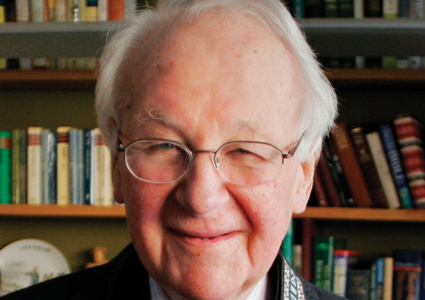
The "Evangelical Pope": The late Reverend John Stott
The death of an international figure often invites a raft of revisionism: an effort to interpret the person's legacy in terms that suit political or ideological prejudices. Recent commentary over the passing of an evangelical leader, the Reverend John Stott, exemplifies this vice, perhaps most grievously in an essay by New York Times columnist Nicholas Kristof. Whatever the intent, it was a "tribute" typical of those that degrade rapidly into mere propaganda.
A longtime Anglican minister at All Souls, Langham Place in London's West End, Stott was one of the world's most influential figures in evangelical Christianity over the past half-century. He was a key framer of the 1974 Lausanne Covenant, a touchstone document in the rise of global evangelicalism. He wrote nearly 50 books, and his preaching and teaching reached beyond England and the United States into the developing world. He died in July at the age of 90.
But to suggest, as Kristof and others have done, that Stott interpreted the mission of Jesus as a call to social justice — as if Christ was crucified for his jeremiads against global warming — is to belittle the heart and soul of his ministry.
For Stott, clear thinking about contemporary problems began with a belief in the Bible as God's Word and in Jesus as his Son, come to earth to rescue humanity from its guilt and shame. In his 400-page commentary on the New Testament book of Romans, he calls this "the most humbling and levelling of all Christian truths". Stott urged this truth upon his audience repeatedly, in every culture and country in which he ministered. He was devoted to the controversial task of evangelism — the task of persuading others that their eternal happiness depends on their belief in Jesus as their Saviour.
This was Stott's foundation for social action: a faith that inspired a deep and costly love for every human soul. "Is it then, healthy or unhealthy to insist on the gravity of sin and the necessity of atonement, to hold people responsible for their actions, to warn them of the peril of divine judgment, and to urge them to confess, repent, and turn to Christ?" he asked in The Cross of Christ. "It is healthy."
It is also unpopular, especially among the secular-minded, who tend to dismiss such ideas as arrogant, hateful, primitive — and dangerous. Thus there is no mention of Stott's actual beliefs in Kristof's essay: the intellectual equivalent of discussing Italy's Chianti region with no reference to wine. "We tend to come to [the Bible] with our minds made up," Stott warned, "anxious to hear only the reassuring echoes of our own prejudice."
John Stott allowed the teachings of Jesus to transform his ideas about justice and mercy, even if it brought him criticism. It would be heartening to see more liberal elites do the same. At the very least, they might venture out of their echo chambers for a moment, if only properly to honour the dead.


Post your comment
- Tsar Of The Holy Land
- Kennedy's False Note
- A Syrian Precedent
- Spending Spree
- Phoney Freedom
- Capitalist Capital
- Tate Hangs Back
- Bookish Brummies
- Stand Up For Surrey
- Darwinian Disbelief
- Washington Reds
- Erdogan's Folly
- Rude Britannia II
- No French Please
- Airtime To Fill
- Hands Off Judges
- Poetic Injustice
- A World of Flowers
- A Toast To Civilisation
- Royal Age Concern

- The Zombie Argument that Refuses to Die
- Online Only: The Price Paid for Criticising Islam
- Overrated: Dan Brown
- Is the Brain the Key to Understanding Religion?
- Overrated: George Monbiot
- Time to Wise Up to the Muslim Brotherhood
- 'Please Sir, I Just Want to Learn More'
- The Alternative History of an Undivided India
- The Zombie Argument that Refuses to Die
- Online Only: The Price Paid for Criticising Islam
- Overrated: Dan Brown
- Is the Brain the Key to Understanding Religion?
- Overrated: George Monbiot
- Time to Wise Up to the Muslim Brotherhood
- 'Please Sir, I Just Want to Learn More'
- The Alternative History of an Undivided India
- Decline and Fall of the History Men
- Uncritical Theorists Who Misread the Nazis
- The Zombie Argument that Refuses to Die
- The Banality of Hannah Arendt
- From Kitsch to Cool: Picasso and Modern Art
- Is the Brain the Key to Understanding Religion?
- Time to Wise Up to the Muslim Brotherhood
- Midfield Virtuoso Finds His Perfect Pitch
- Online Only: The Price Paid for Criticising Islam
- Overrated: George Monbiot
- Letter from Ukraine: Reviving Lost Literature
- On Pilgrimage with the Hasids
- Tsar Of The Holy Land
- The Blob Has Run Schools For Decades. Not Any More
- Bismarck Versus Blair — A Foreign Policy Crossroads
- My Dieting Guide: Listen To Mother