



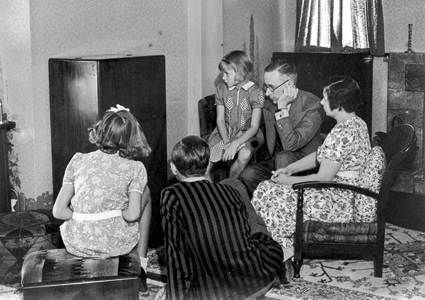
Children's Hour: This was a common sight in the Fifties. But Reith's BBC now seems as old-fashioned as the family values that sustained it
The riots on England's streets in August confirmed all too graphically the existence of an underclass. The high number of black faces among the young rioters triggered renewed agonising over England's ethnic minorities. But the most disturbing aspect of the new underclass is that much of it is indigenous.
In the poorest fifth of households, children of the white English working class are now performing significantly worse at school than their black and Bangladeshi counterparts whose underachievement has been the conventional concern of social policy, according to research by the Financial Times last April. They are more likely to get stuck in the bottom fifth of the academic league tables and are even less successful than those children of immigrants for whom English is a second language. The problem is most acute not in London but in the North: in Hull a poor white child has a greater than two-thirds chance of finishing at the bottom of the academic pile. Yet the education system, despite its failings, cannot reasonably be blamed as the sole culprit. The origins of this new underclass lie deeper.
Over the past half-century the English class war has been fought on two fronts, one economic, the other cultural. From the 1980s the working class lost the economic war: manual jobs disappeared, there was competition from a massive influx of low-skilled immigrants, and social protection through unemployment benefit and the state pension deteriorated to among the lowest in Europe. The English middle class benefited from the consequent cheap labour and low taxes. The working class won the culture war. Fifty years ago there was a single television channel, run by the BBC, which, from Children's Hour to The Brains Trust, held to the standards set by Lord Reith. Respect — both self-respect and the respect of others — was to be achieved through respectability, defined by the stuffy but functional lower-middle-class virtues of thrift, sobriety, fortitude, endeavour and family. In his magisterial social history of postwar Britain, David Kynaston entitles his volume on the 1950s Family Britain, and he surely highlights its central distinctive feature.


- Migrant Crisis? Europe Hasn't Seen Anything Yet
- Why Palmyra Should Matter To The West
- Corbyn's Rise Makes Cameron Redundant
- No, Jeremy: Politics Is All About Borders Now
- Why 'Lady Chatterley' Still Provokes Us
- For Climate Alarmism, The Poor Pay The Price
- Will Putin's Empire Outlast The Soviets?
- British Witnesses To Lenin's Revolution
- Bibliophiles Beware: Online Prices Are A Lottery
- How Jeremy Corbyn's Coup Hijacked Labour
- Corbyn's Signpost Back To The Ghetto
- Unionists, Don't Despair: Scotland Is Not Lost — Yet
- Britain's Apologists For Child Abuse
- Lift The Fee Cap And Set Universities Free
- The Story Behind One Dead Man's Penny
- Hitler's 'Ecological Panic' Didn't Cause The Holocaust
- Meet The Montalvos: The First Global Family
- Mr Gove, Here Is Our Statute of Liberty
- A British Bill Of Rights
- Something For Nothing Just Won't Do Any More

2:12 PM
2:10 PM