


"Not a monster queen": A.N. Wilson believes Elizabethan torture was a "cult" invented by martyrologists
Erasmus, that Renaissance man par excellence, said book lovers are not those who keep pristine editions under lock and key but those who dog-ear and annotate books, "who prefer the marks of a fault they have erased to a neat copy full of faults". This being so, I must love A.N. Wilson's latest book The Elizabethans. I've scrawled all over it in the process of correcting its faults.
Wilson never fails to provoke, and he particularly enjoys provoking Roman Catholics. In the case of The Elizabethans you don't have to be a Catholic to see that Wilson has an agenda, and that he is willing to pursue his agenda, even if it means contradicting himself. On the surface, that agenda is to create through short chapters arranged like poly-phonic voices an impression of playful complexity: Elizabethan England in all its variety. Wilson's deeper agenda is to promote a national identity built on the "doughty Protestantism" of that necessarily compromised invention "the Church of England". In Wilson's narrative, the Elizabethan Church of England is always unifying, never divisive, always tolerant, repressive only out of necessity, and always intellectually rigorous, unlike Catholicism which indulges in "double-think".
In "attempting to acclimatise ourselves" to the sociopolitical realities of Elizabethan England, Wilson comments, "we must resist the laziness of parallel...Rather than draw modern parallels we must continually re-enter the Elizabethan world." Yet Wilson's favourite parallel is to cast recusant Catholics as Islamist suicide bombers, a parallel in which every papal bull is a "fatwa" and every Jesuit priest a traitor to his country. It's a lazy comparison, because where England's Catholics were concerned to achieve freedom quietly to profess their faith without being forced to answer the "Bloody Question" (whether they professed loyalty to the monarch or the Pope), today's British Muslims take religious freedom and participation in British political and intellectual life as inalienable rights.
This is more than mere papist-baiting or iconoclasm from this high church atheist (or is he now an ex-atheist?) Wilson's attitude to Catholicism, at least in The Elizabethans, is frankly hostile. Take for example his comment that "some of the vandalism" to English churches, monasteries, and abbeys "— the ripping up of copes and chasubles and the use of missals to line pudding basins — should be seen in the light of those patriotic enthusiasts in 1939-40 who turned signposts the wrong way round to confuse any Nazi storm-troopers who might have come marching down the English roads." Following Wilson's logic, all those whose instinct is to preserve their religious heritage are turned into Nazi sympathisers. This is strong language, and it must necessarily give the modern reader pause to consider what it augurs to hear Catholics allied to Nazis and terrorists.
What sort of countermeasures does Wilson have in mind, "given the twin threats still posed to the world by Islam and Roman Catholicism"? He doesn't appear averse to the idea of poverty, imprisonment and torture being inflicted upon a whole swathe of English citizens. Although such measures were "intrusive" and "caused great hardship and suffering", they were nonetheless justified because, well, "they were hard times". "It is difficult to think of any political system, any state, that could tolerate in its midst those who plotted the murder of the head of state and the overthrow of the system. Comparable cases today, in which Islamists have been involved in terror plots or attempts to bring about a pan-Islamic world order, are rooted out as thoroughly as governments are able." Which is fine if you're talking about Osama bin Laden, but not when you're talking about a wife and mother like Margaret Clitherow, squashed to death for the grievous crime of harbouring a Catholic priest so that she and her family might continue to worship (in private) according to conscience.
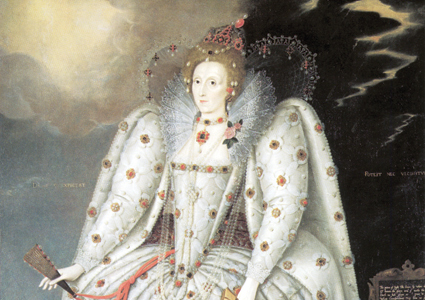
It doesn't take a giant leap from this position to justify the torture of political prisoners. Wilson makes light of torture inflicted by Elizabeth's spymasters, presenting the narrative of Elizabethan torture as nothing more than a "cult" invented by "martyrologists" who like "to dwell on the quasi-pornography of torture". From this point of view Margaret Clitherow brought her grisly, but titillating, end upon herself by effectively committing suicide, and Elizabeth is "not the monster queen" that revisionist historians have made her out to be.
In Wilson's rereading of Elizabethan history, only Catholic historians are revisionists. The "vehemently anti-Catholic" historian J.A. Froude is singled out for particular praise and admiration. This would be bad practice in a scholarly context but The Elizabethans aims to capture the popular imagination. Swashbuckling, panache, ceremony and swagger are in; impartial analysis is out, replaced by moral relativism.
Wilson begins his narrative with a discussion on what he calls "The Difficulty" (something academic historians have always called "history"). "The Difficulty is really a moral one: things which they, the Elizabethans, regarded as a cause for pride, we — the great majority of educated, liberal Western opinion — consider shameful." The reader is meant to understand that it is very big of Wilson to face "The Difficulty", and even bigger of him to ignore it: "I do not want this book to be a tedious and anachronistic exercise in judging one age by the standards of another." The answer is to dispense with judgment altogether, and thus it is that Wilson happily indulges abuse, rapine and murder so long as it was perpetrated with a certain amount of style and ironical humour.
At one point he describes how Sir Francis Drake "marooned a black woman who was heavily pregnant": "How the woman came to be pregnant — she was ‘gotten with child between the captain and his men pirates' — does not indeed reflect well upon Drake, if you choose to judge a 16th-century privateer who was at sea for nearly three years by the enlightened standards of a land-bound historian." Oh, so men were at sea for a long time; that makes gang rape OK then — silly me for daring to judge Drake by the standards of my own time.
When Wilson starts waxing lyrical about "Drake's Dial", a brass compass made in 1589 and now on display at the National Maritime Museum, it's easy to wonder whether in writing his narrative of Elizabethan England he didn't swap his moral compass for that of Sir Francis Drake.


- The Loss Of Faith Made Music Mute
- The Great Betrayal: How Liberals Appease Islam
- Political Correctness Is Devouring Itself
- The New Language Of Political Narcissism
- Why The World Still Loves Shakespeare
- Don’t Listen to Britain’s Designer Demagogues
- Who's in Charge of BBC News?
- An English parliament: the only way to save the UK
- The Loss Of Faith Made Music Mute
- The Great Betrayal: How Liberals Appease Islam
- Political Correctness Is Devouring Itself
- The New Language Of Political Narcissism
- Why The World Still Loves Shakespeare
- Don’t Listen to Britain’s Designer Demagogues
- Who's in Charge of BBC News?
- An English parliament: the only way to save the UK
- The Loss Of Faith Made Music Mute
- The Great Betrayal: How Liberals Appease Islam
- Why The World Still Loves Shakespeare
- Who Will Lead The Berlin Band?
- Putin and the Art of Political Fantasy
- Political Correctness Is Devouring Itself
- The New Language Of Political Narcissism
- Inside The World Of 'Non-Violent' Islamism
3:07 AM
5:12 PM
12:12 PM