



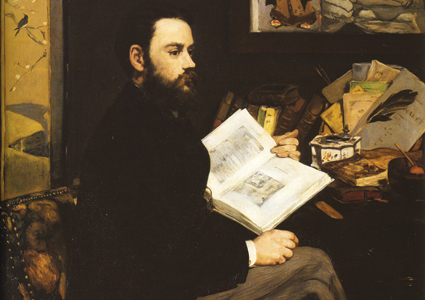
The art of protest: Emile Zola by Edouard Manet, c. 1868
On January 13, 1898, Emile Zola published his celebrated open letter to the President of France, J'Accuse, in which he accused senior officers in the French army of thwarting a revision of the case against Alfred Dreyfus, convicted of selling secrets to the enemy four years before and then serving a life sentence on Devil's Island. Furthermore, wrote Zola, these officers in the Army High Command had conspired to protect the true traitor, Charles Walsin-Esterhazy.
Where Zola led, other eminent writers, scholars, artists and academics were quick to follow. On January 14, the day after the publication of J'Accuse, a petition calling for a revision was published in L'Aurore under the headline "Manifesto of the Intellectuals" — the first mobilisation in modern times of scholars, writers and artists as a force shaping public opinion. It had been drawn up by Zola himself with Emile Duclaux, head of the Institut Pasteur. Duclaux and Lucien Herr, the librarian at the Ecole normale supérieure, circulated the petition among the scientists and scholars at their institutions. The net was extended by younger writers such as Marcel Proust who went around Paris collecting signatures. "I was the first Dreyfusard," Proust would later claim, "for it was I who went to ask Anatole France for his signature."
The term "intellectual", already used by the novelist Guy de Maupassant and by the nationalist man of letters Maurice Barrès, was ridiculed by the anti-Dreyfusards. Barrès referred to the signatories of the manifesto as the "demi-intellectuals", and the literary critic Ferdinand Brunetière questioned the very idea that authors and academics should possess some superior wisdom when it came to the law. "The intervention of a novelist," he wrote, "even a famous one, in a matter of military justice seems to me as out of place as the intervention, in a question concerning the origins of Romanticism, of a colonel in the police force." He castigated scientists too for their arrogant assumption that their insights into the working of the material world somehow placed them on the moral high ground.
To Brunetière, the Dreyfusard intellectuals' impugning of the integrity of the French High Command was symptomatic of the wider takeover of France by arrivistes — "Freemasons, Protestants and Jews". Barrès was even more specific in associating the Dreyfusards with those "foreign" elements in French society — the sons of immigrants like Zola, rootless cosmopolitans, Germanised philosophers, and of course the academics at the Ecole normale where "many students and the most respected masters were Jewish".
Like this article? Share, save or print using the icons below:


Post your comment
More Features
- Now Or Never
- Who Will Heal This Divided Country?
- What Made The West Great Is What Will Save Us
- Shock And Awe: Tales Of A Washington Insider
- We Shouldn't Let Old Men Rot Away In Jail
- Arnold Wesker’s Bid To Build A New Jerusalem
- Our EU Deal Gives Us The Best Of Both Worlds
- Brexit Would Save Us And Set Europe An Example
- Are Both Sides Playing By The Referendum Rules?
- Should We Stay Or Should We Go?
- Ignore Project Fear: Brexit Won't Ruin Us
- Uncontrolled Immigration Means Finis Britanniae
- The Next US President Must Carry A Big Stick
- Can Clinton Or Trump Crack The US Tax Code?
- How to Survive the Fourth Industrial Revolution
- The Spectre Of Mayor Khan's Islamist London
- Students Are Leading The Free Speech Fightback
- Fortress Europe Faces An African Migrant Tsunami
- Trump May Be Bad, But What Comes Next Will Be Worse
- Myth Of Stressed-Out Soldiers On The Street
Popular Standpoint topics

- Empty Seats At The Met
- Labour's Antisemitism Problem
- Why Only Countries Willing To Take Risks Will Survive And Prosper
- Did Burke Betray The Cause Of Liberty?
- Culture And Politics In The Age Of Trumpery
- The Spectre Of Mayor Khan's Islamist London
- Islam and the French Republic
- Rediscovering The Point Of Language