


Dial M for Melodrama: The Labour MP Tom Watson's account of the phone-hacking scandal fails to reflect on his personal motives or the wider political revenge he seeks
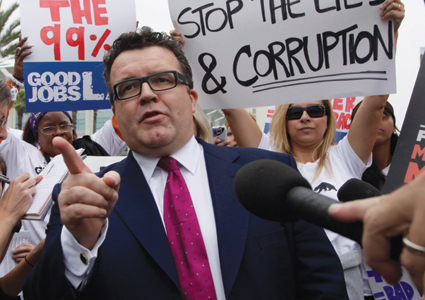
Has Rupert Murdoch been a force for good or bad in Britain? To an increasing number of people the question will seem absurd. Of course he has been a force for bad. That is certainly the view of the Labour MP Tom Watson and his co-author, Martin Hickman, a journalist on the Independent, in their book Dial M for Murdoch: News Corporation and the Corruption of Britain (Allen Lane, £20). In an exhaustive account of the News of the World phone-hacking scandal, they find a very great deal that is wrong with the media tycoon and absolutely nothing that is right. In the final chapter, they go up a gear and let fly, asserting that "Rupert Murdoch was not running a normal business but a shadow state."
Wow! It is some claim. I'm not wholly sure what a "shadow state" actually is, but it sounds formidable, frightening and powerful. The phrase would seem to imply that the ruler of this mysterious parallel entity, Rupert Murdoch, has ambitions that extend far beyond money-making to the control and ordering of our lives. It is, in fact, an assertion so wild as to verge on the lunatic, and one wonders how two apparently intelligent and well-balanced people could have brought themselves to make it. But then Murdoch seems to have this effect on his critics. He is the embodiment of evil and they, of course, are the embodiment of virtue.
Perhaps there is little point in trying to introduce a note of rationality into what is certainly no longer a rational debate, but I shall try. I freely admit — how could I not? — that the phone hacking reflected enormous discredit on the News of the World journalists involved in it, the Murdoch executives who orchestrated the subsequent cover-up, and the Metropolitan Police who connived and colluded in the affair. However, even Watson and Hickman admit there is no evidence that Rupert Murdoch knew about either the practice or the cover-up, though they maintain, with some justice, that he helped foster a free-wheeling, swashbuckling tabloid culture at the newspaper, and therefore cannot escape responsibility for what happened.
Of course if Murdoch had personally approved illegal surveillance of celebrities and others there would be no point in trying to make any kind of case for him. But I very much doubt that he did. News Corp, of which he remains chairman and chief executive, employs more than 50,000 people in many countries, and he simply did not have his eye on the ball in a tiny backwater of his vast empire. Nor did his son James, who might have been expected to, given that he was on the spot in London (Rupert generally works in New York) and responsible for News Corp's British operations.


- The Coalition We Need To Defeat Islamism
- Are We Losing The War On Home-Grown Terror?
- Cameron Gave Libyans A Chance. Pity They Blew It
- Brexit Will Give Global Free Trade A Boost
- The Real EU Referendum Winner May Surprise You
- Is Theresa May The True Heir To Mrs Thatcher?
- Race To The White House Through The Looking-Glass
- Brexit Gives Us A Historic Opportunity
- American Conservatives Must Stand Up To Trump
- Cicero's Analysis Of Decline Offers Lessons For The West
- Deepdene: Rise and Fall of the House of Hope
- Debunking the EU Referendum Myths
- Britain's Opportunity Is Europe's Warning
- Controlling Immigration Is Good For Democracy
- The Pied Piper of Islington
- The West Cannot Afford To Ditch Nato
- End Of History — Or Clash Of Civilisations?
- We Can Defeat Islamist Terror — But Not On Our Own
- Without the Emperor, What is Left of Old Japan?
- Now Or Never

2:07 AM
2:06 PM