



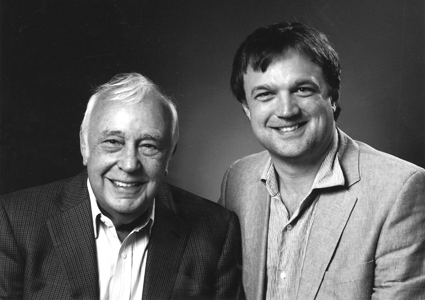
Fathers and sons: Robert (left) and Edward Skidelsky peddle a subtle form of paternalism
Economics has never been a neutral field. Value judgments have always crept in, if only through the back door of methodology. Traditional economics, for instance, assumes purposive individual behaviour and takes preferences as given. Technically this is done for the sake of abstraction and generality. But the more important reason is philosophical: it's about respecting other people's choices. Economics, then, simply means to analyse individual decision-making and its impact on the economic tissue of society. However, these basic assumptions have come under attack. Critics ridicule the so-called homo economicus as a caricature: People aren't always so rational, they do not always know what they want or, perhaps worse, they sometimes want things that are bad for them. They make mistakes; they do not always weigh costs and benefits wisely. But isn't it more humble and respectful of others to suppose that they do? Who are we to start from the assumption that they don't? And who are we to tell people what they should want?
Traditional economists seem to be alone in bothering themselves with qualms of this sort. A long time ago, the Chicago economist and Nobel Prize winner George Stigler (1911-91) argued that "social policy and institutions, not individual behaviour" was the proper concern of the economist. Those days are gone and the distinction is collapsing at breathtaking pace. Even within modern economics, the evil poison of intrusiveness into other people's designs is spreading fast. Richard Thaler and Cass Sunstein launched the notion of "libertarian paternalism", justifying that the state "nudge" people towards desirable behaviour — in their own interest, of course. Today's soft and subtle paternalists not only aim to influence social policy and institutions in such a way that socially desirable individual behaviour results, whatever that means. They also endeavour to lead people either to happiness, as "happiness economists" like Richard Layard do, or even to the vaster notion of personal fulfilment, to the "good life". This is what the distinguished economic historian Robert Skidelsky proposes in his new book How Much is Enough? (Allen Lane, £20), written with his son Edward, a lecturer in philosophy at Exeter.
Widespread dissatisfaction with the performance of the market system is behind the desire for a new approach to economics and economic policy. Since the beginning of the global financial crisis in 2008, which the world is still far from having overcome, public opinion no longer seems to value the incomparable achievements of capitalism. The tide has turned. Notwithstanding the political mistakes that led up to the crisis, notwithstanding human hubris, including an excessively expansive monetary policy, the crisis has demonstrated the vulnerability of the system. Where was the invisible hand when crisis loomed? Invisible, rejoice those who happily close their eyes to government failure. They therefore embark wholeheartedly on the project of "taming the market".
"Taming the market" — what a perversely solomonic formula. The first and hidden message in this expression addresses the free-market camp, and it consists in admitting that yes, the market is indeed useful. It is productive. But only to an extent. When it goes beyond certain limits, some taming will be needed. And this is how the second and not so hidden message brings the anti-capitalists out of the closet: in the end, government has to take over. Politics has to triumph over abstract market forces. Haven't these people read any public choice theory? How come they so blindly trust the wisdom of the democratic process? Of course it is only through ignoring the pervasive evidence of government failure that they can have their cake and eat it: sure, spontaneous coordination in the marketplace is efficient and innovative, but let's rein it in as we see fit. Rules are not enough; we are entitled to some enlightened ad hoc regulation. That will make the market process non-spontaneous? Oh well, it's for our benefit, and some greater good.


Post your comment
- A Recipe For Disaster
- Culture And Politics In The Age Of Trumpery
- Will Labour Listen To Its Eurosceptic Voters?
- Would Brexit Play Into Putin's Hands?
- Why Brexit Could Be A Blessing For Europe
- Will The Pollsters Get It Right On The Referendum?
- The Great Illusion: Why We Are Still Europe’s Fall Guys
- Make June 23 Britain’s Independence Day
- Don't Pit Generations Against Each Other
- Let Justice Be Done Though The Liberal Heavens Fall
- A Fascist Coup In Poland? Give Us Poles A Break
- It's Sharia, Not Alcohol, That Threatens Women
- Double Games Of The UK Muslim Brotherhood
- The Land Where History Repeats Itself As Tragedy
- Holocaust Survivors Are Still Waiting For Justice
- Rhodes, Race, And The Abuse Of History
- Shame On The Liberals Who Rationalise Terror
- France, Islam, And The Second Class Sex
- Isis Is Not Invincible — If The West Has The Will
- After Paris, Who Will Speak For France?

- Shame On The Liberals Who Rationalise Terror
- The Cowardice Of John Le Carré
- Beyond Obama: Advice To The Next President
- The Establishment Is In Denial — Yet Again
- Is There A Right Way To Write?
- Did Burke Betray The Cause Of Liberty?
- Double Games Of The UK Muslim Brotherhood
- Two Languages And The Chasm Between Them