


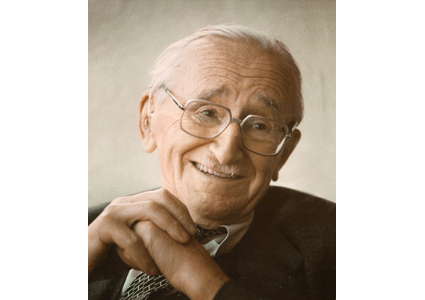
 The Left's chief bête noire: Classical liberal Friedrich Hayek
History doesn't repeat itself — but climates of opinion do. Some 80 years ago, the Great Depression triggered a deep suspicion of laissez-faire and initiated the era of big government. The crisis was interpreted as a failure of the market and so government was called upon to fix the mess. This view prevailed despite the publication in 1963 of a groundbreaking monetary history of the Depression by the economists Milton Friedman and Anna Schwartz. They demonstrated convincingly that the Federal Reserve's monetary policy was largely responsible for the severity of the crisis. But their insight remained outside the mainstream and the welfare state expanded rapidly. It was only in the Seventies that the tide began to turn when Keynesian deficit-finance measures failed to cure the stagflation that followed the 1973 oil price shock.
At that point public opinion opened up to supply-side economics; notions such as privatisation, liberalisation and deregulation entered the mainstream. But since the financial crisis that overwhelmed the developed world in 2007-08 the tide has turned again. Like the Great Depression, it is being interpreted largely as a failure of the market, and governments feel entitled to reclaim their prerogative. As before, the view that government played its part in paving the way to disaster remains difficult to sell despite the evidence in its favour. The climate of opinion has turned against free markets; paternalistic interventionism is fashionable again. Neoliberalism, a Continental academic term of art once meant to describe a rule-based political philosophy valuing liberty, individualism and the rule of law, seems to have become a dirty word.
The anti-liberal discourse is strikingly similar around the world. It begins by stating that neoliberalism used to be the reigning ideology, its sweeping success not even stopping at the front door of the British Labour Party or the German Social Democrats. According to this view neoliberal thought still predominates despite the crises since 2008. It is odd how different perceptions can be. Have we really been living in a world of unregulated free markets? That heterogeneous group of people who don't mind being called neoliberals nowadays doesn't quite see the world that way. Every year some of them gather for the conference of the Mont Pelerin Society (MPS), set up by the great defender of classical liberalism, Friedrich Hayek, in 1947. I attended its general meeting in Prague last month.
"We live in a far more socialist and statist society than we had imagined," Vaclav Klaus, the Czech President, declared. Even if privatisation, liberalisation and deregulation had once made it to the top of the political agenda, other issues have been equally successful: the collectivist project of the welfare state has never slowed down substantially. The threats to liberty linger almost everywhere, said Klaus, listing socialism, "greenism", the growing influence of NGOs, the apotheosis of science, the "demagogical element of democracy", manipulation by the press and "dangerous supranationalism".
The critics of neoliberalism have found common ground in the assumption that neoliberal politics is the result of one great global conspiracy. They seem to think that neoclassical economics, monetarism and public choice theory provided the tools to form a selfish money-oriented, efficiency-centred, government-mistrusting mentality. The key culprits are Hayek, Friedman and James M. Buchanan, and a network of trans-atlantic think-tanks — led by the Heritage Foundation and the Institute of Economic Affairs — which allegedly ensured that their body of thought was put into practice by politicians. Again, the usual suspects surface, three in particular: Ronald Reagan, Margaret Thatcher, and the unspeakable Augusto Pinochet. One detractor from this view, however, is Daniel Stedman Jones, a British historian. In his new book, Masters of the Universe: Hayek, Friedman and the Birth of Neoliberal Politics (Princeton University Press, £24.95), he convincingly shows that neoliberal reforms were launched almost everywhere by left-wing governments.


Post your comment
- A Recipe For Disaster
- Culture And Politics In The Age Of Trumpery
- Will Labour Listen To Its Eurosceptic Voters?
- Would Brexit Play Into Putin's Hands?
- Why Brexit Could Be A Blessing For Europe
- Will The Pollsters Get It Right On The Referendum?
- The Great Illusion: Why We Are Still Europe’s Fall Guys
- Make June 23 Britain’s Independence Day
- Don't Pit Generations Against Each Other
- Let Justice Be Done Though The Liberal Heavens Fall
- A Fascist Coup In Poland? Give Us Poles A Break
- It's Sharia, Not Alcohol, That Threatens Women
- Double Games Of The UK Muslim Brotherhood
- The Land Where History Repeats Itself As Tragedy
- Holocaust Survivors Are Still Waiting For Justice
- Rhodes, Race, And The Abuse Of History
- Shame On The Liberals Who Rationalise Terror
- France, Islam, And The Second Class Sex
- Isis Is Not Invincible — If The West Has The Will
- After Paris, Who Will Speak For France?

- Shame On The Liberals Who Rationalise Terror
- The Cowardice Of John Le Carré
- Beyond Obama: Advice To The Next President
- The Establishment Is In Denial — Yet Again
- Is There A Right Way To Write?
- Did Burke Betray The Cause Of Liberty?
- Double Games Of The UK Muslim Brotherhood
- Two Languages And The Chasm Between Them