


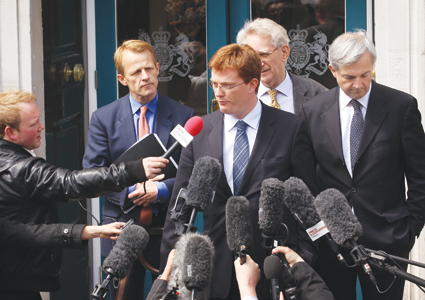
Liberal leverage: The Lib Dem coalition negotiators in May 2010 (left to right) David Laws, Danny Alexander, Andrew Stunell and Chris Huhne (credit: Getty)
There were many compelling reasons for the Conservatives to form a coalition with the Liberal Democrats in May 2010. The arithmetic of the general election results, which meant that the Conservatives were the leading party but fell slightly short of winning an overall majority of seats in the House of Commons, as well as the grim economic conditions they inherited, made it in the national interest for David Cameron to do the deal with Nick Clegg. That logic endures to this day.
But such an arrangement is quite different from thinking that coalition must now become a permanent part of our political arrangements —especially on terms that are advantageous to advocates of radical constitutional reform. That, of course, is exactly what Robert Hazell — author, with Ben Yong, of The Politics of Coalition: How The Conservative-Liberal Democrat Government Works (Hart Publishing, £19.95) — wants. Hazell founded the Constitution Unit at University College London in 1995. It has worked tirelessly (and with considerable success) to undermine the UK's traditional Westminster model of democracy in order to replace it by a continental European system of proportional representation and coalition government.
In short, the existing British electoral system hurts the Liberal Democrats, whereas a continental European system would mean that the Liberal Democrats would almost always be in office. Under that system, elections would produce hung parliaments and the Liberal Democrats would usually be able to play Labour off against the Conservatives and would enjoy the whip hand in deciding whether to enter into office alongside one party or the other. Only if the two main parties became so fed-up with being treated in this manner that they allied with each other in a Con-Lab "grand coalition" would the Liberal Democrats be denied power.
In view of these party political realities, it is not surprising that the constitutional reforms which Hazell advocates are popular with the Liberal Democrats. What is more alarming is that they appear to have enjoyed such strong backing from senior civil servants such as the recently retired Cabinet Secretary Gus (now Lord) O'Donnell, who afforded Hazell and Yong excellent access to the Whitehall system. Supporters and critics of Hazell's programme of constitutional change agree that his unit at UCL has a close relationship with and influence on the senior civil service and with the Liberal Democrat leadership. This "long and deep" impact is advertised on the unit's website in a section entitled "Constitution Unit Influence".


Post your comment
- Euphoric Labour won’t win power led by a pied piper
- Don’t be ‘difficult’ — try ‘formidable’, Mrs May
- Enough is enough of terror — but also of our self-doubt
- Iraq’s Christians pray for help that never comes
- The Atlantic alliance may be broken beyond repair
- Catholic tastes: both English and European
- Brexit as myth: Exodus, Reckoning, or Sacrifice?
- A Decent Woman Betrayed By Her Gruesome Twosome
- Can Macron Save France — Or Is He Its Undertaker?
- Europe's Revival Is At Hand, Thanks To Brexit
- Is This The Most Important British General Election Since 1979?
- The New Europe Must Be About More Than Money
- Our Best Brexit Policy Is All-Out Free Trade
- The Bursting Of Our 'Kabubble' Fantasies
- Gambling On A Greater More Gracious Britain
- Xi Versus Trump: The Emperor And The Tycoon
- Can Trump Square The Circle On Fiscal Reform?
- Donald Trump And The Dividing Of America
- Theresa May Emerges From Thatcher's Shadow
- Not Tweets And Anger But Redoubled Vigilance

- Time To Revisit The Two Cultures
- Opposites meet in the land of Scrugletopia
- The Battle Against The Philistines Never Ceases
- How The EU Elite Paved The Way For Populism
- Anything Dennett Can Do, Scruton Does Meta
- Why France Is Revolting Against The Ancien Regime
- Can Macron Save France — Or Is He Its Undertaker?
- A Decent Woman Betrayed By Her Gruesome Twosome