


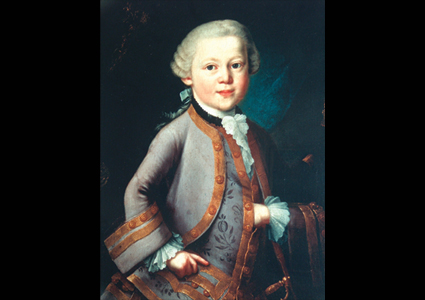
 Enough anniversaries already: Mozart, aged seven, painted in 1763
It dawned on me with great relief the other day that, unless I’m still writing strong in my nineties, I will never have to observe or partake of another Mozart anniversary so long as I live. Yippee!
I say that not to disparage anniversaries or, indeed, Mozart. Both have a recognised stall in the marketplace and neither is likely ever to be dislodged. However, each has the power to distort mass taste. Put together, they can—and do—wreak untold harm on the world’s cultural values.
The Nazis understood this all too well when, in 1941, they launched a jamboree in the 150th year after Mozart’s death and his nameless burial in Vienna. “A nation that forgets its great sons does not deserve to own them,” cried Joseph Goebbels, claiming that Mozart’s music embodied the supreme German quality of relentless clarity (and we all remember the consequences of relentless clarity).
The 1941 fest was, as Erik Levi points out in his book Mozart and the Nazis (Yale, 2010), organised and financed by the Reich with a view to establishing Mozart’s Aryan supremacy and their own cultural legitimacy. In the lands under German occupation, Mozart was the imposed sound of music, odious and ineluctable.
The next significant date, the 1956 bicentenary of his birth, saw the rehabilitation of the composer’s native Salzburg as the Bethlehem of an immaculate godchild, free of political contention. This was, to a degree, the Mozart that had been promulgated by war- time Allied media as a counterweight to Nazi propaganda. It was also the Mozart borne into exile by his greatest experts and interpreters, from Alfred Einstein to Bruno Walter, men who preached that every note of Mozart was an ineffable, celestial perfection: from Moses to Mozart, there was none like Mozart.


6:12 PM
5:12 PM
3:12 PM
12:12 PM
8:12 AM
9:12 AM