


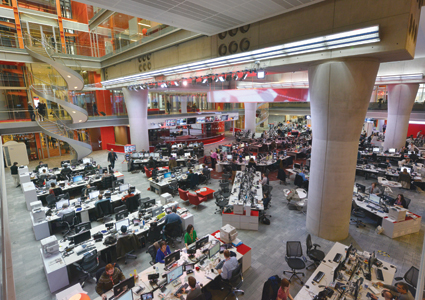
 Broadcasting House: Despite the scale of the operation, BBC News does not break stories
A few weeks ago, Sean O'Neill, the crime correspondent of The Times, claimed that Lord Hope, the former Archbishop of York, had covered up allegations that a senior Anglican clergyman had abused choirboys and school pupils.
You have to have worked in a newsroom to know how hard it is to break a story like that. How do you get victims to talk to you? How do you know whether you can trust them? Accusations of sexual abuse are hard to prove. In the absence of forensic evidence, impossible to find years after the alleged event, they often come down to "he says, she says" or in the case of many paedophiles, "he says, he says." Then there are Britain's ferocious libel laws to navigate.
Nevertheless, O'Neill stood-up the story, and went home convinced that he and The Times would receive some credit for publishing. The next morning the Today programme reported: "It has emerged that the former Archbishop of York had covered up allegations that a senior Anglican clergyman had abused choirboys and school pupils."
Emerged? Does the BBC think that stories appear like rocks at low tide? Does it imagine that passers-by can point their fingers and say, "Oh look, evidence of corrupt political donations has emerged"? H.L. Mencken may have gone too far when he said that "for every nugget of truth some wretch lies dead on the scrapheap". But it remains the case that someone has to put in the work and take the risks if investigative journalism is to survive.
Euphemists favour the passive voice because it denies agency and whispers lies. When the BBC says "it has emerged" rather than "The Times reported" it was hiding the fact that someone else had dug up the information. If this were a rare lapse, I would not bother writing about it. But the BBC deploys the passive voice as a matter of course to cover the embarrassing truth that it is relying on the research of others.
On the face of it, the BBC remains stuck with the self-regard of the last century. Newspapers and broadcasters could assume then that they were the sole source of news for their audience. When a rival secured a scoop, they could get away with passing off the story as their own, and engage in what journalists call "byline banditry".
In the age of the internet, their audiences can see through such shabby deceits within seconds. The best editors know it. They exploit the potential of the web and insist that their writers link to published sources. The readers can then check for themselves and read more if they wish.
But there is more to the suppression of sources than mere vanity. If the BBC were to report honestly, its viewers and listeners would realise how few stories the corporation breaks, even though it has thousands of journalists working for BBC News. You get a sense of the scale of the operation at the refurbished Broadcasting House in central London. On the ground floor is the largest newsroom in Europe. Above it are floors of studios stretching up to the sky. It is a magnificent sight, and houses many fine journalists. Right-wingers who loathe the BBC would do well to listen to Radio 4 from the Today programme through to the Shipping Forecast. If prejudice did not blight their minds, they might then grasp how much of British life would pass unnoticed if the BBC did not exist. Yet however indispensable the BBC is to the national culture, it does not break hard news.
Panorama has had only one genuine exclusive in years: its superb investigation into the abuse of mentally-handicapped patients by staff at the Winterbourne View care home. BBC Newsnight, once the pride of British television journalism, is now a sorry sight. BBC managers have starved it of resources. Channel 4 News has taken its place as the unmissable current affairs show.
It is not just "the cuts" that explain the corporation's failure of nerve. Investigative journalism is dangerous. It destroys BBC managers' careers. This month is the tenth anniversary of the scandal about the Today programme's claim that Labour had sexed up the dossier that justified Britain helping to overthrow Saddam Hussein. In hindsight we can see that the BBC was right to say that the government had spun the evidence that Iraq possessed weapons of mass-destruction, but wrong to imply that it lied.
At least some of us know that both the BBC and New Labour treated David Kelly, the government scientist who had briefed the Today programme, abysmally. His Whitehall superiors forced him to deny the BBC's story. The BBC committed the most unforgivable sin a journalist can commit and compromised its source. Dr Kelly committed suicide shortly afterwards.
The rights and wrongs of the affair matter less to BBC management than the consequences. After the official inquiry into Dr Kelly's death, the director-general had to resign. Ten years on, another director-general resigned because Newsnight failed to investigate the abuse of children by Jimmy Savile and then broadcast ludicrous allegations that a senior political figure was an abuser.
If honourable newspaper editors get a story wrong, they apologise. If they are in the right, but the government of the day or an interest group does not like what they have published, they tell the government or interest group to "go away" or perhaps use stronger language. Because the BBC is funded by the state and forces every household to contribute to its budget, however, it collapses under pressure, leaving its managers buried beneath the rubble.
The loss of two director-generals in a decade has incubated a frightened culture. You can tell that BBC journalists are ashamed of it by their pretence that stories "emerge". I hope Tony Hall, the new Director-General, finds the courage to allow a better BBC journalism to "emerge" in its place. As the money flows out of privately-funded media, the BBC will soon be one of the few organisations with the funds to pursue investigative journalism. All it needs is for its conservative critics to get off its back and for its managers to find their backbones.


5:10 AM
5:09 PM
9:06 AM
9:06 PM
10:05 PM
7:05 PM
2:05 PM
10:05 PM
7:05 PM