


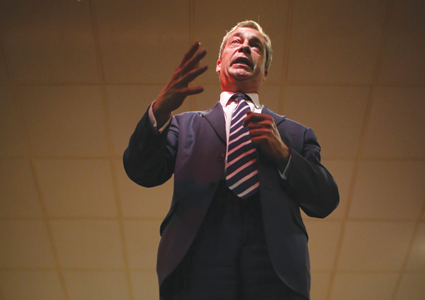
 On a pedestal: Anti-EU campaigners like Nigel Farage can be heard
It was just another Paris lunch. The editor of the Nouvel Observateur, and other media grandes fromages, at their local eatery opposite the Paris Bourse. David Cameron had just made his speech looking us all in the eye and promising an In/Out referendum. Prime ministers have ruminated about Europe in the past but this was the first time one had used In/Out language. In addition he gave a precise date for the referendum (by the end of 2017) to follow very imprecise negotiations to recast Britain's relationship with the EU in a way Mr Cameron and his Eurosceptic party could endorse.
Unlike the wriggle room Tony Blair and then David Cameron left themselves over the Constitutional and Lisbon treaties it is hard to see how such a solemnly delivered promise of a plebiscite can be swerved around. The Liberal Democrats have endorsed it — just as Charles Kennedy's announcement that he would vote with Tories in favour of a referendum on the EU Constitution forced Tony Blair's hand in 2004. Then I was the last minister to hold out in the Foreign Office where Jack Straw, Mike O'Brien and even Bill Rammell, more Europhile even than me but with a highly marginal seat to defend, had been moaning about doorstep demands for a referendum at our ministerial meetings for months before Blair caved in. By spring 2004, the combination of Tories, Lib Dems and Labour MPs unable to face down the clamour for a referendum in the Eurosceptic press, meant that Blair had no choice but to concede one.
The referendum appetite grows with feeding. David Cameron and his Foreign Secretary William Hague thought they could pacify the referendistas with the offer of an eccentric Bill that promised a referendum if ever there was a "significant transfer" of sovereignty to Brussels. Note the FCO bill drafters' weasel word "significant". It would be up to ministers to decide if any future treaty meant a significant shift in power to Europe. If they decided it wasn't significant then no referendum would be necessary. (Calls for this referendum Bill to cover a future treaty allowing Turkey to join were dismissed. The EU and Britain would change out of all recognition if 80 million Anatolian Muslims were allowed to come and live in Britain, but William Hague clings to the one British bit of EU policy which sounds progressive — the admission of Turkey to full EU membership.)
But far from the referendum Bill disposing of the problem all it did was whet the appetite of UKIP and anti-EU Conservatives as they demanded the real thing. Mr Cameron duly conceded in January. His decision has fundamentally altered the terms of trade about Britain's membership of Europe and made UK withdrawal, if not quite certain, extremely probable. The pro-European Ed Miliband sensibly refuses to reveal his hand on a referendum and told a gathering of pro-EU London elites (though to be fair Andrew Neil was there) at the German Embassy on June 10 that Labour was not in favour of an In/Out referendum now.
Mr Miliband is right to delay, to "wait and see", in Asquith's famous temporisation on Irish Home Rule. The European parliamentary election next May will be a defining moment. If the relentless rise of UKIP continues, it is implausible that Labour could be the only party to enter the 2015 general election campaign denying the people their chance to vote in a referendum on Europe. Perhaps public opinion will shift. Perhaps the media will call time on Nigel Farage's braggadocio. After all, Senator Joe McCarthy persuaded Americans for years that Communists were controlling the United States, just as Mr Farage tells us Europe is controlling the United Kingdom, until finally journalists told the truth and McCarthy's exaggerations and distortions were seen for what they were.
Perhaps the businesses that will lose out when we leave Europe and the City firms that will see all regulation for banking, insurance, currency and commodity trades move to the continent will speak up. Perhaps Rupert Murdoch will retire to the Leveson Home for Citizen Kanes and the Sun and The Times will revert to their 1975 pro-Europe stance. Perhaps after 2015, the rest of Europe will do anything, concede any opt-out, pay any price-triple the rebate, abolish the European Court of Human Rights — in order to persuade British voters not to leave. Perhaps, perhaps, perhaps.
If Angela Merkel retires after 2015, the chances of a pro-British constellation being in power in Brussels and key EU capitals like Paris, Berlin, Rome and increasingly Warsaw are zero. The Conservative Party quit the main centre-right political grouping, the European People's Party, in 2009 just at the time when its affiliates were winning a majority in most EU nations, in the European Parliament and on the Commission itself.
So as I enjoyed my Paris lunch I explained to my French media friends that it was time to take seriously the idea that Britain would leave the EU if a referendum were to be held in four years' time. They all thought that British grumpiness was due to annoyance over the rebate, the influence of the Murdoch press on British politics, and a failure to understand that Britain had won most of the big EU treaty battles of recent years.
This French puzzlement is captured by Le Monde's foreign affairs commentator, Alain Frachon, who wrote:
"Why on earth do they want to leave? We know that being original is in the British, especially the English, DNA. But to go from that excellent character trait in the British to actually leaving the European Union is a step that even the least rational of the French finds hard to understand. For one simple reason: Europe is British, a fact which seems to have escaped the notice of UKIP and the Tories who also want to see their country leave Europe."
For Le Monde's writer, Europe has rejected the French vision of a "Europe half social-democratic and half-run by the state". On the contrary, "London has won. With an EU of more than 20 members there is no common policy save creating a big single market." And that thanks to British diplomats. "An Oxford or Cambridge graduate is worth three French énarques because they have fashioned Europe according to British conceptions," M. Frachon declared.
"No, no, no," I told my French friends. That was not how the EU was seen in Britain. The reasons the British desire to leave Europe were deeper, I explained. The British political class had never really liked Europe. Labour was worse than the Conservatives. Attlee had refused to join the Iron and Steel Community and Gaitskell had denounced Macmillan's first effort to enter Europe as "an end to a thousand years of history". A majority of Labour MPs had voted against going into Europe in 1972, and the same majority opposed Harold Wilson's renegotiation and the Yes vote in the 1975 referendum. Labour put withdrawal from Europe into its 1983 manifesto.
Tony Blair, despite being pro-European, offered a referendum on joining the euro, which effectively killed the idea. Gordon Brown's five irrelevant tests were a red herring. Mr Blair appointed three previously devout Eurosceptics as his foreign secretaries and did little to encourage pro-European discourse from his own government or to promote pro-European MPs and ministers.
Since 1997, the Conservative Party under William Hague, Iain Duncan Smith, Michael Howard and now David Cameron has been uniformly Eurosceptic. Even if the Prime Minister and Foreign Secretary had to drop the scorn and open contempt for Europe they showed in their years in opposition, Mr Cameron has promoted avowed Eurosceptics to senior cabinet jobs. To be openly pro-European on the Tory benches since 2005 has been almost as rare as a woman cardinal electing a pope in Rome.
Like a court jester, Ken Clarke has been kept on, but no one is fooled that his presence dilutes the notion promoted by the generation of Margaret Thatcher's children and protégés that Europe is a succubus from which a vigorous, free trade Britain focused on Conrad Black's Anglosphere, China and the other emerging markets needs to free itself.
The Europe that Britain joined in 1973 grew at nearly twice the rate of the UK. Until the fall of the Berlin Wall, and the abrupt halt to German growth after the country absorbed the dead weight of bankrupt Communist East Germany, the EU seemed a better place to do business than Britain. Then Thatchernomics and the deft way Blair and Brown incorporated deregulation, market opening and globalisation into Labour's governing progamme (until the 2007-08 banking collapse) meant that for the first time since 1950 Britain was outperforming European economies. Who then needed Europe, all the more so as the enduring eurozone crisis was held up in Britain as a disaster? Britain's membership of the EU "is like being shackled to a corpse", declared the Eurosceptic Tory MP Douglas Carswell in October.
He and Daniel Hannan and the irrepressible Boris Johnson all enjoy dancing on the EU's grave. The gravedigger-in-chief, Nigel Farage, seems to have become a BBC staffer as the broadcasters employ him 24/7 to use his vivid language to trash Europe. In France, the anti-Europeans are hard, unforgiving, far-Right politicians like Le Pen, père et fille, or demagogic lefties like Jean-Luc Mélanchon. In Britain, the Eurosceptics are graduates of Have I Got News for You and use direct, vernacular English. They have all the press on their side, especially the offshore owned news media. Even the culturally pro-European Guardian opposed the euro and anti-European columnists outnumber the dwindling pro-European writers by ten to one. The Guardian's pro-European sage, Hugo Young, was replaced after his death by the scornful Eurosceptic Sir Simon Jenkins, and only the Financial Times, unread outside City boardrooms, found a little space for pro-European veterans like Sir Geoffrey Howe or Sir Peter Sutherland occasionally to make the case for Europe.
The pro-Europeans have lost confidence in their cause, find it difficult to make the case, and have no natural political home since the ruling party, the Conservatives, is in varying degrees Eurosceptic and the post-Blair Labour Party hopes the Euro-boil will lance itself without Labour politicians ever having to make the case for Europe day in, day out. There are no witty, stylish, man-in-the-street pro-Europeans able to take on Nigel Farage or Boris Johnson or Daniel Hannan. Although Lord Sainsbury has helped to finance a beefed-up pro-EU website, Britishinfluence.org, it cannot match the reach of the much better funded anti-European propaganda operations. Business for New Europe has kept the pro-EU flag flying but the anti-EU Business for Britain was launched in April with the redoubtable campaigner and propagandist Matthew Elliott of the Taxpayers' Alliance as its chief executive.
The bad news has never stopped. The arrival of hundreds of thousands of European workers after 2004 had a profound impact. Previously immigrant meant a brown or black face from the old empire. Now the immigrants attacked by UKIP, the BNP, the tabloids and Tory MPs talking about benefit tourists are mostly Christian, white and European. The European Court of Human Rights, much admired when it stood against torture in Turkey or false imprisonment in Russia, became an object of hate when it ruled that like Switzerland Britain should let prisoners vote. As vice-president to Jacques Delors at the EC, Lord Cockfield was a hero when he replaced national regulation and customs to achieve the 1986 Single European Act. But the faintest hint from one of his French or Finnish successors that perhaps, just maybe, the City needs a little more regulation to avoid future RBS or Libor disasters is met with outrage.
The British were never occupied by the Nazis, resisted the Vatican and the Kremlin and would not bow down before the Berlaymont. I explained to my French friends that all these tributaries were coming together into one confluence that would gather in force ahead of the referendum. As a result Britain would leave Europe even if such an outcome was not the declared wish of the Prime Minister and was Ed Miliband's nightmare. Britain, I said, was either the first in Europe or the last. We were last of the big Western European nations to join Europe and would be the first to leave.
The centrifugal and disintegrative forces in Europe are now such that, while Britain may be the first to say no to the EU as presently constituted, other countries in different ways will also face difficult choices over their European future. It is not what I wish and will be a major defeat for what I think are British interests. But we have reached a point when a plebiscite is more important than parliament and our politicians have lost control of the flow of events. Brexit will take place. What happens after no one knows.


- The Plot to Islamise Birmingham’s Schools
- Nigeria, Iraq, Gaza—The Threat is the Same
- Radical Islam and its Invisible Victims
- The Man Who Tried to Teach us all a Lesson
- Globalisation and The Crisis of the Nation State
- The Medium Isn’t Always the Message
- What sort of Europe does Cameron Want?
- Is China outstripping the West at innovation?
- Piketty’s panacea will make inequality worse
- The Moral Strength of Leonard Cohen
- Designer who taught us to keep it simple
- The US Can Still Help Save Syria — and Iraq
- Russian Resurgence has Blindsided Nato
- On Europe, Nothing Less than Treaty Change will do
- Putin has his Useful Idiots on the Left and the Right
- Sarajevo: Where the Century of Terror Began
- Allen Lane’s Pelicans Take Wing Once More
- How Not to Remember the First World War
- Opera is Not Just Our Most Expensive Noise
- Jonathan Miller: One Man, Two Cultures

5:09 AM
9:09 PM
9:08 PM
9:07 PM
4:07 PM
11:07 PM
4:06 PM
4:06 PM