



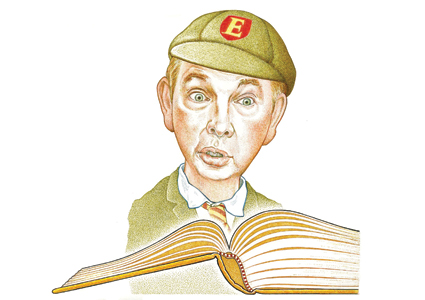
Most of the time I don't think about being adopted. Any more than I think about the colour of my eyes. Or the size of my feet. It's all part of who I am — and how I was made.
But sometimes it hits you. There's a moment when you can't help but think that your life might have been different — very different — if another family had taken you into their hearts.
Like the day six years ago when, as Shadow Education Secretary, I was looking at the recently published GCSE performance of schools. One in particular caught my eye. A comprehensive on Merseyside where just 1 per cent of the children had managed to get five C passes at GCSE, including English and maths.
Five GCSE passes (including English and maths) is the basic passport any child needs to be eligible for further study or a decent job. It's the minimum a 16-year-old needs to have a decent chance in life. There's not a single Labour politician, Guardian columnist, trade union general secretary or university professor of education who would conceivably find their child falling short of that standard acceptable. But in that school in Merseyside, 99 out of 100 children failed to acquire even that basic level of knowledge. What would happen to them, I thought? Who was angry on their behalf? Who cared?
And what would have happened to me if I'd been at that school? My own, adoptive, parents weren't wealthy. They'd been accepted to adopt me because their background was similar to my birth mother's. They were also chosen because they lived a few hours away from her home city of Edinburgh.
What, I wondered, if I had been adopted by similarly loving parents who happened to live a few hours south of Edinburgh? On Merseyside? In the catchment area of that school? What chances in life would I have? Would I now be sitting around the Shadow Cabinet table?
How, I thought, could we tolerate such grotesque unfairness? How, after ten years of a government committed to education reform, did we still have a school in the European City of Culture where 99 out of 100 16-year-olds had effectively been robbed of their future? How could we as a society allow ourselves to entertain such low expectations of our children?
The fact that the school was on Merseyside struck another chord with me. I'm a fan of Liverpool — its vibrancy, its humour, its resilience. And one of my favourite films — Willy Russell's Educating Rita — is set in the city. Rita, played by Julie Walters, is a working-class woman who wants to better herself and so signs up for an Open University course. She bewitches her lecturer Frank — played by Michael Caine — who sees in her a love of learning he'd almost entirely lost.
Frank's desire to help Rita extends to inviting her into his life. But Rita finds that a step too far. In an — almost unbearably poignant — scene at the heart of the film, Rita is invited to a dinner party at Frank's. When she arrives at his door she can hear the bookish chatter from inside — but she can't bear to cross the threshold because she fears she isn't sophisticated enough for his middle-class world.
Instead, she returns to the warmth and intimacy of her family's local. There she joins in a boozy sing-song to a cheap jukebox hit. She loves everyone around the table — and there is no doubt that there is a solidarity and a sense of humour in the pub that is absent from Frank's dining table. But Rita knows, nevertheless, that she has gone back to square one. She feels she may have missed out — perhaps forever — on the chance to choose her own life rather than accept the hand she's been dealt. Her mother instinctively knows Rita deserves better and, mid sing-song, turns to her and says, "There must be better songs to sing." And at that point you weep for her.
But Rita, determined to find those better songs to sing, returns to university. Willy Russell gives her a second chance to achieve her full potential. But what of all the contemporary Ritas who were at that Liverpool school where just 1 per cent got the qualifications which even allowed them to think of university? What songs are they going to have the chance to sing?
Those two stories — one fact, one fiction; one tragic, one poignant — are all you really need to know about this government's education policy. We are angered by the waste of talent in an education system where hundreds of thousands of children leave school without worthwhile qualifications. We are ashamed that the poorest in our society have been those most likely to lose out. We are convinced that the level of ambition in our education system has been far too low for far too long. And we want to give all children the chance to choose their own future.
That ambition is undeniably radical. In fact, it's the realisation of a long-cherished but never yet fulfilled liberal dream.
For most of human history most individuals have had their futures determined by forces beyond their control. Most men and women were hewers of wood and drawers of water-condemned to manual jobs dictated by where they grew up and who their parents were. They had no effective control over their economic lives, and thus very little control over their destinies. They never had the chance to fulfil themselves, or shape the world. They were the village Hampdens, the mute inglorious Miltons, the 99 out of 100 children who left that Merseyside school at 16 without five good GCSEs.
But education can change that. There is nothing fixed about any child's future. Deprivation need not be destiny. If the right professionals — under the right leadership, with the right level of ambition — are given the freedom to teach the subjects they love in a disciplined environment, then any child can succeed.
Over the last three years the coalition government has been setting out to prove that every child can succeed. We've been recruiting more highly qualified teachers. We've made it easier to pay good teachers more. By granting 3,000 state schools academy status we've given their headteachers the freedom that independent school heads have long enjoyed. We've given teachers the chance to build ambitious new academic institutions from scratch through our Free Schools programme. We've restored rigour and honesty to our exams by getting rid of the dumbed-down syllabuses and rigged assessment techniques that produced grade inflation. We've rewarded schools that teach the traditional subjects which help all students get into university. We've given heads and teachers new powers to keep order in the classroom. We've toughened up inspection. And we've transformed vocational qualifications so at last they're as rigorous as academic courses.
The aim has been to encourage every school to match the best. And the best state schools in this country are wonderful proof that every child — from no matter what background — can succeed.
I've stood in classrooms where half the children come from homes where English isn't spoken, where half the children are so poor they're eligible for free school meals, where their family memories are of ethnic cleansing in Kosovo or terror in Somalia, and heard those children discuss tyranny and legitimacy in Julius Caesar and Macbeth. And those children were only ten.
I've visited schools where more — many more — children than the national average are registered as having special educational needs. But where every child manages to perform well above the national average in numeracy and literacy.
I've talked to headteachers whose schools have done what some consider impossible — eliminated any gap in academic performance between children from the richest and poorest homes. Those children so poor they are eligible for free school meals get the same — impressively high-marks at GCSE as those from affluent backgrounds. There is an urgent need to ensure that every school is as good as these.
There's a social justice imperative.
Children only have one chance and I don't want more years to go by when hundreds of thousands of our poorest children leave school without the qualifications they need to succeed.
There's an economic imperative.
With every week that passes, the need for change in education grows, because of the impact of globalisation. Globalisation is an ugly word for a double-edged force. The economic changes of the last 20 years have — in Thomas Friedman's famous phrase — made the world flatter. That generates tremendous opportunities for those with the wherewithal to exploit them. But it also creates new problems for those without wealth, connections or, above all, education. The economic returns for the highly qualified continue to grow — and for those with mathematics qualifications they are growing at a remarkable rate. But for those without qualifications, jobs are fewer, wages are lower and opportunities are diminishing. We can't hope to compete internationally, and provide jobs for all, when 40 per cent of children still leave school in England without five good GCSEs and when our country languishes at 25th and 27th in the world for the quality of our students' literacy and numeracy. That is why the case for reform is so urgent.
But above all there is a moral imperative to reform our schools.
The principal goal of education is enlightenment — the introduction of a new generation to human creativity — and the glories of civilisation in all their richness. Whether that is the literature of Austen or Atwood, the joy of cricket or the pleasure of chess, the music of Bowie or Beethoven, the breakthroughs of Leibniz or Turing, the creations of Brunel or Berners-Lee, the work of Poussin or Gauguin, the discoveries of Curie or Feynman, the purpose of education is opening young minds to the achievements of great minds.
At the moment, access to the best that has been thought and said is restricted to a fortunate few. Because of the dumbing-down of both our exams and school curricula under Labour, children can go through school never having read a novel written before the 20th century, never having read or seen an entire Shakespeare play, never having learned a poem by heart, never having had the chance to appreciate, or play, classical music, never having the chance to learn about the achievements of the greatest scientists and engineers, never having had the chance to play in the competitive sports in which England has long excelled, never being encouraged to engage with anything which is not immediately "relevant" to their lives. But if all children are told about is what they already know, how will they ever-like Rita-learn better songs to sing?
There is no doubt that most parents have aspirations for their children which are far higher than many of the professionals who condescend to them. The Millennium Cohort Study of 19,000 children born in the UK in 2000-01 recently interviewed mothers about their ambitions for their seven-year-old children. An astonishing 97 per cent of mothers wanted their child to go to university.
Whether or not a student decides that university is right for them, the evidence is clear that a proper academic education to the age of 16 is the best way of maximising any child's chances of success in the future. The work of the educationist E.D. Hirsch and the studies in cognitive science assembled and analysed by Daniel Willingham demonstrate, with irresistible power, that a traditional knowledge-rich curriculum is the key to educational success, whatever path a student eventually decides to follow. Hirsch has proved, over a distinguished academic lifetime, that the greater the level of cultural capital children enjoy, the more rapidly and effectively they learn to read, and the greater their appetite for further discovery. Willingham's work — and that of the many cognitive scientists he has analysed — demonstrates that it is through the acquisition of knowledge that intelligence is formed. And the more a child learns, memorises, and commits to heart, the greater the capacity for critical thought and creative work. The virtues which so many who declare themselves opponents of traditional education wish to foster — curiosity, a desire on the part of learners to pursue their own learning, creativity and critical thinking — can only really effectively come from immersion in a rigorous, knowledge-rich curriculum with traditional subjects and teachers schooled in those subjects.
That these truths have been denied, mocked or sidelined for so long is proof enough of the need for change in our education system. That is why one of our most important reforms — and certainly the most controversial-has been our toughening of exams and the curriculum.
We have had to overhaul our national curriculum to get it into line with the best performing education jurisdictions — like Singapore, Hong Kong and Massachussets. We've had to reform GCSEs to get rid of modules, re-sits, formulaic questions, questionable coursework and dumbed-down papers designed to keep certain students' aspirations low. We've also had to reform A-levels to ensure they are once more proper two-year courses — with room for in-depth study — and the sort of rigorous questions which are appropriate preparation for university study.
But while these changes have been controversial, the most supportive voices have been those of teachers. Teachers like Tom Bennett, Andrew Old, Daisy Christodoulou and Standpoint's own Matthew Hunter, have taken to the web and Twitter to support the changes we have been making — in defiance of their unions — and have won massive followings.
Indeed, the most encouraging trend of the moment in education is that the people pressing for change most determinedly are not politicians, but teachers. And that's as it should be — because our policies are designed to enhance the prestige of the profession, restore the lustre attached to academic study and give teachers the chance to lead change in education.
Perhaps the most powerful demonstration of that is the Free School programme — which allows idealistic teachers to set up their own state schools in communities that have been poorly served by existing schools. Teachers — like former Standpoint columnist Katharine Birbalsingh, or Mark Lehain at Bedford Free School, or the team behind Greenwich Free School — are in the vanguard of change.
Free schools provide parents with choice they've been denied by local bureaucratic monopolies, challenge existing schools to raise their game, and they provide an opportunity for idealistic teachers to bring the sort of education the rich have always been able to buy for their children to communities which have been shortchanged in the past. Already the first 24 free schools are out-performing other state schools and are massively oversubscribed.
Free schools are a dramatic demonstration of the growing determination among more and more teachers to set higher expectations for students. But they're not the only evidence of a new culture of greater ambition for all children.
Alongside the growth in free schools there has also been a big increase in the number of academies. As the name suggests, academies are schools freed from bureaucratic control to concentrate on becoming successful academic institutions. As Tony Blair explained in his memoirs, an academy "belongs not to some remote bureaucracy, not to the rulers of government, local or national, but to itself, for itself. The school is in charge of its own destiny. This gives it pride and purpose. And most of all, freed from the extraordinarily debilitating and often, in the worst sense, politically correct interference from state or municipality, academies have just one thing in mind, something shaped not by political prejudice but by common sense: what will make the school excellent."
There are now 3,000 academies — and many of them are passionately engaged in improving underperforming schools by taking them under their wing — "sponsoring" them. Some have achieved amazing transformations.
Greenwood Dale sponsors the Nottingham Girls' Academy, which has around double the average number of pupils on free school meals. In its first year as an academy, the percentage of pupils achieving five good GCSEs, including English and maths, has jumped from 37 per cent in 2011 to 56 per cent in 2012.
Sir Joseph Williamson's Mathematical School in Rochester, a grammar school and one of the first National Teaching Schools, became an academy and founded the Williamson Trust in April 2011. The Trust now has four academies, including one which, having being in special measures, is now judged good by Ofsted and has seen results double since 2009. The secret of academies' success is really no secret at all — it's great teaching and high expectations.
Many of those making the biggest difference in academies and free schools are alumni of Teach First or members of its sister organisations Teaching Leaders and Future Leaders. All three are charities designed to recruit outstanding young people who are academically distinguished and who have also demonstrated real leadership ability into classrooms in our most challenging communities. They explicitly bypass the old teacher recruitment routes and thus challenge the monopoly of the old teacher training colleges.
The evidence so far indicates that they are making a dramatic — and welcome — difference to every school in which they operate. And these charities — by explicitly targeting students with the best degrees from top universities — have helped change the profile of teaching overall by leading a new generation of academically accomplished undergraduates into the profession. That's why the coalition government has increased their funding — to allow Teach First to quadruple in size and encourage Teaching Leaders and Future Leaders to work in more schools. And we've sought to apply those lessons more widely.
We've explicitly set out to recruit more academically inspiring young people by awarding scholarships to students with top degrees from good universities in subjects such as mathematics, physics, chemistry and computing.
We've deliberately ensured they can train in the best environment to learn about classroom management, discipline and effective teaching: schools. We've given the best heads the chance to recruit trainee teachers direct — so they can bypass the teacher training colleges and guarantee an attractive start for any idealistic graduate. Already the evidence from Ofsted suggests that teacher training in schools is superior to the courses offered by the old colleges.
We want as many of those superb new teachers as possible to teach where they're most needed — in the primary schools where a third or more of children still leave incapable of following a secondary curriculum and the secondaries where half or more still leave without five decent GCSEs. In order to make it easier to attract and keep them in those schools, we have dismantled the old pay and conditions arrangements, designed by the unions, which simply rewarded longevity of service, to bring in performance-related pay. So good teachers can now be paid more.
And because we've introduced a pupil premium — more money for schools with children from poorer backgrounds — challenging schools will now have both the money and the freedom to attract great teachers. In America, research by the New Teacher Project in its report The Irreplaceables showed that great teachers in challenging schools — those who were irreplaceable figures in the lives of poor children — were more likely to stay if their contribution could be recognised through performance pay.
Nothing matters more in ensuring that our schools improve than recruiting the right people. That is why I am so fortunate to have been able to appoint outstanding people to the jobs that matter in our education system. And I am particularly lucky that they have so stoically withstood criticism from the enemies of promise, who have presided over failure in the past, in order to safeguard our children's future.
Sir Michael Wilshaw, Her Majesty's Chief Inspector of Schools, has set higher expectations for what all schools should achieve, and concentrated, with piercing moral clarity, on the failure to educate so many of our poor children adequately. Glenys Stacey, the chief executive of the exams regulator Ofqual, has reduced grade inflation, restored rigour to GCSEs, eliminated many of the dodges used to game the exam system and is making sure our A-levels are world-class. Professor Alison Wolf, of King's College London, has dramatically improved vocational education by making it easier to secure high-quality work experience, getting rid of Mickey Mouse courses and making vocational qualifications as rigorous – in their structure and marking — as academic qualifications. All three have had their decisions attacked by the teaching unions, but their bravery in fighting for higher standards in all our schools is an inspiration.
There is so much more to do to improve every child's chances in this country – from raising the standard of nursery education to improving the number of genuinely high-quality apprenticeships, from ensuring more top academics join those like Fields medallist Tim Gowers in writing curriculum materials for our schools exploiting the potential of new technology to accelerate learning. But we have, I hope, as a nation come far enough in the last six years to recognise that there can be no future in settling for mediocrity. There is no excuse for a system where so many children leave without qualifications or prospects. When it comes to academies, free schools, a knowledge-rich curriculum, rigorous exams, the recruitment of academically distinguished teachers and freedom to pay good teachers more, there can be no turning back.


- The Plot to Islamise Birmingham’s Schools
- Nigeria, Iraq, Gaza—The Threat is the Same
- Radical Islam and its Invisible Victims
- The Man Who Tried to Teach us all a Lesson
- Globalisation and The Crisis of the Nation State
- The Medium Isn’t Always the Message
- What sort of Europe does Cameron Want?
- Is China outstripping the West at innovation?
- Piketty’s panacea will make inequality worse
- The Moral Strength of Leonard Cohen
- Designer who taught us to keep it simple
- The US Can Still Help Save Syria — and Iraq
- Russian Resurgence has Blindsided Nato
- On Europe, Nothing Less than Treaty Change will do
- Putin has his Useful Idiots on the Left and the Right
- Sarajevo: Where the Century of Terror Began
- Allen Lane’s Pelicans Take Wing Once More
- How Not to Remember the First World War
- Opera is Not Just Our Most Expensive Noise
- Jonathan Miller: One Man, Two Cultures

4:10 PM
12:10 AM
11:10 PM
12:10 PM
11:10 AM
11:09 PM
3:09 PM
3:09 PM