



What makes us human? The way we think is surely part of the answer. Among our thinking skills, self-awareness is a promising candidate for the cognitive capacity that sets us apart from the other animals on earth. The distinction is not absolute – evolutionary differences seldom are. We know that chimpanzees can recognise themselves in mirrors, and to that extent are self-conscious. But it is likely that we and only we have a really well-developed understanding of ourselves as subjects of experience — as animals with minds. We put this to work when we ponder our own and others' thoughts and feelings. Our self-awareness feeds our addiction to "mental time travel", by which we project ourselves into the past when we reminisce, and into the future in imaginative thought. These capacities, for "theory of mind" and mental time travel, together with our closely related talent for language, have been identified by many contemporary thinkers — in psychology, anthropology and elsewhere — as the intellectual hallmarks of adult humankind. But if we want to understand how we experience the world, listing capacities does only half the job, as it says little about the content of our self-understanding. This has changed radically in the course of human history. We believe that this content is in the midst of a revolution which originates in science but is destined for a much wider cultural expression.
Of all the questions we can ask about ourselves and our world, among the most fundamental are those which concern our understanding of what matter is, what mind is, and their relation with one another. Two kinds of answer to these questions have been given, roughly successively. The first has been described by Charles Taylor as envisaging an "enchanted universe" in which matter is "porous" to mind, and mind to matter. This view is animistic — it takes the natural world to be richly populated with various kinds of mind — and anthropomorphic — it explains the workings of nature in human terms. It draws no sharp distinction between the "mental" and "physical" and assumes that the human meanings we find in the universe belong precisely there. There are "tongues in trees, books in the running brooks/Sermons in stones, and good in everything". Such a view lingers in some of our more ancient artefacts, practices and beliefs, especially those associated with art and religion, in the light cast by the scientific revolution, and have become the object of both fascination and perplexity.
The porous view has been replaced by a very different conception of nature. From René Descartes and Isaac Newton to David Hume and Immanuel Kant, the material world has come to be seen as mindless, and the mind as set against it. Enchantment gives way to disenchantment, the porous interconnections between mind and matter are replaced by a sharp boundary that defines the "buffered self". The movements of the planets, the processes of life, indeed the workings of our own bodies are reconceived in terms of wonderfully intricate machinery. As the medical historian Charles Singer wrote: "The course of physiological advance may be described briefly as the expulsion of the mental element from process after process associated with vital activity." The mind became an anomaly in the material world: the 17th-century chemist Robert Boyle described this ethereal being as "a kind of imprisoned angel". Inheriting this tradition, the great neurophysiologist Sir Charles Sherrington noted — with considerable frustration — "to man's understanding the world remain[s] obstinately double".
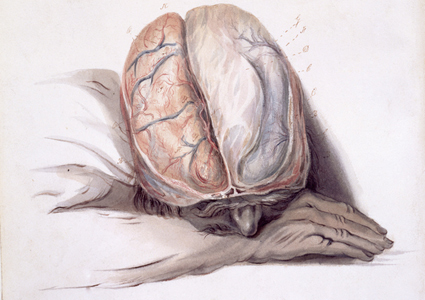
This dualistic tradition was bound, sooner or later, to confront its own incoherence. Charles Singer's words anticipate this moment-the process of "expulsion" he described had, eventually, to stop, as it became ever clearer that one set of vital processes, those occurring in the brain, were precisely the source of the "mental element" in our lives. This knowledge, was to some degree, ancient — Hippocrates had written 500 years before the Christian era that "from the brain and from the brain only arise all our pleasures, joys, laughters and jests, as well as our sorrows, pains, griefs and tears". In the 17th century, Thomas Willis, the royalist physician, father of neurology and founder member of the Royal Society, had "addicted [himself] to the opening of heads" precisely to "unlock the secret places of man's mind". Paul Broca, the 19th century Parisian neurologist and anthropologist, wrote that "the great regions of the mind correspond to the great regions of the brain". These thinkers recognised that mind is the intimate, not the antithesis, of matter.


11:02 AM
10:09 AM
3:09 PM
9:09 PM
8:09 PM
8:09 PM
5:09 PM
11:09 AM
9:09 PM
9:09 AM