


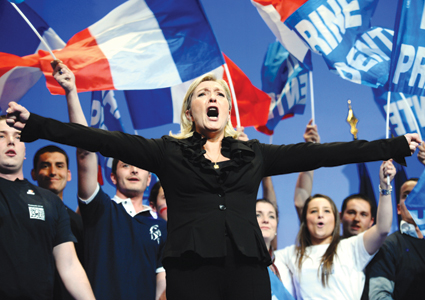
 Marine Le Pen: The Front National president insists that only a strong leader and a strong state can protect France from its many enemies
Since his election as president of the French Republic in May 2012 I have written twice in Standpoint about François Hollande. On each occasion I expressed serious reservations about both the man and the policies he intended to pursue. Friends in France responded in two ways. Some said that I was being unfair, that Hollande was a man of ability and determination who would see things through. Others insisted that, on the contrary, I was being far too generous, that I had understated Hollande's all-too-obvious weaknesses and deficiencies. Recent evidence suggests that it was the latter who were correct.
François Hollande is now the most unpopular president of the Fifth Republic, with an approval rating last month of just 21 per cent. Attempts to reassert his authority before the French electorate have unfailingly backfired. Even members of his own party have taken to booing and whistling when Hollande's name is mentioned.
Not only this, but his government looks to be disintegrating. Hollande's prime minister, Jean-Marc Ayrault, has quickly achieved the status of a near-invisible man. Ministers frequently and publicly disagree with each other. Measures are announced, only to be withdrawn days later after the latest round of popular protests. The impression is one of confusion and panic.
Beneath this lies a deeper intellectual and ideological disarray. From the days of François Mitterrand onwards, Hollande's Socialist Party has clung to the ideal of Europe as the means through which socialism could be attained. The euro crisis and a policy of austerity imposed upon a reluctant France by Brussels have brought this vision crashing to the ground. The result, as the political scientist Gérard Grunberg commented in Le Monde, is that the Socialist Party has no clear views about any issue of real importance.
If Hollande's difficulties with Breton lorry drivers and protesting school children have received press coverage in Britain, relatively little attention has been given to the travails of the UMP, the party of former president Nicolas Sarkozy. No sooner was Sarkozy's defeat declared than he announced he was retiring from politics. What followed was a bitter and unseemly squabble between the rival candidates to replace him as leader of the UMP.
If these divisions have now been papered over, they have served only to hasten speculation that Sarkozy will soon return to the political frontline. Certainly the polls indicate that he retains significant support among the electorate. Nevertheless, the liberal and conservative wings of his party look to be irreconcilably divided. Above all, the UMP demonstrates on an almost daily basis that it does not know how to respond to the rise in popularity of Marine Le Pen's Front National.
Here is the big political story of recent months. In parliamentary by-elections, in municipal elections and in opinion polls support for the Front National has been increasing dramatically. Only last month a poll published in the left-wing Nouvel Observateur revealed that in next year's European elections more people intended to vote for the Front National than for any other party. The shock waves are still being felt. The personal popularity of Marine Le Pen is even higher. When, therefore, she announces that she intends to redraw France's political map, she is now taken very seriously.
Ever since its creation in October 1972 the Front National has baffled commentators. No one seems quite able to decide what exactly the party stands for or where it came from. The simplest and most convenient response was to see it as yet another party of the extreme Right and to assume that it too would soon fade from view. Many of its earliest supporters undoubtedly lived up to this image. Under its first leader, Marine's father Jean-Marie Le Pen, the party faithful were often leftovers from the Vichy regime and the cause of a French Algeria. Many had been followers of the short-lived anti-tax Poujadist movement of the 1950s.
Yet the party gradually widened its electoral support and even the rabble-rousing Jean-Marie Le Pen moved his party away from some of its more controversial policies. However, keeping the party together was never easy. Internal splits were frequent.
The Front National also faced united opposition from all the major parties of both the Right and Left in the form of the so-called "republican front". In brief, the Front National was accorded pariah status by its political opponents. The treatment it received from the press and television channels was not much friendlier.
How then can the current popularity of the Front National be explained? Most obviously, by the failure of the governments of both Sarkozy and Hollande, of the Right and the Left, to address issues of long-term concern to a sizeable proportion of the French electorate. It is tempting to reduce these issues to those of unemployment and immigration; but they extend to disenchantment with the European Union, fears for the French economy, high levels of taxation, and the sense that France is on the slide. Opinion poll after opinion poll reveals that the French are pessimistic about their future. Those same polls also disclose a deep and growing distrust of politicians.
Greater popularity also owes something to the way the Front National now chooses to position itself. In 2011, Marine Le Pen was elected its leader. Since then she has done everything she can to clean up the party's image; for example, skinheads are now banned from attending the party's rallies. She herself is articulate, clever and funny, and, like her father, is an impressive public performer.
Twice divorced, Marine Le Pen is also noticeably less hardline on the moral issues that had strong appeal for the Front National's early supporters. She accepts the legalisation of abortion and civil partnerships for gay couples. Although she opposed the recent law on same-sex marriage, she attended none of the massive demonstrations organised by its opponents. Having previously been largely dependent upon the votes of working-class males, under her leadership the Front National is gaining support among the young and the retired, and especially among women. Above all, Marine Le Pen insists that it is wrong to describe her party as belonging to the "extreme Right".
So what are the Front National's policies? These were clearly set out before 4,500 rapturous party members in a recent speech by Marine Le Pen in Marseilles. The predominant theme was the restoration of national sovereignty. In terms of specifics, this was taken to mean withdrawal from the EU and the euro, the protection of the French economy from "unfair" competition and the forces of globalisation, priority for French citizens in jobs and housing, an end to mass immigration, a tough stance on law and order issues and a reassertion of French cultural identity. It also means a strong and independent France in defence and foreign affairs.
When we look at the rhetoric used to spell out these policies they become more interesting. For example, the euro is described as a "German invention" designed expressly to suit German interests and to weaken French industry and agriculture. A France without any control of its borders is at the mercy of "the high priests of the European Union". With great relish Le Pen talked of the removal of the EU flag from all public buildings. A "patriotic" protectionism would defend France from the world of "international finance", from "speculators" and from "voracious big bosses" in search of cheap labour. The fight against crime is a fight against "the terrorism of the streets". A people is terrorised, Le Pen proclaimed, before it is subdued.
Illegal immigrants are equated with "organised gangs of criminals", "traffickers" and "itinerant thieves". They flourish because of the "leniency" — in French the word is the more powerful laxisme — of the state. If French power and identity are being destroyed it is by an enemy that cannot be seen and that seeks to construct a "supranational and illegitimate identity at the exclusive service of the market".
An independent France means not only a withdrawal from Nato and opposition to intervention in Syria but putting an end to a situation where France is the "whore of pot-bellied emirs" and the "mistress" of America. Most alarmist of all, a failure to adopt the Front National's policies, Le Pen concluded, runs the risk of condemning France to "disunion, insurrection and perhaps civil war".
When she came to summarise her programme Le Pen did so with the simple and seemingly inoffensive slogan of "Work, Justice and Production", but she also called for a new style of politics — no more false promises and no more defeatism, she told her audience — and a rebuilding of France's political institutions. Two themes stand out here. The first is Marine Le Pen's view that France has been betrayed by a political class divorced from the daily realities of French men and women and who are indifferent to the fate of the country. The second is that the only voice that should be heard is the voice of the people.
It is these two themes that best enable us to understand what sort of party the Front National is. The French Right has always been a complex phenomenon. From 1789 onwards it has had its counter-revolutionaries. It has also had its liberals. Valéry Giscard d'Estaing would be a good example of an Orléanist liberal. A third tradition has been Bonapartism. By the end of the 19th century this tradition had been transformed into a form of national populism. Some people have argued that it is to this tradition that Gaullism belongs. It is also a tradition that easily straddles the Left/Right divide.
This is the voice one hears from Marine Le Pen and the Front National. At its heart is an appeal to the people, to the whole nation, regardless of social class or any other distinction. As that appeal has to be direct and unmediated, it entails a distrust of parliamentary democracy and of politicians. Your values, Le Pen tells her audiences, are my values. With this comes the regular denunciation of elites, the privileged, (usually foreign) oligarchies and what Le Pen, like earlier representatives of this tradition, describes as the "feudalities" who control the French state and subvert France's wealth.
As for France itself, in a changing and threatening world, it is in decline and under threat of social disintegration. Only a strong leader and, as Le Pen insists, a strong state can afford protection from its many enemies. It is from this perspective that Le Pen can argue that the Front National is not a party of the extreme Right but the "patriot party".
What will the future bring? François Fillon, Sarkozy's former prime minister, is talking openly about the need for an electoral alliance with the Front National. If the opinion polls are to be believed, the party will make significant gains in local elections next March. It could well win May's European elections.
Should this occur, what comes next is anyone's guess. François Hollande is well protected by the French constitution and he still has more than three years of his mandate to run. In all probability he will seek to form a new government at some point in the near future. But this is hardly likely to turn the situation around. Were he to call a general election, the Socialist Party would be wiped out.
So, it looks as if the ball will remain in Marine Le Pen's court for some time to come. Meanwhile the black government minister Christiane Taubira is openly subjected to racist abuse and the government scarcely responds. We can only look on with a mixture of fascination and horror.


Post your comment
- Beirut: Hariri — An Assassination Too Far
- New York: A ‘Post-racial’ American vs an Old Coot
- Pristina: Kosovo's Liberal Islam
- Oslo: Courage and Cowardice in Scandinavia
- ONLINE ONLY: Washington, D.C.: It's Not Rocket Science!
- La Hague: Recycling the French Model
- Jerusalem: No Via Media for Anglicans
- ONLINE ONLY: Beirut: Blood Holiday
- Rome: Arrivederci Roma
- Darfur: Panic at the Palace
- ONLINE ONLY: Letter from Bamian
- Caucasus: Diary, August-September, 2008
- ONLINE ONLY: South-East Asia: The Demons of Ignorance
- New York: Diary
- Ypres: Never Say Never Again
- New York: A Cousin in the White House
- Caracas: Chávez's Secret Fan Club
- Prague: Diary
- Park City, Utah: Movie that Pulls Aside the Veil
- Beirut: Blood on the Streets
- India: Tariq Ali's Plan for Pakistan
- Berlin and Cologne: A Tale of Two German Cities
- Mumbai: On the 'Slumdog' Trail
- Budapest: Screwed Left, Right and Centre
- Paris: Mayhem in the Marais
- Stanford, CA: Intellectual Life Under Obama
- Colombia: A Nation Reborn
- Paris: Prisoner of the Barbarians
- United States: The Path to Rome via San Francisco
- ONLINE ONLY: Black Russian
- South Africa: The ANC'S Health Lesson for Obama
- Lisieux, France: Relics of Thérèse
- Germany: Heidegger - Being, Time and Place
- Moscow: Putin's Empire Strikes Out
- Connecticut: My Battle Against Google
- Montana: Home From Home on the Range
- Siberia: In Search of the Gulag
- Rio's Heart of Darkness
- Mogadishu: Armageddon on Steroids
- Havana: The Castros Will Not Be Absolved
- Kaliningrad: Russia's Outpost in Europe's Heart
- Bishkek: Bloodsoaked Revolution
- Bishkek: Downfall of a Dictator
- Oslo: Signing OFF on Human Rights
- Bajaur: A Talk with the Taliban
- Bahrain: Women Drivers Welcome Here
- Tajikistan: In Search of the Yeti
- ONLINE Only: Ankara's Proxy
- Johannesburg: Hard Pressed
- Istanbul: Press Freedom Alla Turca
- Xinjiang: Taming China's Wild West
- The Lesson of Oz
- The Surge is Working — So Far
- A Tale of Love, Bulls and Goats
- Old-order Collapse
- Egypt's New Dawn Chorus
- From Carthage to Kasserine
- After Gaddafi: A New Libya Emerges
- To the Polo Saddle Born
- The Settlements: Life Between the Lines
- Exposed: Carnita's Cover Story
- "At last, I feel proud to be Libyan"
- Books Do Furnish a Little Freedom
- Fat Chance for Christie—This Time
- Easy Lies the Head that Wears the Crown
- Putin's Chinese Whispers
- Cain Isn't Able and Newt Defies Gravity
- The Ten Years' War against the Taliban
- We The People Say: Get Out of The Way
- Wanted: A New Ronald Reagan
- Time to Crunch the Numbers
- Who's Really Supreme?
- From Art as Life to Blood and Soil
- Talking Tactics
- The Wagner Family Soap Opera Rolls On
- Winning the Veepstakes
- Romney Takes a Risk with Ryan
- Window Brothels Get the Red Light
- Can Romney Spring an October surprise?
- Canada's Crusader for Conservatism
- No-Go Areas on the Campaign Trail
- Republicans Must Avoid Civil War
- Norway's Problem with Anti-Semitism
- Turks, Arabs and Jews: The Middle East in Crisis
- Nations United in Hypocrisy
- Siberia: Shamans, Spies and the Secret Police
- Barracked by Obama's Oratory
- Women Come Last in Syrian Refugee Camps
- The Dawn of Obamageddon
- Americans Know Her True Worth. Do We?
- Hapless Hollande’s French Farce Flops
- Save the NYPD So It Can Save the City
- Obama's Secrets Start Unravelling
- Syria Isn't Bosnia: Don't Arm the Rebels
- Who Can Stop Hilary in 2016?
- Teaching China's Anglophiles
- On Pilgrimage with the Hasids
- From Eastern Europe to the East End
- True Grits
- The Rise and Rise of Marine Le Pen
- Cold Comfort On Global Warming
- Hunting the Lynx with the Old Believers
- High-tech Israelis Aim For The Moon
- The Russians Are Coming
- The Turbulent Minister is Right
- Bad Times for Good Samaritans
- This Expat Paradise is a Woman’s Nightmare
- Two Generations Lost to Communism
- Strangers in their own Holy Land
- The Isles are Full of Big Noises
- The Kurds: Israel's not so Improbable Allies
- Islam and Innocence: Canada’s Predicament
- The Fifth Republic’s Darkest Days?
- Let's Make Putin's London Cronies Sweat
- The Global Politics Of Netanyahu's Victory
- A Grim Prospect For South Africa's Jews
- No End In Sight To The Exodus From Libya
- Undeterred, Erdogan Usurps Ataturk's Legacy
- Gaza Withdrawal Symptoms
- Red Flags Flying Over Parliament Square
- Mutinous Talk In The Highlands
- Our Principles Are All We Have
- Why The Swedes Have Had Enough
- Canada's First Nations Come Last
- Islam and the French Republic
- Unconventional Convention
- The Dying Days Of Zuma's South Africa
- I'm Not Antisemitic, But...
- The ELM, Dispatches and Awlaki
- A Larger Than Life Predator

- Islam and the French Republic
- Why On Earth Should Anyone Study Philosophy?
- The Dying Days Of Zuma's South Africa
- His Master's Voice: Scruton On Wagner
- Why The Most Civilised Of Men Felt Like A Fraud
- Political Misconduct
- Cicero's Analysis Of Decline Offers Lessons For The West
- Trump's Appeal Is More Roosevelt Than Reagan