



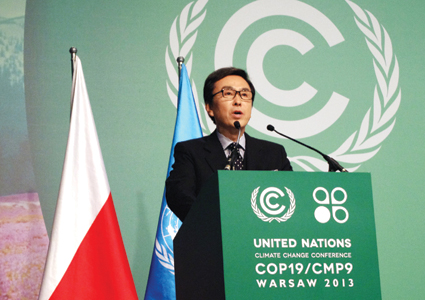
 No deal: Japanese Environment Minister Nobuteru Ishihara refuses to agree to the emissions reductions required by the Kyoto Protocol
The United Nations' annual climate change conference held in Warsaw from November 11-23, was a sedate affair that attracted little public attention. It's been a hard four years for international climate negotiations since the debacle in Copenhagen in December 2009. At least 40,000 people from around the world flew into Copenhagen to encourage world leaders to save the planet from the carbon dioxide emissions produced by, among other things, aeroplanes.
It didn't work out that way. In the first place, the tens of thousands of NGO delegates from environmental groups were excluded when the 130 or so prime ministers and presidents arrived with their entourages because the convention centre could hold fewer than 20,000 people; and so the activists, who after all provide the political push behind the global warming agenda, had to be content with a massive protest rally in the streets (as snow fell gently on their stocking caps). Not even the magic provided by America's then new president, Barack Obama, could save the negotiations from imploding. And as Rupert Darwall recounts in his outstanding book, The Age of Global Warming: a History (Quartet, £25), it was not only a major setback for the negotiating process. It was also a humiliation for the West and particularly for the European Union, administered by China and India.
Although many expert observers concluded that the Copenhagen meltdown has doomed efforts to negotiate a new agreement to replace the 1997 Kyoto Protocol, which was set to expire at the end of 2012 (but has since been extended to 2020), the fact is that the international global warming establishment is too powerful and the economic interests supporting it are too large to go away quietly. Thus the Warsaw conference, known officially as COP-19 (for the 19th Conference of the Parties to the UN Framework Convention on Climate Change — or UNFCCC), made modest steps towards concluding a new agreement to limit global greenhouse gas emissions at COP-21 in Paris in December 2015.
Whether a new agreement will be signed in Paris or soon thereafter is an open question. However, those who are confident that not only has the global warming bandwagon slowed down but that the wheels have actually come off would do well to consider the damage that a losing army can still inflict in the latter stages of a war.
The most notable aspect of COP-19 was the role that climate science played in the conference sessions and the many side events. It was negligible. The conference began a few days after Typhoon Yolanda (or Haiyan) hit the Philippines. Naderev Sano, head of the Philippines delegation, announced on the first day that he would not eat during the conference "until a meaningful outcome is in sight". Sano made an impassioned plea for action: "What my country is going through as a result of this extreme climate event is madness, the climate crisis is madness. We can stop this madness right here in Warsaw."
The head of the UN Intergovernmental Panel on Climate Change and many of the scientists who contributed to the IPCC's Fifth Assessment Report, a draft of which was released in September, did nothing to contradict this obvious nonsense, even though the report could find no trend in extreme weather events and specifically no trend in hurricanes and typhoons. On the contrary, the head of the World Meteorological Organisation stated that it is now an indisputable fact that natural disasters are increasing as a result of climate change. Nor did the scientists who spoke at a high-level IPCC briefing I attended mention the fact that as atmospheric levels of carbon dioxide have continued increasing and have now reached a level of 400 parts per million (or one in 2,500), global mean temperatures have not increased in the past 16 years. UN Secretary General Ban Ki-moon even claimed that the IPCC's Fifth Assessment Report completely dispels all the rumours spread several years ago by climate sceptics, one of which of course was that warming had stopped a decade ago.
Tying Typhoon Yolanda and other storms to climate change was repeated by a number of officials and diplomats over the course of COP-19. The most careful expression I heard was from Todd Stern, the top US climate negotiator. He said that while no causal connection could be scientifically established, the typhoon was entirely consistent with what science tells us to expect from climate change. Stern failed to mention that there is no event that is not consistent, including the lack of Atlantic hurricanes in 2013.
The typhoon played neatly into the hands of poor countries who have been demanding reparations from the developed world for losses and damages suffered as a result of extreme weather events and sea-level rise. After long, acrimonious negotiations, it was agreed to create a new "Warsaw International Mechanism for Loss and Damage". Funding details are to be arranged at a later date. Of course, wealthy countries already provide tens of billions of pounds a year in disaster aid regardless of the cause of the disaster.
Loss and damage is only the newest avenue for wealth transfers. At Copenhagen in 2009, President Obama achieved agreement that the developed countries should provide funding to assist poor countries to reduce emissions and adapt to climate change. The number that was casually thrown up and quickly adopted was that funding should ramp up to $100 billion a year by 2020. The Green Climate Fund has recently been officially created with a director and offices in South Korea (although North Korea would be more appropriate since that nation has already cut its emissions to near zero). There are many poor countries eager to receive payouts from the Green Climate Fund, but, as Ban Ki-moon remarked, the fund is so far just an empty shell. The problem is that the wealthy countries, with the exception of China, are struggling economically and have no cash to spare. And China has made it clear that it has no intention of contributing to the fund because it is still a developing country.
The fact that the cupboard is bare and likely to remain bare is now the chief concern of the poor countries. Many hours at the official sessions were devoted to speeches admonishing the US and the EU to commit to start contributing to the Green Climate Fund immediately and reach $70 billion by 2016. No agreement was reached in Warsaw on when, where, and how the money is going to be raised, so this will be a top agenda item when the 194 nations belonging to the UNFCCC gather late next year in Peru.
The main action at COP-19 was in the committee that is negotiating a successor agreement to the Kyoto Protocol by the end of 2015, which is to be ratified and go into effect by 2020. This committee met for many hours and far into the early hours of the morning on several days. The disagreements are longstanding, fundamental and intractable. Progress was so slow that two and perhaps three more week-long sessions will be held before the next climate conference in Lima in December. In addition, a summit of heads of state has been set for September 24 at the UN's headquarters in New York.
There is agreement that setting targets for reductions in greenhouse gas emissions should follow a bottom-up approach rather than the top-down framework in the Kyoto Protocol. Thus COP-19 agreed that the 194 parties to the UNFCCC should develop their own national plans and submit them by early 2015. Some process will be developed to review these plans and then decide whether taken together they will be sufficient to avoid catastrophic global warming, which has been defined as a rise of two degrees centigrade or more in the global mean temperature.
It seems almost certain that the national plans will fall short of this goal, as defined and measured by the IPCC. What happens in that case is a mystery. On the other hand, if the IPCC would admit that their model projections have been disproved by the lack of any warming for the past 16 years, perhaps we could all agree that the goal of avoiding warming of two degrees centigrade has already been achieved.
The 1992 UNFCCC divided the member nations into two categories-developed and developing. The 1997 Kyoto Protocol required that the 37 developed nations undertake mandatory emissions reduction targets and timetables, while the developing nations could undertake voluntary measures and that the developed nations would help pay for these measures. The main reason the US Senate never ratified Kyoto is because China was exempted from the colossally expensive emissions cuts that Vice President Al Gore signed the US up for.
A decade later, this is now an even bigger issue. Chinese emissions are now far above those of the US and the EU and are going to continue to rise rapidly as China builds scores of new coal-fired power plants. China's emissions have gone up so much that per capita they are now close to the EU's. Yet China continues to insist that the developed economies as listed in 1992 bear a historical responsibility to make the emissions cuts, while China and other emerging economies, such as Brazil and South Korea, continue to develop.
The flaw in China's position is that according to International Energy Agency projections its cumulative emissions will within a couple of decades surpass those of the EU since 1800 and those of the US soon after. The Obama administration, like the Bush administration before it, insists that the 1992 list of developed economies must be adjusted to reflect changing realities. The Chinese delegation said no at every session in Warsaw.
But China and the US are in their different ways no longer the only obstacles to saving the planet from global warming. The Conservative government in Canada withdrew from the Kyoto Protocol in 2012. Australia's new government announced that it could not send a high-level minister to Warsaw because it would be too busy repealing the country's carbon tax. And Japan announced that as a result of closing its nuclear power plants after the Fukushima disaster, it would not be able to make the emissions reductions required by the Kyoto Protocol. It may be that Australia, Canada and Japan are blazing a path that other nations may decide to follow as it becomes apparent that the costs of a new climate agreement far outweigh the benefits.
Christiana Figueres, the highly capable and extremely well-connected Costa Rican executive secretary of the UNFCCC, challenged conference participants to keep their feet on the ground but to raise their eyes to the stars. I have given her advice some thought in the weeks since returning from Warsaw to Washington, but she has not shaken the conclusion I reached when Kyoto was negotiated in 1997: in the unlikely event that global warming turns out to be a problem, a UN treaty cannot possibly be the way to solve it.


Post your comment
- Beirut: Hariri — An Assassination Too Far
- New York: A ‘Post-racial’ American vs an Old Coot
- Pristina: Kosovo's Liberal Islam
- Oslo: Courage and Cowardice in Scandinavia
- ONLINE ONLY: Washington, D.C.: It's Not Rocket Science!
- La Hague: Recycling the French Model
- Jerusalem: No Via Media for Anglicans
- ONLINE ONLY: Beirut: Blood Holiday
- Rome: Arrivederci Roma
- Darfur: Panic at the Palace
- ONLINE ONLY: Letter from Bamian
- Caucasus: Diary, August-September, 2008
- ONLINE ONLY: South-East Asia: The Demons of Ignorance
- New York: Diary
- Ypres: Never Say Never Again
- New York: A Cousin in the White House
- Caracas: Chávez's Secret Fan Club
- Prague: Diary
- Park City, Utah: Movie that Pulls Aside the Veil
- Beirut: Blood on the Streets
- India: Tariq Ali's Plan for Pakistan
- Berlin and Cologne: A Tale of Two German Cities
- Mumbai: On the 'Slumdog' Trail
- Budapest: Screwed Left, Right and Centre
- Paris: Mayhem in the Marais
- Stanford, CA: Intellectual Life Under Obama
- Colombia: A Nation Reborn
- Paris: Prisoner of the Barbarians
- United States: The Path to Rome via San Francisco
- ONLINE ONLY: Black Russian
- South Africa: The ANC'S Health Lesson for Obama
- Lisieux, France: Relics of Thérèse
- Germany: Heidegger - Being, Time and Place
- Moscow: Putin's Empire Strikes Out
- Connecticut: My Battle Against Google
- Montana: Home From Home on the Range
- Siberia: In Search of the Gulag
- Rio's Heart of Darkness
- Mogadishu: Armageddon on Steroids
- Havana: The Castros Will Not Be Absolved
- Kaliningrad: Russia's Outpost in Europe's Heart
- Bishkek: Bloodsoaked Revolution
- Bishkek: Downfall of a Dictator
- Oslo: Signing OFF on Human Rights
- Bajaur: A Talk with the Taliban
- Bahrain: Women Drivers Welcome Here
- Tajikistan: In Search of the Yeti
- ONLINE Only: Ankara's Proxy
- Johannesburg: Hard Pressed
- Istanbul: Press Freedom Alla Turca
- Xinjiang: Taming China's Wild West
- The Lesson of Oz
- The Surge is Working — So Far
- A Tale of Love, Bulls and Goats
- Old-order Collapse
- Egypt's New Dawn Chorus
- From Carthage to Kasserine
- After Gaddafi: A New Libya Emerges
- To the Polo Saddle Born
- The Settlements: Life Between the Lines
- Exposed: Carnita's Cover Story
- "At last, I feel proud to be Libyan"
- Books Do Furnish a Little Freedom
- Fat Chance for Christie—This Time
- Easy Lies the Head that Wears the Crown
- Putin's Chinese Whispers
- Cain Isn't Able and Newt Defies Gravity
- The Ten Years' War against the Taliban
- We The People Say: Get Out of The Way
- Wanted: A New Ronald Reagan
- Time to Crunch the Numbers
- Who's Really Supreme?
- From Art as Life to Blood and Soil
- Talking Tactics
- The Wagner Family Soap Opera Rolls On
- Winning the Veepstakes
- Romney Takes a Risk with Ryan
- Window Brothels Get the Red Light
- Can Romney Spring an October surprise?
- Canada's Crusader for Conservatism
- No-Go Areas on the Campaign Trail
- Republicans Must Avoid Civil War
- Norway's Problem with Anti-Semitism
- Turks, Arabs and Jews: The Middle East in Crisis
- Nations United in Hypocrisy
- Siberia: Shamans, Spies and the Secret Police
- Barracked by Obama's Oratory
- Women Come Last in Syrian Refugee Camps
- The Dawn of Obamageddon
- Americans Know Her True Worth. Do We?
- Hapless Hollande’s French Farce Flops
- Save the NYPD So It Can Save the City
- Obama's Secrets Start Unravelling
- Syria Isn't Bosnia: Don't Arm the Rebels
- Who Can Stop Hilary in 2016?
- Teaching China's Anglophiles
- On Pilgrimage with the Hasids
- From Eastern Europe to the East End
- True Grits
- The Rise and Rise of Marine Le Pen
- Cold Comfort On Global Warming
- Hunting the Lynx with the Old Believers
- High-tech Israelis Aim For The Moon
- The Russians Are Coming
- The Turbulent Minister is Right
- Bad Times for Good Samaritans
- This Expat Paradise is a Woman’s Nightmare
- Two Generations Lost to Communism
- Strangers in their own Holy Land
- The Isles are Full of Big Noises
- The Kurds: Israel's not so Improbable Allies
- Islam and Innocence: Canada’s Predicament
- The Fifth Republic’s Darkest Days?
- Let's Make Putin's London Cronies Sweat
- The Global Politics Of Netanyahu's Victory
- A Grim Prospect For South Africa's Jews
- No End In Sight To The Exodus From Libya
- Undeterred, Erdogan Usurps Ataturk's Legacy
- Gaza Withdrawal Symptoms
- Red Flags Flying Over Parliament Square
- Mutinous Talk In The Highlands
- Our Principles Are All We Have
- Why The Swedes Have Had Enough
- Canada's First Nations Come Last
- Islam and the French Republic
- Unconventional Convention
- The Dying Days Of Zuma's South Africa
- I'm Not Antisemitic, But...
- The ELM, Dispatches and Awlaki
- A Larger Than Life Predator

- Cultural Climate Change
- Opposites meet in the land of Scrugletopia
- The Battle Against The Philistines Never Ceases
- Home from home for the Bolshevik elite
- Can Macron Save France — Or Is He Its Undertaker?
- How The EU Elite Paved The Way For Populism
- Why France Is Revolting Against The Ancien Regime
- A Decent Woman Betrayed By Her Gruesome Twosome