


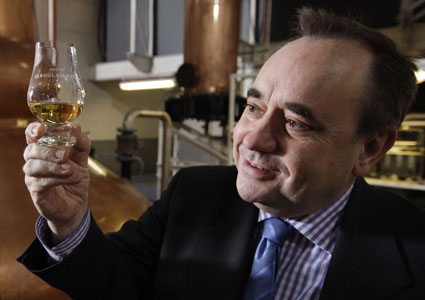
 Alex Salmond: The spirit of Scottish nationalism (credit: John Paul)
Last summer, when I was checking the proofs for my book about the Habsburg Empire, Danubia, I found myself reflecting on the way that across Central Europe over the past century and a half different forms of nationalism have done almost untold damage. Wherever I travelled there were entire towns whose populations had been killed or expelled at the command of one form of nationalist zealot or another. My conclusion (which I am sure is an uncontentious one) was that anyone who makes exclusive claims based around flags, songs or mystical and immemorial borders was at some base level evil — that to believe in such things, which have more in common with magic than rationality, puts the believer and his disciples en route to catastrophe. And then I thought about Alex Salmond.
The Habsburg Empire, which was destroyed during the course of the First World War, joined together part or whole of 12 modern European countries and stretched from the Alps to western Ukraine. It was hardly a model of rationality and could often be cynical or incompetent – but it seems like a vision of paradise compared to the nihilistic disaster that unfolded for its inhabitants from 1914 to the end of the Cold War. Several generations found themselves savaged by all the most horrible elements in Europe's formidable armoury of creepy prejudices sprinkled with a dusting of intellectualism – what language you spoke, your religion, your political views had you herded into different camps at different times. In the end nobody won. Whatever terrible crimes the Communists carried out they at least had a salutary attitude towards the nationalists scattered across Central Europe who had done so much to support the Nazis and to poison community after community that had until then generally lived cheek-by-jowl for centuries, if not in harmony then in grudging indifference.
The lesson of the Habsburg Empire's demise is probably that multinational states are extremely valuable. They define themselves by some measure of tolerance and the heir to the throne, Franz Ferdinand, had until his assassination, planned for his accession all manner of schemes to federalise the Empire. Before the catastrophe of the First World War very few of the Empire's inhabitants imagined that independence was even a rational option. Even Tomáš Masaryk, later to found Czechoslovakia, could only imagine a federal solution – the lands of Bohemia and Moravia which he wished to have autonomy were simply filled with too many people who could never be reconciled to rule by Czech-speakers, as turned out to be the case.
The Habsburg Empire, which was destroyed during the course of the First World War, joined together part or whole of 12 modern European countries and stretched from the Alps to western Ukraine. It was hardly a model of rationality and could often be cynical or incompetent – but it seems like a vision of paradise compared to the nihilistic disaster that unfolded for its inhabitants from 1914 to the end of the Cold War. Several generations found themselves savaged by all the most horrible elements in Europe's formidable armoury of creepy prejudices sprinkled with a dusting of intellectualism – what language you spoke, your religion, your political views had you herded into different camps at different times. In the end nobody won. Whatever terrible crimes the Communists carried out they at least had a salutary attitude towards the nationalists scattered across Central Europe who had done so much to support the Nazis and to poison community after community that had until then generally lived cheek-by-jowl for centuries, if not in harmony then in grudging indifference.
The lesson of the Habsburg Empire's demise is probably that multinational states are extremely valuable. They define themselves by some measure of tolerance and the heir to the throne, Franz Ferdinand, had until his assassination, planned for his accession all manner of schemes to federalise the Empire. Before the catastrophe of the First World War very few of the Empire's inhabitants imagined that independence was even a rational option. Even Tomáš Masaryk, later to found Czechoslovakia, could only imagine a federal solution – the lands of Bohemia and Moravia which he wished to have autonomy were simply filled with too many people who could never be reconciled to rule by Czech-speakers, as turned out to be the case.
This is when I started to think about Salmond. The United Kingdom is Europe's last big multinational state – and in that sense vulnerable to what nationalists love to think of as "the tide of history". But the disasters of the 20th century have perhaps taught us that there are many problems with nationalist ideas on sovereignty. Indeed the European Union was created specifically in order to neuter these problems. One hardly discussed reason why the EU might be antagonistic towards Scottish independence is that Salmond's rhetoric and reality swim in exactly the opposite direction to all the most positive European trends since 1945. While most of Europe pools its sovereignty, here is someone yet again making mystical claims for the greater virtue that would emerge from drawing a ring around a particular chunk of land.
When last summer I first started suggesting to friends that there was something about Salmond's rhetoric that really worried me – that it could be seen as effectively fascist in its mix of flag-waving mysticism allied to socioeconomic gestures to the Left – I found few takers. But following February's UK-SNP name calling, threats and counter-threats I am much more confident that Salmond is indeed a deeply dangerous figure for the UK and a disaster for Scotland. Nationalists anywhere are never driven by reason, because their position is unrelated to reason. Salmond was already a nationalist when American, British and Dutch multinationals were investing many millions of pounds in North Sea oil exploration. His central argument about the autonomy made possible through ownership of oil royalties is therefore merely a rhetorical extra. His socialism is a fraud — he claims that these redirected royalties will make life better in Glasgow, but he intends to do this only by taking those royalties away from the impoverished of those cities outside his new borders – so suddenly the people of Newcastle, say, are flung outside the pale and Scotland's flagship role in improving the condition of the working class throughout the United Kingdom is abandoned. Driving back and forth across the Scottish border myself the other week it seemed incredible to imagine that very soon this could mark a real and hostile line. Salmond claims that a specific group has virtues which are unavailable to those south of that line. But this is only sustainable (because it is untrue) by imagining an "other".
This "other" has been somewhat vague until now. But just as I feared, the process of nationalist state-making inevitably creates and then feeds an enemy, and this phase is now apparent in two equally important and worrying groups. It is impossible not to speculate that the apparent incompetence of Salmond's ideas about currency union and the EU were specifically designed to goad the UK government and the EU into lashing out. Until recently it was probably fair to say that the vast majority of those in most areas of the UK excluded from the referendum had no strong views, beyond a mild incredulity that Scotland could possibly find it desirable to become independent. In a composite state where so many people feel themselves to be British, the language did not really exist to conceive of a United Kingdom which might no longer include such a large element of its Britishness. The potential threat of a now predominantly English state for millions who relied on their Britishness was chilling, but remote. But the implications do now need to be thought through. They also need to be thought through for Ulster, which would become a futile exclave — a further measure of the weird, arbitrary nature of nationalism, with the SNP turning its back on an area with which Scots have as intricate and old a linkage as with England.
The second group consists, of course, of those who vote No in the referendum. The best that the Yes camp can hope for is a very marginal victory — but this would mean that a little under half of those living in Scotland, perhaps at least as passionately, do not think independence a good idea. Any separate Scottish state will have to deal with "disloyalty" on a potentially huge scale. What happens to council areas which decisively vote No? Could these secede? Any new state has to define itself by loyalty to its institutions. I can think of almost no successful examples of this happening without threats and violence. A new Scottish state will be defined against the remainder of the UK. If it is not, then there was no point in creating such a state. But a state created by, say, even 55:45 is a mockery of real democracy – real democracy is about the regular reviewing of choice, not a one-shot plebiscite. Within weeks the legitimacy of such a place could be frighteningly compromised — but the damage could never be undone. Psychologically, how could a new, smaller UK not lash out at its neighbour? How could negotiations over military bases, say, or oil not be vituperative, egged on by the millions of Scots who never wanted independence in the first place? How has this been allowed to happen?
Whatever the result of a referendum, it will change how the UK feels about itself in deeply destabilising ways. There is a chance that it could be positive – that a long overdue general devolution of powers from London across the whole UK might happen. But the stakes are probably already too high for something so genial. Salmond has mortgaged his future on the idea that somehow an act of collective will by a group of people living at this moment within a specific geographical area and in a specific age group, will take a decision which will conjure into existence something better – a state which future generations, those outside these borders and those too young to vote now will be grateful for. To reach this mystical goal he has fuelled what amounts to ethnic hatred, the sundering of previously natural relationships, a dislike of Scotland that was simply non-existent before and an angry bitterness for a large minority whatever the result. As he points the finger at an ever more bulging number of "enemy" targets — the "Westminster government" (a hideously creepy piece of "othering", transmuting Scotland's democratic forum for over 300 years into a sort of hostile camp), the EU, economists, business leaders-it is impossible not to hear in his recent speeches the violent and perhaps irreversible ripping apart of the innumerable bonds that have so far held the UK together.
Indeed it may well be already too late. It must surely be a nightmare to imagine a Scotland falling into the well-worn independence rut of a week or two of parading figures, giant flags and tiny singing children in traditional outfits, followed moments thereafter by impoverishment, a hostile border, flailing autarky and the ever widening hunt for "enemies within", those who hate and challenge the barely legitimate new state, fuelled by dissident groups in England. This is an absurd vision – except that I cannot see a way round it. Or at least, the risks around it seem far too great. No part of Europe has proved immune to nationalist violence — even the dullest regions have been filled with burning houses in their quite recent pasts. Through a miracle of geography, luck, military strength and political intelligence, the island of Great Britain almost alone has avoided this contagion. Nationalism is unappeasable, it soils everything in its path and it has been allowed to cross the North Sea.
If Salmond wants to share everything with the rest of the UK, then there is no need for independence. But this is not what he wants. The referendum is meant to be a moment of chain-shattering change — not just a mild and highly dubious redirecting of revenues to a new state's smirking functionaries. Yet it is impossible to imagine this a happy place, or one which offers any actual benefit to most of its inhabitants. It could in turn promote a disgusting new variety of English nationalism. The SNP will be unable to deliver anything real and will instead create an excluding, under-siege Volk-community, with marginally better crèche facilities. This would be a state viewed with repugnance by most other Europeans and would be a fantastically retrograde step, one that is being managed into being with slipshod and juvenile helplessness by the "Westminster government" almost as much as it has been whipped up by the SNP itself.
This "other" has been somewhat vague until now. But just as I feared, the process of nationalist state-making inevitably creates and then feeds an enemy, and this phase is now apparent in two equally important and worrying groups. It is impossible not to speculate that the apparent incompetence of Salmond's ideas about currency union and the EU were specifically designed to goad the UK government and the EU into lashing out. Until recently it was probably fair to say that the vast majority of those in most areas of the UK excluded from the referendum had no strong views, beyond a mild incredulity that Scotland could possibly find it desirable to become independent. In a composite state where so many people feel themselves to be British, the language did not really exist to conceive of a United Kingdom which might no longer include such a large element of its Britishness. The potential threat of a now predominantly English state for millions who relied on their Britishness was chilling, but remote. But the implications do now need to be thought through. They also need to be thought through for Ulster, which would become a futile exclave — a further measure of the weird, arbitrary nature of nationalism, with the SNP turning its back on an area with which Scots have as intricate and old a linkage as with England.
The second group consists, of course, of those who vote No in the referendum. The best that the Yes camp can hope for is a very marginal victory — but this would mean that a little under half of those living in Scotland, perhaps at least as passionately, do not think independence a good idea. Any separate Scottish state will have to deal with "disloyalty" on a potentially huge scale. What happens to council areas which decisively vote No? Could these secede? Any new state has to define itself by loyalty to its institutions. I can think of almost no successful examples of this happening without threats and violence. A new Scottish state will be defined against the remainder of the UK. If it is not, then there was no point in creating such a state. But a state created by, say, even 55:45 is a mockery of real democracy – real democracy is about the regular reviewing of choice, not a one-shot plebiscite. Within weeks the legitimacy of such a place could be frighteningly compromised — but the damage could never be undone. Psychologically, how could a new, smaller UK not lash out at its neighbour? How could negotiations over military bases, say, or oil not be vituperative, egged on by the millions of Scots who never wanted independence in the first place? How has this been allowed to happen?
Thinking about the Habsburgs, it is probably fair to say that they would have viewed the very idea of agreeing to a referendum as insane. We have somehow sleepwalked into a situation where our political classes have created something ruinous. The SNP are like the dwarves in The Hobbit who can only open the stone door into the mountain when the keyhole appears at a specific time on a specific day. To their amazement they found themselves in power through the implosion of Labour's credibility, facing off against a comically rebarbative (and atypical) "southern English toff" government in London, and in the run-up to the 700th anniversary of the Battle of Bannockburn. This entirely fluky alignment has made a bid for independence plausible, for a few moments: and so something which will be irreversible and hugely damaging to almost everyone involved has been somehow allowed to go ahead. Incidentally, should there not perhaps be some minor element in Nato's mission which involves dispatching squads to arrest anyone who organises political rallies around old battle commemorations? Or indeed arrests anyone who even tries to use some daft medieval scrimmage like Bannockburn to trump later centuries of cooperation and mutual respect? Anything involving slow drumbeats, flaming torches, body-paint, the usual junk, is so patently disturbing that it is hard to believe it is allowed to happen at all. It may be a grand day out for all the family, but there are plenty of places to put children's bouncy-castles other than on a blood-soaked field. In what sense is this any different from commemorating Tannenberg or Kosovo Polje? The atavistic anti-Englishness is no less horrible and mad than the anti-Russian or anti-Muslim connotations of these other two examples. How can this be in any sense "socialist", the key marker the SNP uses to differentiate itself and Scotland from a notionally less collectivist and welfarist England? But it in fact squares the circle in a very traditional way — it is "national socialist".
Whatever the result of a referendum, it will change how the UK feels about itself in deeply destabilising ways. There is a chance that it could be positive – that a long overdue general devolution of powers from London across the whole UK might happen. But the stakes are probably already too high for something so genial. Salmond has mortgaged his future on the idea that somehow an act of collective will by a group of people living at this moment within a specific geographical area and in a specific age group, will take a decision which will conjure into existence something better – a state which future generations, those outside these borders and those too young to vote now will be grateful for. To reach this mystical goal he has fuelled what amounts to ethnic hatred, the sundering of previously natural relationships, a dislike of Scotland that was simply non-existent before and an angry bitterness for a large minority whatever the result. As he points the finger at an ever more bulging number of "enemy" targets — the "Westminster government" (a hideously creepy piece of "othering", transmuting Scotland's democratic forum for over 300 years into a sort of hostile camp), the EU, economists, business leaders-it is impossible not to hear in his recent speeches the violent and perhaps irreversible ripping apart of the innumerable bonds that have so far held the UK together.
The Habsburgs would have restored order with a mixture of large bribes, expulsions, prison sentences and the odd execution, because they rightly saw that there was a deeper poison in nationalism than in any countermeasure. Their reasons were self-serving, but subsequent events proved them correct. It is obviously admirable that the UK authorities cannot simply let Salmond cool his heels on the Isle of Man for a few years, but those who value the plurality and anti-nationalism of the UK have sleepily allowed themselves to drift into a situation where they find themselves face to face with something seriously malevolent which feeds off fear, misinformation, conspiracy, grandstanding and scapegoating. We have no choice but to be reasonable or we betray our own values, but this is, as so many times in Europe's 20th century, to allow ourselves to be outflanked by more single-minded forces.
Indeed it may well be already too late. It must surely be a nightmare to imagine a Scotland falling into the well-worn independence rut of a week or two of parading figures, giant flags and tiny singing children in traditional outfits, followed moments thereafter by impoverishment, a hostile border, flailing autarky and the ever widening hunt for "enemies within", those who hate and challenge the barely legitimate new state, fuelled by dissident groups in England. This is an absurd vision – except that I cannot see a way round it. Or at least, the risks around it seem far too great. No part of Europe has proved immune to nationalist violence — even the dullest regions have been filled with burning houses in their quite recent pasts. Through a miracle of geography, luck, military strength and political intelligence, the island of Great Britain almost alone has avoided this contagion. Nationalism is unappeasable, it soils everything in its path and it has been allowed to cross the North Sea.
If Salmond wants to share everything with the rest of the UK, then there is no need for independence. But this is not what he wants. The referendum is meant to be a moment of chain-shattering change — not just a mild and highly dubious redirecting of revenues to a new state's smirking functionaries. Yet it is impossible to imagine this a happy place, or one which offers any actual benefit to most of its inhabitants. It could in turn promote a disgusting new variety of English nationalism. The SNP will be unable to deliver anything real and will instead create an excluding, under-siege Volk-community, with marginally better crèche facilities. This would be a state viewed with repugnance by most other Europeans and would be a fantastically retrograde step, one that is being managed into being with slipshod and juvenile helplessness by the "Westminster government" almost as much as it has been whipped up by the SNP itself.
Like this article? Share, save or print using the icons below:


More Features
- Mr Cameron, Show The Country That You Care
- Campaign Diary
- Defying Duopoly: The Rise Of The Insurgents
- Don't Rig The System In Favour Of Coalitions
- Warring Gangsters Who Run The Country
- Political Correctness Is Devouring Itself
- An Archival Treasure Trove—And All Online
- Do we value freedom of speech in Britain?
- Can Europe's Jews Feel Safe Alongside Muslims?
- We Cannot Avoid The Battle Over Blasphemy
- Inside The World Of 'Non-Violent' Islamism
Popular Standpoint topics

- The Loss Of Faith Made Music Mute
- The Great Betrayal: How Liberals Appease Islam
- Political Correctness Is Devouring Itself
- The New Language Of Political Narcissism
- Don’t Listen to Britain’s Designer Demagogues
- Why The World Still Loves Shakespeare
- An English parliament: the only way to save the UK
- Putin and the Art of Political Fantasy
- The Loss Of Faith Made Music Mute
- The Great Betrayal: How Liberals Appease Islam
- Political Correctness Is Devouring Itself
- The New Language Of Political Narcissism
- Don’t Listen to Britain’s Designer Demagogues
- Why The World Still Loves Shakespeare
- An English parliament: the only way to save the UK
- Putin and the Art of Political Fantasy
- The Loss Of Faith Made Music Mute
- The Great Betrayal: How Liberals Appease Islam
- Why The World Still Loves Shakespeare
- Political Correctness Is Devouring Itself
- Who Will Lead The Berlin Band?
- Putin and the Art of Political Fantasy
- The New Language Of Political Narcissism
- Inside The World Of 'Non-Violent' Islamism
4:09 PM
12:09 PM
8:08 AM
1:06 AM
8:06 PM
6:05 AM
8:04 PM
10:04 PM
12:04 PM
9:04 PM