



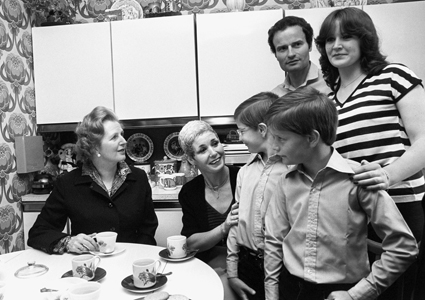
Right to buy this ain't: Mrs Thatcher with the Pattersons in 1980. They were the 12,000th family in London to purchase their council house (credit: PA/PA Archive/Press Association Images)
George Osborne's Budget pension changes, by ending at a stroke the requirement for savers with private pensions to buy an annuity, apparently gave his party, and his leadership hopes, a welcome boost. "Pension and savings joy for all" shouted the Daily Express. "Pension Power to the People" declaimed the Daily Mail. The Tory press had been campaigning vocally for action to help savers, so the trumpet blowing was understandable. The reaction from the Labour Party was pusillanimous. Once the opinion polls showed approval, the Labour leadership ran for cover, agreeing in principle but quibbling about the small print. Meanwhile, experts downplayed their doubts, for fear of being tarred as lackeys of the hated pension funds.
Yet there is much to worry about. Populism is, indeed, popular. It is also potentially dangerous. To announce what amounts to a revolution in pension provision without proper consultation, for almost immediate implementation and at the fag-end of a parliament, is not so much radical as rash. The effective destruction of the annuity, as a means of ensuring that old people have enough to live on until their death, overturns basic assumptions unchallenged by any previous British government. (The Treasury's prediction that 30 per cent of those retiring will still take out annuities is improbable: in Australia, where annuities are not compulsory either, less than 5 per cent choose to do so.) The assumption is that those who, from the age of 55, can now do whatever they wish with their pension pots, will use their new freedom wisely. But will they?
The parallel has been widely drawn with Margaret Thatcher's Right to Buy legislation, which enabled council tenants to buy their homes at hefty discounts based on their years of tenure. Is not Osborne's enfranchisement of private savers a development of Thatcher's enfranchisement of public sector tenants? Well, no — it isn't. Mrs Thatcher was cautious about her most successful housing measure, as about much else. She insisted, as I well recall, exploring the economics. She was finally reassured that what amounted to a transfer of ownership over assets that sitting tenants already effectively controlled (with rents becoming mortgage repayments) would have no significant effect on her pressing objectives in macroeconomic policy. She equally understood that home ownership usually results in better outcomes in every sense. Ownership of one's home isn't any-way a technically demanding business. Investing, by contrast, is.
Mrs Thatcher would not have approved of the Chancellor's change. This is not speculation, because she could have done it herself but didn't. She would have understood the actuarial calculations resulting from greatly increased longevity, and she wouldn't have shied away from the unpleasant reality of returns based on pooling risk. And the reason for today's outcry isn't because the system is suddenly defective but rather that annuity rates have halved, mainly because people are living longer.
Taking personal control of thousands of pounds of cash and deciding how best to use it, as the Osborne pension change requires, is a very different proposition from buying your own council house. The risks are hugely greater. Those in their fifties or sixties, retiring from what may have been a job quite unconnected with finance, have to estimate how long they will live, what capital and annual income they will need, and how much various assets will yield. In theory, they can revise their decisions, which the one-time purchase of an annuity precludes. But, in practice, life generally becomes more not less complicated, and mental faculties less not more capable, as the years go by. Financial improvidence comes in many forms. Boris Johnson displayed his Bullingdon wit by describing hypothetical pensioners eating dog food in a rusty Lamborghini. It is equally probable that many will simply finish poor — and press for a higher state pension — because they keep too much in cash, or because greedy offspring wheedle it out of them. This, in truth, was a Budget devoid of human wisdom, apparently bespoke — designed by young twits for old fools.
Like this article? Share, save or print using the icons below:


More Features
- The Coalition We Need To Defeat Islamism
- Are We Losing The War On Home-Grown Terror?
- Cameron Gave Libyans A Chance. Pity They Blew It
- Brexit Will Give Global Free Trade A Boost
- The Real EU Referendum Winner May Surprise You
- Is Theresa May The True Heir To Mrs Thatcher?
- Race To The White House Through The Looking-Glass
- Brexit Gives Us A Historic Opportunity
- American Conservatives Must Stand Up To Trump
- Cicero's Analysis Of Decline Offers Lessons For The West
- Deepdene: Rise and Fall of the House of Hope
- Debunking the EU Referendum Myths
- Britain's Opportunity Is Europe's Warning
- Controlling Immigration Is Good For Democracy
- The Pied Piper of Islington
- The West Cannot Afford To Ditch Nato
- End Of History — Or Clash Of Civilisations?
- We Can Defeat Islamist Terror — But Not On Our Own
- Without the Emperor, What is Left of Old Japan?
- Now Or Never
Popular Standpoint topics

2:06 PM