



Scottish independence is a solution in search of a problem. Rather than the cogent conclusion of a rigorous analysis of particular woes afflicting the Scottish people, it's an article of faith. That's why its supporters struggle to make a clear profit out of the empirical data, why they are wont to distort history, and why they so often react to criticism by tackling the man and not the ball.
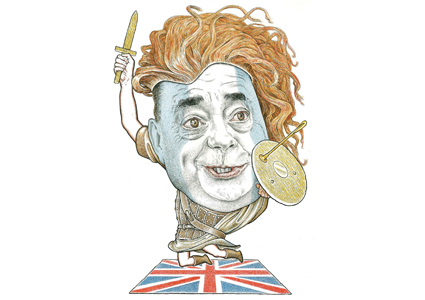
The nationalists have over-simplified history and let anti-English resentment fester (illustration by Michael Daley)
It's also why the latest policies of the separatists — to keep the Queen, the pound, and membership of Nato — are so opportunistic. None of this will surprise readers of David Torrance's biography of SNP leader Alex Salmond, Salmond: Against the Odds (Birlinn, £20), in which a former colleague observes: "When you went through all the arguments you were left with the impression that he didn't know if Scotland would be better or worse off as an independent country. All that mattered was that Scots should rule themselves."
There could be a problem, of course. Membership of the United Kingdom's multinational state could have inflicted some grave and chronic injustice on Scotland, for which remedy had long been sought but never found. The Scots could have been under-represented at Westminster. Their legitimate concerns could have been seriously neglected and their needs unfairly met. Their culture could have been suppressed.
But none of this is so. Since the Scottish Parliament was established in 1999, the Scots have enjoyed representation both in Edinburgh and in London. Indeed, Scottish MPs vote on matters that concern other parts of the UK, whereas the representatives of those other parts cannot vote on matters devolved to Edinburgh. Scots receive more public spending per capita than the English, and whatever strikes visitors to Edinburgh and Glasgow it is not a lack of cultural vitality.
How, then, do members of the Yes campaign in the run-up to September's referendum on independence try to justify their support for it? What stories do they tell to make their visceral conviction plausible? Their strongest tale is that the Scots prefer a left-of-centre, social democratic polity with a more generous welfare state, whereas, judging by its propensity to elect Conservative governments, the English electorate's centre of gravity is markedly farther to the right and more favourable to the free market. As a consequence, the Scots' legitimate aspiration for a fairer, more equal society has been consistently stymied by a neoliberal Westminster.
If this were true, it would certainly be a reason for greater Scottish autonomy and a further devolution of powers from Westminster to Edinburgh, although not necessarily for outright secession from the UK. As it happens, however, the narrative of nationalist politicians doesn't tally with the hard evidence of the social scientific data. According to analysis of the British Social Attitudes survey of 2010:
. . . it seems that Scotland is not so different after all. Scotland is somewhat more social democratic than England. However, for the most part the difference is one of degree rather than of kind — and is no larger now than it was a decade ago. Moreover, Scotland appears to have experienced something of a drift away from a social democratic outlook during the course of the past decade, in tandem with public opinion in England.
From this the authors — including the doyen of Scottish psephologists, John Curtice — conclude that "the task of accommodating the policy preferences of people in both England and in Scotland within the framework of the Union is no more difficult now than it was when devolution was first introduced". Awkwardly for the Yes campaign the late Stephen Maxwell, nationalist intellectual and founder of the modern SNP, agreed, writing shortly before his death in 2012 that there is "nothing in Scotland's recent political record to suggest a pent-up demand for radical social and economic change waiting to be released by independence". The fact that the current nationalist government in Edinburgh has declined to use the Scottish Parliament's existing power to raise the rate of income tax, so as to increase funding for public services, suggests that they know that Maxwell spoke the truth.
Like this article? Share, save or print using the icons below:


More Features
- Our EU Deal Gives Us The Best Of Both Worlds
- Brexit Would Save Us And Set Europe An Example
- Are Both Sides Playing By The Referendum Rules?
- Should We Stay Or Should We Go?
- Ignore Project Fear: Brexit Won't Ruin Us
- Uncontrolled Immigration Means Finis Britanniae
- The Next US President Must Carry A Big Stick
- Can Clinton Or Trump Crack The US Tax Code?
- How to Survive the Fourth Industrial Revolution
- The Spectre Of Mayor Khan's Islamist London
- Students Are Leading The Free Speech Fightback
- Fortress Europe Faces An African Migrant Tsunami
- Trump May Be Bad, But What Comes Next Will Be Worse
- Myth Of Stressed-Out Soldiers On The Street
- The Russian Love Affair With Palmyra Resumes
- How Russia Is Ruled By The Putin Doctrine
- The Doors Of Holocaust Memory Are Closing
- Rediscovering The Point Of Language
- The Novelist For Whom Small Was Beautiful
- A Recipe For Disaster
Popular Standpoint topics

8:08 PM
12:05 AM
12:05 PM
8:05 AM
7:05 AM