


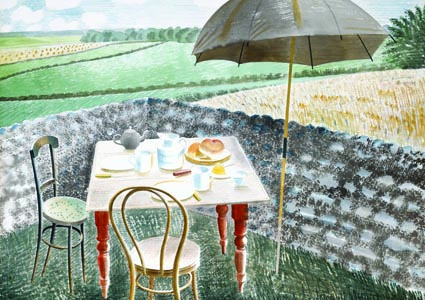
"Tea At Furlongs" (1939)
At the end of a farmhouse garden, a scrubbed table is set for two. Mismatched chairs have been dragged onto the grass. Tea is warming in the pot and a pat of soft butter is waiting to be spread onto rolls with bone-handled knives. There are milk and sugar for those who want them. And this being an English summer, there is also an umbrella on a tall stand. It won't do the picnickers much good, but if it does rain, the rolls at least will stay dry.
Eric Ravilious, the painter of this scene, was rarely happier than with rain running down the back of his neck as he sat beneath a dripping tree in a mizzling landscape.
He preferred the bleached greys of a Welsh January to the brashness of a sunny day in June. In winter he was out with his watercolours as soon as it was light, wearing two waistcoats and two greatcoats to keep warm. Some mornings he would sit on the roof of the house with a drawing board balanced on his knees and only come down when the smell of kippers frying for breakfast became irresistible. On the coldest days, according to his wife Tirzah, whom he had met when she was his student at Eastbourne College of Art, the thin paint would freeze to his brush.
Tea at Furlongs, painted late in the summer of 1939, has a damp feel. The grass is sodden. The table and chairs look as though they have been hastily borrowed from the kitchen to make the most of a half-hour of sunshine between showers. It is a quintessentially English scene: afternoon tea on the lawn, a Sussex flintstone wall, fields enclosed by hedgerows, impending rain.
These were Ravilious's subjects. Tennis in white flannels. Chalk figures on the Downs. Cucumbers growing under glass. Strawberry netting. Dovecotes and gazebos. Railway sidings. Lemonade pitchers. Hansom cabs. Punch and Judy. The lion and the unicorn. The Boat Race. Iron bedsteads and Welsh quilts. Cow parsley. Puddles on tarmac. Soggy seaside holidays.
His favourite writer was P.G. Wodehouse and he was uncommonly fond of tea. This particularly British vision made him hugely popular in his own lifetime.
Born in London in 1903, Ravilious was brought up in Eastbourne where his father ran an antiques shop. He studied at the Eastbourne School of Art and the Royal College of Art in London. He began his career as a mural painter decorating tearooms with pink curtains in seaside resorts like Colwyn Bay and at the Midland Hotel, Morecambe — somewhere for doughty grandmothers to shelter with a slice of Battenberg cake when the breakers were lashing the pier.
He illustrated an edition of Shakespeare and pamphlets of walking routes in the Home Counties. Country Life commissioned him for their calendar and asked him to illustrate a children's book about the British high street with pictures of butchers, bakers and diving-suit makers.
Like this article? Share, save or print using the icons below:


More Features
- How Jeremy Corbyn's Coup Hijacked Labour
- Corbyn's Signpost Back To The Ghetto
- Unionists, Don't Despair: Scotland Is Not Lost — Yet
- Britain's Apologists For Child Abuse
- Lift The Fee Cap And Set Universities Free
- The Story Behind One Dead Man's Penny
- Hitler's 'Ecological Panic' Didn't Cause The Holocaust
- Meet The Montalvos: The First Global Family
- Mr Gove, Here Is Our Statute of Liberty
- A British Bill Of Rights
- Something For Nothing Just Won't Do Any More
- Ditch Ed Miliband's Crazy Energy Legacy
- The English Public School: An Apologia
- An Open Letter To Nicky Morgan
- Escape The Heat: Head To London's Crow's Nests
- Collusion Cut Both Ways In The Troubles
- Decline Of The East? The Chinese Say No
- Conservative, Moi? Jamais De La Vie!
- How To Rescue Iraq From Obama's Folly
- Europe Must Never Again Betray Its Jews
Popular Standpoint topics

7:04 PM