


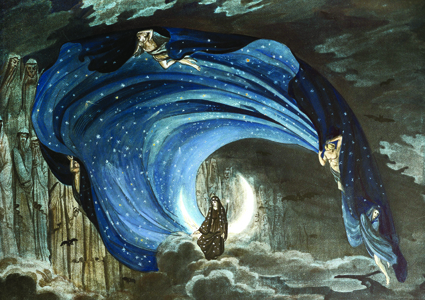
 Feelings released from darkness: The set design for the Queen of the Night from Mozart's "The Magaic Flute", by Simon Quaglio, 1818 (credit: Getty)
"Of all the noises known to man," wrote Molière, "opera is the most expensive." He was referring to the spectacles staged for the court of Louis XIV, in which dances and entr'actes were part of the entertainment and in which the king himself — who was an accomplished dancer — would sometimes appear on stage. The plots were drawn from classical and mythical sources, and the stylised singing and dancing corresponded to the ritualised setting of the drama. We can appreciate these operas today, partly because their leading exponent, Jean-Baptiste Lully, was a master musician, who could elicit heartfelt sentiment from whatever nymph-and-shepherd-infested libretto came his way.
Opera has moved on since Lully's day; but it is still the most expensive of our noises. Costs didn't matter so much when the royal purse looked after them. But the transfer of opera from the court to the town, and from the aristocracy to the bourgeoisie, meant that producers had to look for sales rather than patronage in order to cover their outlay. It wasn't so difficult when the supply of singers was abundant, the sets cheap, and the music easy to sight-read. But by the time the crisp dramas of Mozart and Gluck had morphed into the Gesamtkunstwerk of Wagner and the virtuoso spectacles of Verdi, opera involved investment beyond anything imaginable at the court of Louis XIV. Verdi was immensely popular and the costs of his smaller productions were more than covered by the sales. Wagner was popular too: but his ambitions so outstripped the bourgeois readiness to pay for them that he had to look back to the old way of doing things, calling on a royal purse to subsidise his dreams. Those two great composers helped to create an art form that stands today at the apex of Western culture, but which is always short of funds.
A full-scale spectacle must run for an extended period if it is to cover its costs. Hence an opera can put the composer's name in lights for days on end, and the more costly the production the longer it must run. But it is not the promise of repeat performances that draws so many composers to this supremely demanding art form. Opera is a crown to be won, a sign that the composer has finally stuck his head above the clouds on Mount Olympus. Beethoven wrote his single opera twice, and parts of it more than twice, in the determination to reach the summit where Handel and Mozart stood in triumph. Schubert tried and failed, again and again. Mendelssohn and Brahms shied away, but Schumann laboured for eight years over Genoveva, his only opera, in which the strain of writing is clearly audible. Janáček achieved his first real success, after several attempts, at the age of 50, with Jenůfa. Chausson put his entire life into his one opera, Le roi Arthus, as did George Enescu into his laboured retelling of the Oedipus story. Debussy spent ten years over Pelléas et Mélisande, and Stravinsky's one full-length opera, The Rake's Progress, was accomplished only by means of a complete change of style, from neo-classical Stravinsky to inverted comma "Mozart".
Those examples testify to the determination with which composers have approached the operatic task. Their work might gain only a few performances, before disappearing into the void like Genoveva and Le roi Arthus, like Enescu's Oedipe, Busoni's Doktor Faust and Pfitzner's Palestrina — distinguished operas that are now all but forgotten. Not deterred by those corpses by the wayside, however, composers continue to tackle the lower slopes of Mount Olympus, knowing that, even if they reach the first plateau, holding a completed score in their hands, they may not get to the next one, with a live performance. And beyond that goal lies the distant summit of the operatic art, where stands the handful of composers with works in the permanent repertoire.
Opera has moved on since Lully's day; but it is still the most expensive of our noises. Costs didn't matter so much when the royal purse looked after them. But the transfer of opera from the court to the town, and from the aristocracy to the bourgeoisie, meant that producers had to look for sales rather than patronage in order to cover their outlay. It wasn't so difficult when the supply of singers was abundant, the sets cheap, and the music easy to sight-read. But by the time the crisp dramas of Mozart and Gluck had morphed into the Gesamtkunstwerk of Wagner and the virtuoso spectacles of Verdi, opera involved investment beyond anything imaginable at the court of Louis XIV. Verdi was immensely popular and the costs of his smaller productions were more than covered by the sales. Wagner was popular too: but his ambitions so outstripped the bourgeois readiness to pay for them that he had to look back to the old way of doing things, calling on a royal purse to subsidise his dreams. Those two great composers helped to create an art form that stands today at the apex of Western culture, but which is always short of funds.
A full-scale spectacle must run for an extended period if it is to cover its costs. Hence an opera can put the composer's name in lights for days on end, and the more costly the production the longer it must run. But it is not the promise of repeat performances that draws so many composers to this supremely demanding art form. Opera is a crown to be won, a sign that the composer has finally stuck his head above the clouds on Mount Olympus. Beethoven wrote his single opera twice, and parts of it more than twice, in the determination to reach the summit where Handel and Mozart stood in triumph. Schubert tried and failed, again and again. Mendelssohn and Brahms shied away, but Schumann laboured for eight years over Genoveva, his only opera, in which the strain of writing is clearly audible. Janáček achieved his first real success, after several attempts, at the age of 50, with Jenůfa. Chausson put his entire life into his one opera, Le roi Arthus, as did George Enescu into his laboured retelling of the Oedipus story. Debussy spent ten years over Pelléas et Mélisande, and Stravinsky's one full-length opera, The Rake's Progress, was accomplished only by means of a complete change of style, from neo-classical Stravinsky to inverted comma "Mozart".
Those examples testify to the determination with which composers have approached the operatic task. Their work might gain only a few performances, before disappearing into the void like Genoveva and Le roi Arthus, like Enescu's Oedipe, Busoni's Doktor Faust and Pfitzner's Palestrina — distinguished operas that are now all but forgotten. Not deterred by those corpses by the wayside, however, composers continue to tackle the lower slopes of Mount Olympus, knowing that, even if they reach the first plateau, holding a completed score in their hands, they may not get to the next one, with a live performance. And beyond that goal lies the distant summit of the operatic art, where stands the handful of composers with works in the permanent repertoire.
Like this article? Share, save or print using the icons below:


More Features
- The Spectre Of Mayor Khan's Islamist London
- Students Are Leading The Free Speech Fightback
- Fortress Europe Faces An African Migrant Tsunami
- Even If Trump Is Sunk, Republicans Can't Cruz
- Myth Of Stressed-Out Soldiers On The Street
- The Russian Love Affair With Palmyra Resumes
- How Russia Is Ruled By The Putin Doctrine
- The Doors Of Holocaust Memory Are Closing
- Rediscovering The Point Of Language
- The Novelist For Whom Small Was Beautiful
- A Recipe For Disaster
- Culture And Politics In The Age Of Trumpery
- Will Labour Listen To Its Eurosceptic Voters?
- Would Brexit Play Into Putin's Hands?
- Why Brexit Could Be A Blessing For Europe
- Will The Pollsters Get It Right On The Referendum?
- The Great Illusion: Why We Are Still Europe’s Fall Guys
- Make June 23 Britain’s Independence Day
- Don't Pit Generations Against Each Other
- Let Justice Be Done Though The Liberal Heavens Fall
Popular Standpoint topics

- Shame On The Liberals Who Rationalise Terror
- The Cowardice Of John Le Carré
- The Establishment Is In Denial — Yet Again
- Is There A Right Way To Write?
- A Fascist Coup In Poland? Give Us Poles A Break
- The Stalinist Past Of Corbyn’s Strategist
- The Year Of "Social Justice"
- France, Islam, And The Second Class Sex
- Shame On The Liberals Who Rationalise Terror
- The Cowardice Of John Le Carré
- The Establishment Is In Denial — Yet Again
- Is There A Right Way To Write?
- A Fascist Coup In Poland? Give Us Poles A Break
- The Stalinist Past Of Corbyn’s Strategist
- The Year Of "Social Justice"
- France, Islam, And The Second Class Sex
- Shame On The Liberals Who Rationalise Terror
- The Cowardice Of John Le Carré
- The Establishment Is In Denial — Yet Again
- Is There A Right Way To Write?
- Double Games Of The UK Muslim Brotherhood
- Did Burke Betray The Cause Of Liberty?
- A Fascist Coup In Poland? Give Us Poles A Break
- Two Languages And The Chasm Between Them
8:08 PM
4:07 PM
8:07 AM
4:07 PM
11:07 PM
3:07 AM
4:07 PM
6:07 AM
9:07 PM
3:07 PM