



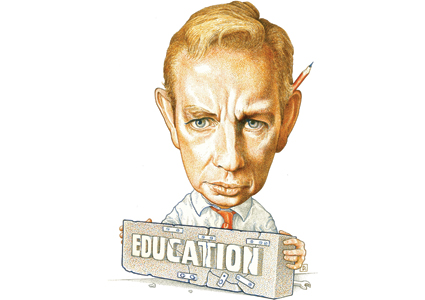
 Three months after Michael Gove became Secretary of State for Education I applied to become a teacher. Four years later, England's education landscape has been transformed, unreservedly for the better.
There was a sense of hopelessness in the schools I visited during my training. So many people I encountered seemed resigned to the idea that in England rubbish schools, like rubbish weather, were a depressing but inevitable feature of national life. This resignation had only been strengthened by the failure of New Labour's programme of reform.
To appreciate the reforms enacted by Michael Gove (who sits on Standpoint's advisory board), one must look back to the state of English schools before 2010. New Labour's failure was not through want of trying. Total public expenditure on education rose from £39 billion in 1998 to £89 billion in 2010. The money was spent on a bewildering array of initiatives and strategies, whose Panglossian slogans now mock their total lack of impact: "excellence in cities", "fresh start", "building brighter futures", "every child a reader", "excellence and enjoyment", "achievement for all" and so on.
As Schools Minister, David Miliband promised that children of the Blair years would be "the best educated generation in our nation's history". Nine years later, an OECD survey found that England was the only country in the developed world where literacy and numeracy levels among 16-24 year-olds were no better than among 55-65 year-olds.
If you want a picture of English schools after thirteen years of Labour reforms, read Katharine Birbalsingh's To Miss with Love (2011), or Charlie Caroll's On The Edge (2010). In the latter account, Carroll travelled England for a year as a supply teacher in inner city schools. He witnessed school arsonists in Birmingham, a playground drug dealer in the Peak District, IT lessons used to browse pornography in Sheffield, and a 13 year old boy in rural Yorkshire who, with indemnity from the senior staff, bullied Carroll so badly that he dared not return to the school.
At the end of his account, Carroll wrote: "The year I travelled England and its toughest schools, the year of this book, came at the tail-end of Labour's time in power. What I saw, and what you have read, is the consequence of Blair's drive for education, education, education."
In essence, New Labour's education reforms did not succeed because they were directed through the existing education establishment. No Labour minister was willing confront the possibility that it was the education establishment itself which was holding back England's schools. In addition, no Labour Education Secretary after David Blunkett had the time to become sufficiently knowledgeable or resilient to take such a stance. From 2001, there was a revolving door to the Department for Education, with five Labour Secretaries coming and going, averaging less than two years in the post.
Like this article? Share, save or print using the icons below:


More Online Only
- Same Difference
- The Tipping Point
- Labour Should Be Cautious About Corbyn
- Remembering Waterloo
- Beware of Greeks Playing Games
- Charleston: Evasions and Excuses
- Getting Away With Murder
- A Helluva Week
- Having One's Cake and Eating It
- Win a pair of tickets to see "Hope" at the Royal Court
- Win a pair of tickets to see Albion!
- The Crescent and the Jackboot: Dealing with Totalitarianism
- A Dream of Scottish Secession
- ISIS and the West: Neutrality absolves nothing
- Heaven and Hell in Campania
- The Irish Free Variable
- Holocaust Lessons
- Georgians Really Revealed?
Popular Standpoint topics

5:08 AM
8:07 AM
10:07 PM
8:07 AM
3:07 PM