


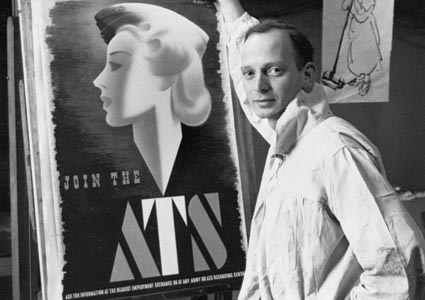
Dedicated to design: Games in his studio with his ATS poster
In life, as in art, Abram Games was a great believer in symmetry. It is there in his emblem for the Festival of Britain: a helmeted Britannia above a four-pointed compass. It is there in his poster for the Dig For Victory campaign where a garden spade ready to turn over a vegetable patch is mirrored in a battleship on choppy waters. It is there, too, in the cover he designed for Penguin's edition of Flames in the Sky, Pierre Clostermann's collection of Second World War air battles. An unblinking pilot gazes fixedly ahead while a blazing plane, superimposed over his flight goggles, plummets to earth.
Games would have been pleased then to discover that on the day marking celebrations for the centenary of his birth, July 29, 2014, his family were also toasting the birth of his tenth great-grandchild. The evenness of the two births falling exactly 100 years apart would have appealed not only to his sense of symmetry but also to his delight in teases and happy chance.
Games was born in Whitechapel in the last few hot days of peace before Britain entered the war in 1914. His father Joseph may have been a Latvian émigré photographer and his mother Sarah a seamstress from the borders of Russia and Hungary, but Games (the family had anglicised the Jewish Gamse) always considered himself a Cockney.
He was educated at the Grocers' Company School in Hackney Downs, though he was not a natural scholar. In one report from his final year, showing the unerring instinct some teachers have for underestimating their pupils, he was described as "lazy, indifferent, careless, untidy" and that his drawing was, at best, weak.
At 16, after two unsuccessful terms at St Martin's School of Art (paid for by his parents as he had failed to win a scholarship), he decided to make a go of things on his own. He attended life-drawing classes at the Royal College of Surgeons and learnt studio discipline from his father.
At 16, after two unsuccessful terms at St Martin's School of Art (paid for by his parents as he had failed to win a scholarship), he decided to make a go of things on his own. He attended life-drawing classes at the Royal College of Surgeons and learnt studio discipline from his father.
As he walked between his home in East London and the Royal College in Lincoln's Inn Fields, he took a keen interest in the posters pasted on London's advertising boards. He found little to inspire. "The general standard," he later said, "was mediocre traditionalism."
He worked for a while at a tight-deadline, churn-them-out, please-the-client commercial advertising firm but was dismissed after he was caught attempting a standing jump over four chairs. His studio boss told him that his work was ahead of its time by ten years. "I cannot wait ten years," was Games's characteristically impatient response.
Like this article? Share, save or print using the icons below:


Post your comment
More Features
- How Jeremy Corbyn's Coup Hijacked Labour
- Corbyn's Signpost Back To The Ghetto
- Unionists, Don't Despair: Scotland Is Not Lost — Yet
- Britain's Apologists For Child Abuse
- Lift The Fee Cap And Set Universities Free
- The Story Behind One Dead Man's Penny
- Hitler's 'Ecological Panic' Didn't Cause The Holocaust
- Meet The Montalvos: The First Global Family
- Mr Gove, Here Is Our Statute of Liberty
- A British Bill Of Rights
- Something For Nothing Just Won't Do Any More
- Ditch Ed Miliband's Crazy Energy Legacy
- The English Public School: An Apologia
- An Open Letter To Nicky Morgan
- Escape The Heat: Head To London's Crow's Nests
- Collusion Cut Both Ways In The Troubles
- Decline Of The East? The Chinese Say No
- Conservative, Moi? Jamais De La Vie!
- How To Rescue Iraq From Obama's Folly
- Europe Must Never Again Betray Its Jews
Popular Standpoint topics
