



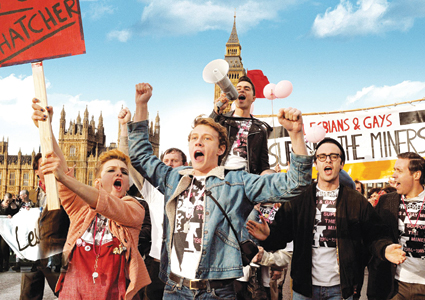
Rose-tinted: Ben Schnetzer (centre) in "Pride" (credit: Nicola Dove)
A scene in Pride sent me back 30 years. A gay activist, Mark Ashton (played with intense conviction by Ben Schnetzer), decides to set up "Lesbians and Gays Support the Miners" from a Bloomsbury bookshop. "Who hates the miners?" he asks. "Thatcher, the police and the tabloid press — does that sound familiar?"
Hardly anyone supports him. A working-class gay from Durham wonders if those would be the same miners who beat him up every day for being queer. Ashton goes on to the streets, nevertheless, and shakes a bucket for donations. Passers-by insult him. He does not answer back in kind but shouts "Merry Christmas."
I stood collecting on the streets for the miners in the winter of 1984, not on the streets of Bloomsbury but of Altrincham, which as one of the most conservative towns in the north of England, was not, on reflection, the best venue for a fraternal whip-round. To be fair, most shoppers politely ignored me or gave despairing looks. But a few turned nasty. When they did, I shouted, "And a Merry Christmas to you too." I was not trying to convince them that business would run riot in Britain if the miners lost, but to remind them that men who had kept the country going through two world wars were being beaten by the police and starved back to work, to suggest that a touch of common humanity was in order.
From the start, Pride felt true. Indeed much of it is true. Mark Ashton was a young Communist (the film does not mention this) who died horribly young from Aids. He organised gay groups to support striking miners in Wales, and so overcame their prejudices that the 1985 gay pride march in London saw an extraordinary sight: miners and their families from South Wales leading the demonstration. I should say before criticising the film that the ensemble acting is superb, and the attempts to deal with repression and homophobia wittily and subtly handled. I do not want to put you off seeing a film which had me wiping away the tears (although I accept that fact alone may put you off.)
Still, its moral uplift, its comfy, cheering wallowing in solidarity illustrates the contradictions of the wave of industrial nostalgia in British cinema. Pride follows Brassed Off, Billy Elliot and Made In Dagenham. They are the Ealing comedies of our day, wistful love letters to a Britain that has gone — and perhaps never was. Producers have turned them into musicals, that most feelgood of art forms. Doubtless Pride will receive the same treatment, and we will see choruses of colliers in West End theatres.
Everyone involved tries to forget that the miners' strike left contemporaries with nothing to feel good about. You get little sense from Pride that the conflict was the closest mainland Britain has come to civil war in a century. Miners filed 551 complaints against the police, 257 alleging assault. As for the police, miners and their supporters injured 1,392 officers — 85 seriously. The Wales Pride presents is a place so big-hearted it can overcome its homophobia after a couple of dances in the miners' social. In reality a taxi driver taking a strike-breaking miner to work was killed by a concrete block dropped from a bridge.
Like this article? Share, save or print using the icons below:


- Shame On The Liberals Who Rationalise Terror
- The Cowardice Of John Le Carré
- Beyond Obama: Advice To The Next President
- The Establishment Is In Denial — Yet Again
- Is There A Right Way To Write?
- Did Burke Betray The Cause Of Liberty?
- Double Games Of The UK Muslim Brotherhood
- Two Languages And The Chasm Between Them
9:12 PM
4:10 PM