



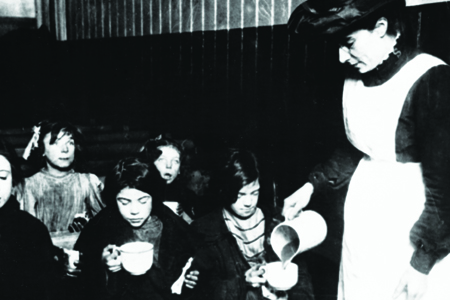
Before the welfare state: A Salvation Army worker gives out breakfast to slum children (image: Museum of London/Heritage Images/Getty Images)
Let me begin with a quote, which will be familiar to many of you: "The making of a good society depends not on the State but on the citizens, acting individually or in free association with one another, acting on motives of various kinds — some selfish, others unselfish, some narrow and material, others inspired by love of man and love of God. The happiness or unhappiness of the society in which we live depends upon ourselves as citizens, not only the instruments of political power which we call the State." That is William Beveridge, from his book Voluntary Action, published in that pivotal year 1948.
The 20th century witnessed an historic, often bitter, contest between individualist and collectivist traditions in the pursuit of social progress. By the 1950s, it resulted in the state reigning supreme in health and welfare provision, with charities reduced to the periphery. Things have moved in recent decades, with something of a charitable revival. By this century, Britain had reached a curious stage in the evolution of social policy, in which the state wanted the voluntary societies to do more and the voluntary societies wanted the state to do more. Now, the exhausted parties seem to be heading for the ropes, in what we have come to call, sometimes admiringly, sometimes not, partnership.
In the ambiguous welfare world of today, it has become necessary to use the word independent before the name of a non-governmental charity, for it is no longer obvious that a charitable institution is not a government agency. Charity law, after all, does not prohibit government authorities from setting up charities. Britain remains a nation of joiners and volunteers, who continually revive our local communities from below. But at the higher echelons of social provision, which attracts the bulk of media attention, there is some confusion over what constitutes a charity. In an era of partnerships and public service contracts, the state and many voluntary bodies have become so intertwined that it is rather fanciful to think of them as representing two distinct sectors. Greyness pervades the discussion.
I would like to begin with some remarks on the history of charity, which should help us to put our current position in context. The boundaries between state assistance and charitable assistance were much clearer in the past. In the 19th century, a general guideline was that charity dealt with deserving cases and the state with the undeserving. This division of responsibilities often broke down in practice but at least it gave some clarity to the issue. There was a measure of state funding of individual institutions in the 19th century. But in general, the attitude of Victorian charitable campaigners to the state was rather like the revulsion felt by the curly-haired boy in Nicholas Nickleby, as his mouth opened before Mrs Squeers's brimstone and treacle spoon.
Like this article? Share, save or print using the icons below:


More Text
- The Writer
- New Poetry
- Cartagena Poems
- A British Subject
- Travels with Betjeman
- Kizerman and Feigenbaum
- Communism’s Comeback?
- Irving Kristol on Jews and Judaism
- Teeth
- La Buena Muerte
- Judaeophobia
- Cool It
- Rachmones
- From 'Russia'
- 'Going Out' and Five Other Poems
- The Final Edition
- 'The Ship of Endurance' And Three More New Poems
- The Letters Of Hugh Trevor-Roper
- Lighten Our Darkness
- Poetry
Popular Standpoint topics

- The Loss Of Faith Made Music Mute
- The Great Betrayal: How Liberals Appease Islam
- Political Correctness Is Devouring Itself
- The New Language Of Political Narcissism
- Why The World Still Loves Shakespeare
- Don’t Listen to Britain’s Designer Demagogues
- Who's in Charge of BBC News?
- An English parliament: the only way to save the UK
- The Loss Of Faith Made Music Mute
- The Great Betrayal: How Liberals Appease Islam
- Political Correctness Is Devouring Itself
- The New Language Of Political Narcissism
- Why The World Still Loves Shakespeare
- Don’t Listen to Britain’s Designer Demagogues
- Who's in Charge of BBC News?
- An English parliament: the only way to save the UK
- The Loss Of Faith Made Music Mute
- The Great Betrayal: How Liberals Appease Islam
- Why The World Still Loves Shakespeare
- Who Will Lead The Berlin Band?
- Putin and the Art of Political Fantasy
- Political Correctness Is Devouring Itself
- The New Language Of Political Narcissism
- Inside The World Of 'Non-Violent' Islamism
2:11 AM
2:11 AM