



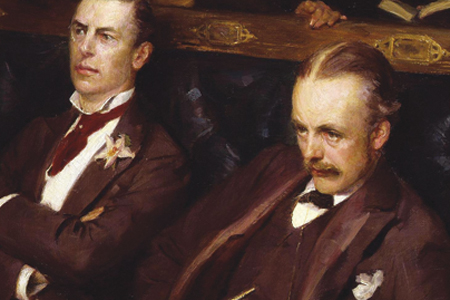
Joseph Chamberlain (left), with Arthur Balfour: The Liberal Unionist embodied the tension between shire Conservatism and metropolitan big business
Roger Scruton is a distinctive and important voice in British Conservatism. He is also extraordinarily prolific and energetic. This book communicates a distinctive conservative disposition with great charm and formidable learning. But that disposition, however admirable, is not the same as the Conservative statecraft practised in our country for the past two centuries.
Roger Scruton's Conservatism is shaped by his own experiences which he describes in the opening section of this book. His personal journey is fascinating and engaging. He describes his father's solid working-class communitarianism. His own work supporting dissidents in Eastern Europe in the 1980s was courageous and important. And having, like him, had the experience of being shouted down on university campuses, I know how deeply dispiriting it is when you discover that some people really do want to narrow the range of opinions that can be freely expressed.
This book roots British Conservatism in our distinctive history. Roger Scruton rightly sees it is as the special responsibility of Conservatives to protect our common law tradition and the institutions which embody that. He is very good on the importance of autonomous institutions — what I called civic conservatism. But he is surprisingly uninterested in where this great tradition comes from or how it has changed over time. He appears to regard it as a happy and perhaps rather accidental gift from history. This means that his account of the role of Conservatives is rather passive and incurious. We are like the inheritors of a stately home which has been in the family for centuries — our job is to preserve it and pass it on but not worry too much how much of the land was acquired by aggressive enclosures, what the royal mistress got up to, or what deals were done to escape inheritance tax.
I am persuaded by Alan Macfarlane's excellent work suggesting that our tradition of ordered liberty emerged with the Anglo-Saxons from the woods of Germany. In the wise words of Benjamin Franklin, "Britain was formerly the America of the Germans." But you still need to explain real political decisions in 1215 or 1688 or indeed 1867. It is not just a tradition given to us. We enjoy it because of Edward Coke and Blackstone and Maitland as well of course as Pitt and Disraeli and Thatcher. It is something shaped by political decisions over centuries and sometimes fought for.
As soon as we see this tradition as emerging from centuries of political argument we have to recognise that there is more to Conservatism than just a disposition to conserve. That is just the start of the politics — we are endlessly having to decide what to conserve and how. Would Squire Scruton in 1720 have made his peace with the Glorious Revolution and the House of Hanover? Somehow, I suspect from the tone of this book that he would not. And a century and a half later Dean Scruton, writing from his cathedral close, would surely have been shocked by Gladstone's approach to Ireland.
Like this article? Share, save or print using the icons below:


3:10 PM
3:10 PM