


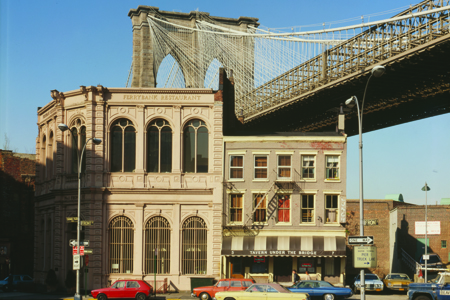
Brooklyn Bridge, 1982: Kristol grew up in Brooklyn when it was a poor neighbourhood, very different from today's gentrified borough
"Is there such a thing as a ‘neo' gene?" With this query Irving Kristol opens his 1995 essay, "An Autobiographical Memoir." His life, he recalls, has been a series of such "neo's": neo-Marxist, neo-Trotskyite, neo-socialist, neo-liberal, and, finally, neo-conservative. "No ideology or philosophy," he explains, "has ever been able to encompass all of reality to my satisfaction. There was always a degree of detachment qualifying my commitment."
But there is an exception. One "neo" has been "permanent" throughout his life, Kristol writes, and was "probably at the root of all the others." In his religious views (although not, he notes parenthetically, in his religious observance), he has always been "neo-orthodox."
This is a remarkable testament by the "godfather of neoconservatism." The political lineage of neoconservatism is well known, from its beginnings in a dissident Trotskyism and on to its various mutations in the 1970s and 80s and its emergence as a distinctive political and cultural orientation. In Kristol's case, less well known is the existence of the religious gene, the neo-orthodox gene — which is to say, Judaism — not as an appendage or by-product of the other neo's but as a permanent feature of his life, indeed at the root of all the others.
Kristol's memoir is an invitation to inquire into that missing gene, and his own writings provide the best avenue into such an inquiry. His many reflections on Jewish religion and theology, the relation of Jews to secular society and culture, the Holocaust and anti-Semitism, and the contemporary situation of Israel are memorable in themselves. They are also memorable for the light they shed on neoconservatism, giving a spiritual and moral dimension to the mundane issues of politics, economics, or foreign affairs. Finally, they remind us of a Kristol who is more than the godfather of neoconservatism in its familiar guise, more far-ranging and spirited, more perceptive and more provocative.
Kristol confesses that his neo-orthodoxy is "something of a puzzle" even to him. His Jewish family, he recalls, was Orthodox in the sense common in his Brooklyn neighborhood. His father attended services on the High Holy Days and his mother kept a kosher kitchen but (like many if not most women in that milieu) was rarely seen in the synagogue. As a child, he went to the local Hebrew school two afternoons a week and Sunday mornings, learning to read the prayer book and Bible by translating the Hebrew into Yiddish, although he knew neither language. (At home, his parents spoke Yiddish to each other and English to the children, so his bar-mitzvah speech, delivered in Yiddish, had to be memorised.) In school, the rabbi enforced classroom discipline by a strong slap in the face and taught the children to fear Gentiles and to spit when passing a church. "If ever there was a regimen that might have provoked rebelliousness," he reflects, "this was it."
Like this article? Share, save or print using the icons below:


More Text
- Liberty And Sovereignty
- Art And Public Culture In The 1830s And Today
- The Casanova Of LaSalle Street
- The Writer
- New Poetry
- Cartagena Poems
- A British Subject
- Travels with Betjeman
- Kizerman and Feigenbaum
- Communism’s Comeback?
- The State of Charity
- Teeth
- La Buena Muerte
- Judaeophobia
- Cool It
- Rachmones
- From 'Russia'
- 'Going Out' and Five Other Poems
- The Final Edition
- 'The Ship of Endurance' And Three More New Poems
Popular Standpoint topics

6:12 AM
8:12 AM
2:12 PM