



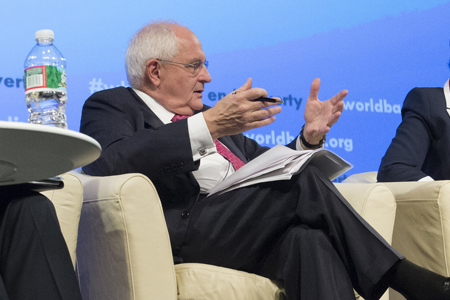
Unrepentant: The FT's chief commentator, Martin Wolf, refuses to admit his errors (photo: Brangelina Clawson/World Bank)
Among his many gifts, John Maynard Keynes had a flair for self-advertisement. By giving his 1936 book of new economic ideas the title of The General Theory of Employment, Interest and Money, he deliberately echoed the name that Einstein had chosen over 20 years earlier for his theory of relativity. Economics might be a human science rather than a natural one, but Keynes's message was that it could still aspire to the rigour and modernity of scientific endeavour.
According to numerous accounts, the policy impact of The General Theory was greatest in the field of public finance. Whereas before Keynes governments were convinced that they should balance their budgets, afterwards they accepted that the budget position should be used to stabilise the business cycle and to secure higher employment. In the 1950s and 1960s Keynesian fiscal activism was often praised as one of economics' greatest contributions to the happiness of mankind. The old budget-balancing principles were mocked as little better than the tribal customs of out-of-date finance ministries, whereas Keynesianism could boast of its scientific credentials.
But there was a problem. A large budget deficit implied a big increase in the national debt and debt holders needed to be paid a rate of interest. Of course the larger the debt, the higher were the interest payments. Even worse, in the Britain of the 1970s runaway inflation pushed up the nominal rate of interest to unprecedented peaks. Investors had therefore to be paid interest rates well into the teens, to persuade them to buy current issues of government debt. As the stock of debt rose because of persistently high deficits, and as maturing low-interest-paying government securities were rolled over into new high-interest-paying equivalents, the burden of interest payments soared.
The Thatcher government decided that enough was enough. The growth of public debt had to be checked. In the 1981 Budget the government raised taxes in order to reduce the budget deficit, even though the economy was in a bad recession. A move back towards a more balanced budget position was seen as essential, regardless of Keynes's intellectual legacy. To many economists in British universities, this so-called "tightening" of fiscal policy would reduce spending power, undermine demand and output, and destroy jobs. At the prompting of two leading figures in the Cambridge economics faculty, 364 university economists wrote a letter to The Times in protest against the 1981 Budget. They were accusing Treasury ministers not just of folly, but of ignorance of the best thinking on the subject, which in their view was the thinking that came from Keynes' General Theory.
Given their elevation of economic principles to scientific status, the Keynesians saw the 1981 Budget almost as a laboratory experiment. Not only did they believe that an increase in the budget deficit stimulated aggregate demand and that a reduction in the deficit restrained it. They were also confident that the budgetary stance was one of the most powerful influences — perhaps even the most powerful single influence — on economic activity. The letter from the 364 warned that "present policies will deepen the depression", and threaten "social and political stability".
Among his many gifts, John Maynard Keynes had a flair for self-advertisement. By giving his 1936 book of new economic ideas the title of The General Theory of Employment, Interest and Money, he deliberately echoed the name that Einstein had chosen over 20 years earlier for his theory of relativity. Economics might be a human science rather than a natural one, but Keynes's message was that it could still aspire to the rigour and modernity of scientific endeavour.
According to numerous accounts, the policy impact of The General Theory was greatest in the field of public finance. Whereas before Keynes governments were convinced that they should balance their budgets, afterwards they accepted that the budget position should be used to stabilise the business cycle and to secure higher employment. In the 1950s and 1960s Keynesian fiscal activism was often praised as one of economics' greatest contributions to the happiness of mankind. The old budget-balancing principles were mocked as little better than the tribal customs of out-of-date finance ministries, whereas Keynesianism could boast of its scientific credentials.
But there was a problem. A large budget deficit implied a big increase in the national debt and debt holders needed to be paid a rate of interest. Of course the larger the debt, the higher were the interest payments. Even worse, in the Britain of the 1970s runaway inflation pushed up the nominal rate of interest to unprecedented peaks. Investors had therefore to be paid interest rates well into the teens, to persuade them to buy current issues of government debt. As the stock of debt rose because of persistently high deficits, and as maturing low-interest-paying government securities were rolled over into new high-interest-paying equivalents, the burden of interest payments soared.
The Thatcher government decided that enough was enough. The growth of public debt had to be checked. In the 1981 Budget the government raised taxes in order to reduce the budget deficit, even though the economy was in a bad recession. A move back towards a more balanced budget position was seen as essential, regardless of Keynes's intellectual legacy. To many economists in British universities, this so-called "tightening" of fiscal policy would reduce spending power, undermine demand and output, and destroy jobs. At the prompting of two leading figures in the Cambridge economics faculty, 364 university economists wrote a letter to The Times in protest against the 1981 Budget. They were accusing Treasury ministers not just of folly, but of ignorance of the best thinking on the subject, which in their view was the thinking that came from Keynes' General Theory.
Given their elevation of economic principles to scientific status, the Keynesians saw the 1981 Budget almost as a laboratory experiment. Not only did they believe that an increase in the budget deficit stimulated aggregate demand and that a reduction in the deficit restrained it. They were also confident that the budgetary stance was one of the most powerful influences — perhaps even the most powerful single influence — on economic activity. The letter from the 364 warned that "present policies will deepen the depression", and threaten "social and political stability".
Like this article? Share, save or print using the icons below:


More Features
- We Need Churchill's Vison of Liberty More Than Ever
- The Play's The Thing, So Leave The Words Alone
- An Aesthetic and Moral Disaster
- How we Syrians destroyed our home — with your help
- Euphoric Labour won’t win power led by a pied piper
- Don’t be ‘difficult’ — try ‘formidable’, Mrs May
- Enough is enough of terror — but also of our self-doubt
- Iraq’s Christians pray for help that never comes
- The Atlantic alliance may be broken beyond repair
- Catholic tastes: both English and European
- Brexit as myth: Exodus, Reckoning, or Sacrifice?
- A Decent Woman Betrayed By Her Gruesome Twosome
- Can Macron Save France — Or Is He Its Undertaker?
- Europe's Revival Is At Hand, Thanks To Brexit
- Is This The Most Important British General Election Since 1979?
- The New Europe Must Be About More Than Money
- Our Best Brexit Policy Is All-Out Free Trade
- The Bursting Of Our 'Kabubble' Fantasies
- Gambling On A Greater More Gracious Britain
- Xi Versus Trump: The Emperor And The Tycoon
Popular Standpoint topics

- Opposites meet in the land of Scrugletopia
- The Battle Against The Philistines Never Ceases
- Home from home for the Bolshevik elite
- Can Macron Save France — Or Is He Its Undertaker?
- Why France Is Revolting Against The Ancien Regime
- How The EU Elite Paved The Way For Populism
- A Decent Woman Betrayed By Her Gruesome Twosome
- Last Of The Great Elitists
10:01 AM
9:01 AM
2:12 AM