


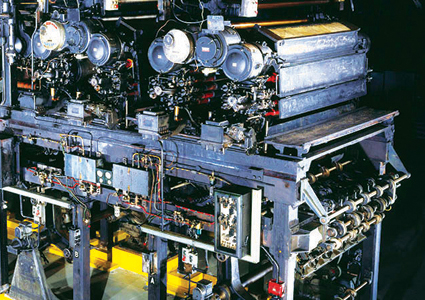
 The good old days: This printing press was built in 1934 for the “Daily Mail”; it was decommissioned in 1999 (image: Science Museum London, via Flickr)
If you want to see the future of online news and entertainment, look at the Mail and see a future neither the Mail nor its enemies want.
If Labour is not in power after the general election, you will hear many leftists blaming the Mail for their defeat. For more than a century, they say, it has pumped out thuggish attacks against every prominent liberal and leftist, and injected its particular venom—a paranoid poison—into wider debate. To its conservative readers, by contrast, the Mail is their shield against a world that would ignore their wishes, take their money and laugh at their convictions.
But it won’t be either a thug or a shield for much longer. As traditional newspaper readers die out, online journalism is the future. MailOnline is the most visited “news” site in the English-speaking world. Go there, however, and you will struggle to find the propaganda that drives the Left wild. There is no section at the top of its front page marked “opinion” or “comment” for readers who want conservative argument. Run your cursor past “News”, “Sport”, “TV & Showbiz”, “Fashion”, “Promos”, “Femail”, and—this must hurt—“Australia”, and finally at the far end of a list of 24 sections you will reach a tag marked “columnists”. Click on it and you find sports columnists, financial columnists and gossip columnists. Buried among them—like mossy tombs in a Victorian graveyard—are the remains of the right-wing pundits whose rages and laments boomed around the old newspaper.
In the past, editors knew little about what people read. Now they know precisely what readers want, and in the case of MailOnline it certainly isn’t the old left-baiting polemicists.
Publishers can measure how many people click on a piece, how long they look at it for, whether they make it past the first paragraphs, and then get bored, or stick with it to the end. They can tell where readers live and—because of their cookies in their browsers—their likely income and interests. (Have they been looking to buy a new car or maternity dress?) They use that knowledge to put customised advertisements in front of them. They can tell within minutes of publication whether an article is being retweeted, read and finished; whether, in short, it was worth publishing at all.
You would need Wilde’s heart of stone not to burst out laughing at the sight of right-wing propagandists reduced to irrelevance by the market forces they have spent their lives supporting. And if they were the only casualties of technological change, I would laugh too.
Unfortunately, there are two simple facts about online publishing which you cannot escape wherever you write or read. The only way for sites that offer free content to make money is from advertising. News sites therefore have to strain to attract hits. But even if they get the readership, and even if grateful advertisers recognise their achievement, web advertising revenue cannot compensate for lost sales and the near-monopoly control of classified advertising—for houses, jobs, cars and just about everything else—that newspapers and magazines enjoyed before it moved online.
Editors are chasing more readers for less money, and the way to make money is to attract as many readers and keep them on the site so they can soak up the ads. It doesn’t have to be lowest common denominator journalism—the Guardian is trying to become a global site for serious English-speaking readers—but most of the time it is. In America, Gawker, a tabloid site, and Forbes, a once serious business journal, are taking the logic of the new publishing economy to its obvious conclusion. They determine writers’ pay by how many unique visitors they bring in. At Gawker, managers tell trainees they will receive $5 per 1,000 unique monthly visitors—up to $6,000 maximum per month. If the hopefuls meet their targets after three months, they will allow them to stay. If they don’t, they’re out. The results are predictable. The last time I looked, the top piece on the Gawker site was: “What Happened to the Runner Who Shit [sic] Himself During a Half-Marathon?”
The system turns journalists into thieves and liars. Not the traditional journalistic frauds in the Jayson Blair/Johann Hari mould but liars who lie because lying is a corporate imperative. To get traffic, fewer and fewer news sites can afford to send out writers to find original content. So they steal from other news sites, or lift and repackage a YouTube video or Twitter exchange that may go viral.
In a confessional piece that deserved far more attention than it received, Luke O’Neil, a Boston journalist, described in Esquire how “the churn-and-burn pace of daily writing has led to my passing along some pretty sketchy nonsense”. He would steal and rebrand anything that might catch the passing reader: a preacher feeling up a waitress in an American café, a comedian who live-tweeted a break-up on an apartment roof, anything whatsoever about celebrities without checking whether the stories were true.
He wanted the traffic. His employers wanted the traffic. Without the traffic, they had no income. If checking might endanger a story, then he wouldn’t check because he knew that if he didn’t steal the story someone else would take it, rewrite it and find a headline that would draw in passing trade. “That’s the secret that Upworthy, BuzzFeed, MailOnline, ViralNova, and their dozens of knockoffs have figured out,” O’Neil concluded. “You don’t need to write any more—just write a good headline and point.”
You simply cannot describe what follows as journalism. There’s no original research and no original thought. The next logical step is for web companies to look at your preferences and interests and give you what they think you want if that is what it takes to keep you on their sites. They will customise news as they already customise advertisements. Google says that the company wants to look at your consumption of news, your search patterns, your mail and your posts, anticipate your intellectual and emotional wishes, and give you work which matches them, so that you need not read anything that would tax, unsettle or surprise you.
This is a dumbed-down future Daily Mail pundits should rail against. Except, of course, they can’t. Their editors would fire them.


- Cultural Climate Change
- Opposites meet in the land of Scrugletopia
- The American mind continues to close
- The West must restore a sense of the sacred
- Sweet singing in the choir
- Home from home for the Bolshevik elite
- A portrait of the artists as a pair of young wastrels
- The new Leviathan: Trump and the nation state
3:04 PM
12:04 PM
12:04 PM
10:03 AM
11:03 AM
4:03 PM