



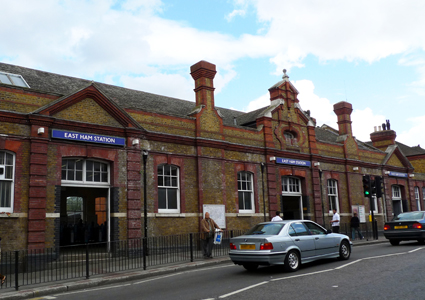
 East Ham Tube Station: An appallingly sadistic crime took place near here (photo: Ewan Munro, via Flickr)
Crime—who’s doing it, why and to whom—so consistently forms part of London’s news agenda that for many of us it barely registers. All part and parcel of the great metropolis, etc. But occasionally one reads of an incident so awful, so disturbing, that just for a moment one’s mental moorings are shaken, as though jolted from below by something menacing but unseen.
This particular case of a few weeks ago certainly wasn’t headline news and on the Richter scale was just a tremor, but it hovered in my mind for days. At around 11 o’clock on a Saturday night in East Ham, a fortysomething man was approached outside the Tube station by two younger men, who asked him for cigarettes. When he replied that he didn’t have any, they attacked him, punching him and stealing his backpack, ID card and bankcard. They then frog-marched him to a cashpoint to force him to take money out.
When he couldn’t, they attacked him a second time. They then dragged him to a nearby park, where they beat him with a metal pole. They then forced him to perform a sex act on them. This they filmed.
The man was eventually released from his ordeal when somebody heard his cries for help and called the police. Nevertheless, 11pm on a Saturday is not exactly the dead of night, so much of this must still have happened in full view of passers-by who (to be charitable) might have been too afraid of getting involved. The brazenness of the two men suggest they fully understood this collective fear, which of course is bad enough. But it was the randomness of the attack, its prolonged nature and the sheer humiliation they then wanted to heap on this poor man, presumably a total stranger, which was so chilling.
As I said, this is far from being an epoch-defining incident. The case of the Central Park jogger in New York in 1989 was one such, in which the horrendous beating and raping of a young professional woman who was left for dead became emblematic of a city seemingly spiralling out of control—and which ushered in the zero-tolerance era of Rudy Giuliani. If we are to believe the statistics (and many increasingly don’t), crime in London has fallen; certainly there are fewer knife killings then five years ago.
The 2011 riots might well have been the capital’s biggest one-off crime wave in generations, but memories of them have faded remarkably quickly. Nobody, it seems, is waiting to declare this or that case as the last straw; the situation doesn’t appear bad enough to warrant it.
What is so unsettling about incidents such as the East Ham one is the way in which they display a form of pure sadism, in which the desire to hurt and degrade appears to stand alone from the ostensible point of the crime (in this case robbery). However, other than regret at the inaction of others and shock at the absence of anything even approaching a moral compass on the part of the perpetrators, what is most notable about such cases is our own reaction. We recoil, but then don’t consider the details for too long. We go back to our lives, accepting such incidents as the downside of a city life which has so many upsides.
It’s certainly not enough to make us say, “That’s it—there’s something rotten in the state of London. I’ve had it with this place, I’ll up sticks.”
The prevalence or not of crime is traditionally put forward as a deciding factor in the desirability of an area—the so-called quality of life it affords. And it is certainly meant to affect house prices. But for a great number of us, it seems, levels of crime are just a factor on a pros-and-cons sheet of where we choose to live.
Some bright sparks at Cambridge recently produced research which showed just that. A sample of 56,000 Londoners concluded that people tend to cluster together in areas that suit their “personality types”, regardless of levels of crime or income. Those who see themselves as “open to new experiences” tend towards certain more central areas, those who want a more conventional existence are to be found further out.
No surprises there, you might say. Also, it’s fair to say that young people are generally less shocked and destabilised by crime than their elders, and London is increasingly a young person’s city, at least in aspiration and preoccupation, if not materially.
But it did make me wonder about my own choices. I’m not sure whether crime in my part of south-east London is less or more than the London average. And the fact that I’m not sure says it all. I might have moments of appalled shock, but that is what they are—moments.
But then a greater truth dawns—I am single, and I have no children. And when it comes to weighing up crime against openness to new experiences, children change everything.


- The Loss Of Faith Made Music Mute
- The Great Betrayal: How Liberals Appease Islam
- Political Correctness Is Devouring Itself
- The New Language Of Political Narcissism
- Why The World Still Loves Shakespeare
- Don’t Listen to Britain’s Designer Demagogues
- Who's in Charge of BBC News?
- An English parliament: the only way to save the UK
- The Loss Of Faith Made Music Mute
- The Great Betrayal: How Liberals Appease Islam
- Political Correctness Is Devouring Itself
- The New Language Of Political Narcissism
- Why The World Still Loves Shakespeare
- Don’t Listen to Britain’s Designer Demagogues
- Who's in Charge of BBC News?
- An English parliament: the only way to save the UK
- The Loss Of Faith Made Music Mute
- The Great Betrayal: How Liberals Appease Islam
- Why The World Still Loves Shakespeare
- Who Will Lead The Berlin Band?
- Putin and the Art of Political Fantasy
- Political Correctness Is Devouring Itself
- The New Language Of Political Narcissism
- Inside The World Of 'Non-Violent' Islamism
7:03 AM