


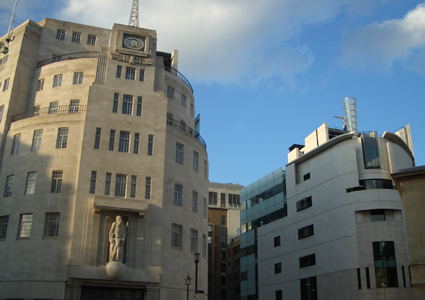
 Double standard: The BBC's bias could be seen in the contrast between interviews with party leaders (photo: Dave Smith, via Flickr)
For as long as I can remember Tories have been grumbling about the bias shown against them and their causes by the BBC. In the 1980s Norman Tebbit often laid into the Corporation; he was particularly upset at what he regarded as its unpatriotic coverage of the Falklands War. Many in the Conservative Party felt Michael Howard was unjustly vilified by the BBC during the 2005 election campaign for expressing misgivings about mass immigration that have since become commonplace. In the years following the creation of the Coalition in 2010, several Tory ministers believed they were getting a rough ride from the BBC, though for the most part their complaints remained private. Even David Cameron was said to be intermittently furious at what he regarded as unfair treatment from Auntie.
After the stunning election victory on May 7 these deeply felt frustrations, so long held in check, may well boil over. It so happens that the future of the BBC is on the political agenda because of next year’s decennial charter review. And the Tories, no longer inhibited by pusillanimous Lib Dems, and at last in a position to follow their own instincts, believe with some justice that they weren’t dealt with even-handedly during the election campaign. Grievances include coverage skewed in favour of Labour on the BBC’s news website, and Andrew Marr’s coruscating interview of Mr Cameron, whom he interrupted some 23 times, and wrongly accused of having written that fox-hunting was his “favourite” sport. (Ed Miliband, by contrast, was treated much more indulgently when interviewed by Marr, who in his days as a newspaper columnist happens to have been a strong Labour supporter.) Some Tories also resent the BBC’s invariable assumption on all its news programmes that a hung parliament was the only feasible outcome of the election.
These gripes might still die away. Indeed, the commentariat, which got the result so wrong (I do not exempt myself), takes it for granted that the political sound and fury over the next five years will be generated by the European Union, Scotland, the Human Rights Act and welfare cuts. These are doubtless highly contentious issues, but mightn’t the BBC also be explosive? I ask because if David Cameron had scoured the wide world to find someone who disapproved of the Corporation, he could scarcely have found a fiercer critic than John Whittingdale, a former private secretary to Margaret Thatcher, who has been unexpectedly plucked from the back benches and his role as chairman of the Commons Culture Committee, and made Secretary of State for Culture, Media and Sport. His appointment didn’t go down well with some anti-Tory numbskull in the BBC press office, who retweeted a message highlighting Mr Whittingdale’s opposition to gay marriage and his support for foxhunting. This was hurriedly deleted.
Of course, once the bitter memories of the campaign have faded, Mr Cameron’s enthusiasm for shaking up the BBC might falter. He is not one of nature’s radicals, after all. But the choice of Mr Whittingdale must tell us something. Only last October the Thatcherite veteran questioned the long-term future of the annual £145.50 licence fee, suggesting it was “worse than a poll tax”. His Commons committee produced a report on the BBC’s future three months ago which warned that the licence fee is “becoming harder and harder to justify”.
Isn’t it obvious to everyone save myopic BBC employees and narrow-minded Guardianistas that in the new media world the Corporation and its antiquated funding arrangements stand in need of reform? I don’t doubt it retains some strengths. It is one of the few national institutions that remind us we are British, which may explain why it has got up the noses of the Scottish National Party. And despite much dumbing down it still has pockets of excellence, some which might struggle in an entirely commercial environment. Its virtues should be defended. But the BBC as an entity has become too powerful as an arbiter of cultural values and too dominant as a source of news.


- The Coalition We Need To Defeat Islamism
- Are We Losing The War On Home-Grown Terror?
- Cameron Gave Libyans A Chance. Pity They Blew It
- Brexit Will Give Global Free Trade A Boost
- The Real EU Referendum Winner May Surprise You
- Is Theresa May The True Heir To Mrs Thatcher?
- Race To The White House Through The Looking-Glass
- Brexit Gives Us A Historic Opportunity
- American Conservatives Must Stand Up To Trump
- Cicero's Analysis Of Decline Offers Lessons For The West
- Deepdene: Rise and Fall of the House of Hope
- Debunking the EU Referendum Myths
- Britain's Opportunity Is Europe's Warning
- Controlling Immigration Is Good For Democracy
- The Pied Piper of Islington
- The West Cannot Afford To Ditch Nato
- End Of History — Or Clash Of Civilisations?
- We Can Defeat Islamist Terror — But Not On Our Own
- Without the Emperor, What is Left of Old Japan?
- Now Or Never

8:06 AM