


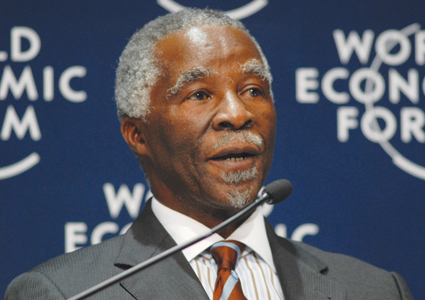
 Thabo Mbeki: His government did much to incite the international anti-Israel campaign (photo: World Economic Forum)
The President of the Student Representative Council at Wits University, Johannesburg, Mcebo Dlamini, recently declared that he “loves Adolf Hitler”. After all, he said, there are some white people who still admire Cecil Rhodes today so why should he not admire Hitler? “Hitler was a great leader even if he had faults. I love him for his charisma, his strong leadership, his organising ability. Whites are making out that the Jewish Holocaust was worse than the black holocaust in South Africa, which shows that every white has an element of Hitler in him. But Hitler was no worse than other great villains of history such as Napoleon, Tony Blair and George W. Bush.”
Simultaneously, the SRC President at the Durban University of Technology, Mqondisi Duma, demanded the expulsion from the university of all Jews who do not publicly declare their loyalty to the Palestinian cause. Duma doubtless knew that although many Jews are willing to criticise the Netanyahu government, only a rather freakish fringe are willing to side publicly against their confreres in Israel so that in effect he was demanding that the campus be cleared of nine Jews out of every ten.
Yet not many years ago Nelson Mandela happily accepted an honorary doctorate from Ben Gurion University at Beersheva and dwelt admiringly on the fact that BGU is a world leader in combating desertification, in water purification and in assisting agriculture in harsh conditions — and that it was making all this expertise available to South Africa. Moreover, Mandela never tired of praising South African Jews for having sided against apartheid and provided so many members of the Progressive, Liberal and Communist parties. Yet Israel now lists South Africa as a country where the Jewish community is under major threat and strongly recommends that the entire community here leave for Israel as soon as possible. So how has it come to this?
The short answer is that 40 per cent unemployment and the evident failure of the ANC government has engendered a bitter, indeed toxic mood among militant black youth. They are looking round for targets. First there was the Rhodes Must Fall campaign. Then the streets erupted into murderous xenophobia against immigrant workers. Now a new target is needed. Historically, it has never been long before people in such a mood alight upon the Jews.
But there is a longer answer too. Thabo Mbeki, who became president in 1999, suffered badly from paranoia and a grandiosity complex. He wanted to be president not just of South Africa but of all Africa and even of the whole Third World. Thus he pumped life and money into the long-defunct Non-Aligned Movement so that he could preside over it. And like so many who have spent their life in the struggle, he wanted the struggle to go on. If Africa’s liberation was now complete, where else should the struggle move ? Obviously, to Israel — another mainly white implant in the Third World. And by foregrounding the Palestinians and grandstanding about them Mbeki could hope to win the support of Muslim nations for his leadership of the Third World.
So endless Mbeki cabinet conferences were devoted to the Arab-Israeli problem. This was done under the public pretence that South Africa, “the miracle nation”, would take its peace-making skills to Israel and help bring about a full settlement there at last. This was regarded both by local Jews and Israelis with complete bemusement. After all, Mbeki’s meetings included extensive representation of Palestinian groups but only a few far-left Jews were invited. Officially, Israel said nothing but made it clear privately that since the ANC wanted to see a “liberated” Israel under Hamas rule, any idea of mediation was simply laughable.
Mbeki knew that, of course, and his real objective was not mediation at all but to carry out the groundwork for an international anti-Israel campaign closely modelled on the old anti-apartheid model, with mounting pressure for boycotts, disinvestment and sanctions. The ANC was still well connected to the old international anti-apartheid network and was able to use this array of generally left-wing organisations to popularise the new cause. The result has been the mushrooming growth of the Boycott, Divestment and Sanctions (BDS) movement.
The first fruit of this campaign was seen at Unesco’s World Conference Against Racism in Durban in 2001. The ANC had always had particularly strong networks within UN agencies — during the struggle period it had been able to get the UN General Assembly to set up a Special Committee on Apartheid and to vote through a resolution denouncing apartheid as a “crime against humanity”. This latter was pushed through by the Soviet and Afro-Asian blocs despite the strong opposition of Western nations, which argued that the “crime against humanity” category referred to atrocities such as the Holocaust and the Armenian genocide and that, appalling as apartheid might be, it was certainly not genocidal: South Africa’s black population soared under apartheid and millions of other Africans poured into the country looking for work.
The Durban conference quickly turned into a festival of anti-Israeli feeling. At the parallel NGO conference Israeli delegates agreed to allow all manner of anti-Israel motions provided that a motion was also passed condemning anti-Semitism. This was refused and Israel, the US and Canada walked out. Washington was furious that a major UN conference had been so one-sided and blamed the conference chair, Mary Robinson, the UN High Commissioner for Human Rights, who, in the conference’s preparatory stages, had already shown her colours by adopting Muslim dress and agreeing to the exclusion of such distinguished human rights organisations as the Simon Wiesenthal Centre.
Within South Africa the Communist Party has controlled BDS from the first, using it to give it an entrée into the large Muslim, Indian and Coloured minorities which are otherwise in danger of leaving the ANC-SACP fold. South Africa’s BDS has adopted a tribal approach, targeting the local Jewish community rather than Israel, and trying to enforce sanctions against any local Jews who do not declare for the Palestinian cause. Its favoured target has been the Woolworths chain of supermarkets, allegedly because it sells Israeli goods. The store retorts that such goods account for less than 1 per cent of its sales, that all goods are clearly marked by country of origin, allowing customers to choose, and that the company complies with all government trade laws. But the real point for BDS is that the Susman family, which controls Woolworths, is related both by marriage and commercially to Marks and Spencer in the UK — a company which has always strongly sympathised with the Zionist cause. BDS has aggressively picketed Woolworths stores, hassling customers until prevented by court order.
The BDS campaign then switched its focus to Jewish shops and moved the action to university campuses — where the SACP, via its Young Communist League, is influential. Some may see this, of course, as merely a sub-species of the more general anti-white racism which is now prevalent in South Africa. Predictably enough, as the failure of the ANC government becomes more palpable in one area after another, the rage of the younger generation — deprived of jobs and of hope — grows. This is altogether different from anything they were promised by Mandela. In fact, opinion polls in the past have often shown a distinct layer of black anti-Semitism, the result of the formidable influence of fundamentalist Christian sects (the Jews killed Jesus, etc), but it is doubtful if South Africa’s 70,000 Jews are a sufficiently large group to attract prolonged hostility — unless it is very deliberately stirred and stoked.
The first fruit of this campaign was seen at Unesco’s World Conference Against Racism in Durban in 2001. The ANC had always had particularly strong networks within UN agencies — during the struggle period it had been able to get the UN General Assembly to set up a Special Committee on Apartheid and to vote through a resolution denouncing apartheid as a “crime against humanity”. This latter was pushed through by the Soviet and Afro-Asian blocs despite the strong opposition of Western nations, which argued that the “crime against humanity” category referred to atrocities such as the Holocaust and the Armenian genocide and that, appalling as apartheid might be, it was certainly not genocidal: South Africa’s black population soared under apartheid and millions of other Africans poured into the country looking for work.
The Durban conference quickly turned into a festival of anti-Israeli feeling. At the parallel NGO conference Israeli delegates agreed to allow all manner of anti-Israel motions provided that a motion was also passed condemning anti-Semitism. This was refused and Israel, the US and Canada walked out. Washington was furious that a major UN conference had been so one-sided and blamed the conference chair, Mary Robinson, the UN High Commissioner for Human Rights, who, in the conference’s preparatory stages, had already shown her colours by adopting Muslim dress and agreeing to the exclusion of such distinguished human rights organisations as the Simon Wiesenthal Centre.
Within South Africa the Communist Party has controlled BDS from the first, using it to give it an entrée into the large Muslim, Indian and Coloured minorities which are otherwise in danger of leaving the ANC-SACP fold. South Africa’s BDS has adopted a tribal approach, targeting the local Jewish community rather than Israel, and trying to enforce sanctions against any local Jews who do not declare for the Palestinian cause. Its favoured target has been the Woolworths chain of supermarkets, allegedly because it sells Israeli goods. The store retorts that such goods account for less than 1 per cent of its sales, that all goods are clearly marked by country of origin, allowing customers to choose, and that the company complies with all government trade laws. But the real point for BDS is that the Susman family, which controls Woolworths, is related both by marriage and commercially to Marks and Spencer in the UK — a company which has always strongly sympathised with the Zionist cause. BDS has aggressively picketed Woolworths stores, hassling customers until prevented by court order.
The BDS campaign then switched its focus to Jewish shops and moved the action to university campuses — where the SACP, via its Young Communist League, is influential. Some may see this, of course, as merely a sub-species of the more general anti-white racism which is now prevalent in South Africa. Predictably enough, as the failure of the ANC government becomes more palpable in one area after another, the rage of the younger generation — deprived of jobs and of hope — grows. This is altogether different from anything they were promised by Mandela. In fact, opinion polls in the past have often shown a distinct layer of black anti-Semitism, the result of the formidable influence of fundamentalist Christian sects (the Jews killed Jesus, etc), but it is doubtful if South Africa’s 70,000 Jews are a sufficiently large group to attract prolonged hostility — unless it is very deliberately stirred and stoked.
But stoked it has been since the leader of the SACP, Blade Nzimande, was denied a visa to visit Palestine in April by the Israeli government. Israel justified the denial by saying that Nzimande had repeatedly demanded the expulsion of the Israeli ambassador from South Africa and that he had actively supported the severance of relations between the University of Johannesburg and BGU. Nzimande has a considerable sense of self-importance and he returned home with a burning determination to hit back.
The immediate result was a meeting of the ANC, Cosatu (the Congress of South African Trade Unions), the SACP and BDS (with the SACP in a majority in at least three of these groupings) which called for the expulsion of the Israeli ambassador, a ban on travel to Israel by any public employee, an end to automatic visas for Israeli visitors and all such visitors to be interrogated as to their links with the Israeli Defence Force, the prosecution of any South African Jews who serve in the IDF, and the expropriation of any Israeli investments in South African agriculture. This would be tantamount not only to a breach in official relations with Israel but to a ban on Israeli tourists, for almost all of them will have had some connection with the IDF. Given that there has always been an easy flow of people between South Africa and Israel, this would also amount to punishing South African Jews who would like to invite their Israeli cousins to visit them. The events at Wits and DUT have followed this script, with the student leadership signing on to the whole list of demands above.
This represents a new low, even for the SACP. Under Nzimande it has become almost completely rudderless and opportunistic. Having previously advocated the nationalisation of industry, it reversed itself once Julius Malema’s Economic Freedom Fighters took up the same call. It has taken a hyper-militant position in defence of every blunder or indiscretion by President Jacob Zuma, even staging demonstrations in favour of his use of state funds on his palatial residence at Nkandla which it attempted to depict as “rural development”. The party’s May Day statement again calls for “the defence of workers’ democracy” — yet it sided against union leader Zwelinzima Vavi’s denunciation of the “predatory elite” and firmly refused Vavi’s procedurally correct call for a special trade union congress to discuss the issue. But in pushing its BDS front organisation to target quite openly the local Jewish community, it has plumbed new depths.
The SACP’s current antics would have been anathema to the party’s previous generation, whose leadership was largely Jewish, just as today’s ANC would be an object of shame for the likes of Albert Luthuli or Mandela. Why is the SACP behaving in this disgraceful way ? The short answer is political desperation. The party has depended on Cosatu for its funding and even for its premises. Now, not only has the party failed to pay its rent but Cosatu has split, is much weaker — and can less afford the luxury of propping up the SACP. Worse still, Malema has walked off with most of the party’s natural constituency. The result is curious. Instead of rotting like a fish from the head down, the party has crumbled from the bottom up and is now left only with its top layer of leaders (including many MPs and government ministers). Many of these leaders have become fully-fledged members of the predatory elite and, whatever they may say, their behaviour suggests that their relationship to socialist values is tenuous at best. It is a strange way of dying. But death comes to us all. Disgrace need not.
The immediate result was a meeting of the ANC, Cosatu (the Congress of South African Trade Unions), the SACP and BDS (with the SACP in a majority in at least three of these groupings) which called for the expulsion of the Israeli ambassador, a ban on travel to Israel by any public employee, an end to automatic visas for Israeli visitors and all such visitors to be interrogated as to their links with the Israeli Defence Force, the prosecution of any South African Jews who serve in the IDF, and the expropriation of any Israeli investments in South African agriculture. This would be tantamount not only to a breach in official relations with Israel but to a ban on Israeli tourists, for almost all of them will have had some connection with the IDF. Given that there has always been an easy flow of people between South Africa and Israel, this would also amount to punishing South African Jews who would like to invite their Israeli cousins to visit them. The events at Wits and DUT have followed this script, with the student leadership signing on to the whole list of demands above.
This represents a new low, even for the SACP. Under Nzimande it has become almost completely rudderless and opportunistic. Having previously advocated the nationalisation of industry, it reversed itself once Julius Malema’s Economic Freedom Fighters took up the same call. It has taken a hyper-militant position in defence of every blunder or indiscretion by President Jacob Zuma, even staging demonstrations in favour of his use of state funds on his palatial residence at Nkandla which it attempted to depict as “rural development”. The party’s May Day statement again calls for “the defence of workers’ democracy” — yet it sided against union leader Zwelinzima Vavi’s denunciation of the “predatory elite” and firmly refused Vavi’s procedurally correct call for a special trade union congress to discuss the issue. But in pushing its BDS front organisation to target quite openly the local Jewish community, it has plumbed new depths.
The SACP’s current antics would have been anathema to the party’s previous generation, whose leadership was largely Jewish, just as today’s ANC would be an object of shame for the likes of Albert Luthuli or Mandela. Why is the SACP behaving in this disgraceful way ? The short answer is political desperation. The party has depended on Cosatu for its funding and even for its premises. Now, not only has the party failed to pay its rent but Cosatu has split, is much weaker — and can less afford the luxury of propping up the SACP. Worse still, Malema has walked off with most of the party’s natural constituency. The result is curious. Instead of rotting like a fish from the head down, the party has crumbled from the bottom up and is now left only with its top layer of leaders (including many MPs and government ministers). Many of these leaders have become fully-fledged members of the predatory elite and, whatever they may say, their behaviour suggests that their relationship to socialist values is tenuous at best. It is a strange way of dying. But death comes to us all. Disgrace need not.
Like this article? Share, save or print using the icons below:


More Dispatches
- Beirut: Hariri — An Assassination Too Far
- New York: A ‘Post-racial’ American vs an Old Coot
- Pristina: Kosovo's Liberal Islam
- Oslo: Courage and Cowardice in Scandinavia
- ONLINE ONLY: Washington, D.C.: It's Not Rocket Science!
- La Hague: Recycling the French Model
- Jerusalem: No Via Media for Anglicans
- ONLINE ONLY: Beirut: Blood Holiday
- Rome: Arrivederci Roma
- Darfur: Panic at the Palace
- ONLINE ONLY: Letter from Bamian
- Caucasus: Diary, August-September, 2008
- ONLINE ONLY: South-East Asia: The Demons of Ignorance
- New York: Diary
- Ypres: Never Say Never Again
- New York: A Cousin in the White House
- Caracas: Chávez's Secret Fan Club
- Prague: Diary
- Park City, Utah: Movie that Pulls Aside the Veil
- Beirut: Blood on the Streets
- India: Tariq Ali's Plan for Pakistan
- Berlin and Cologne: A Tale of Two German Cities
- Mumbai: On the 'Slumdog' Trail
- Budapest: Screwed Left, Right and Centre
- Paris: Mayhem in the Marais
- Stanford, CA: Intellectual Life Under Obama
- Colombia: A Nation Reborn
- Paris: Prisoner of the Barbarians
- United States: The Path to Rome via San Francisco
- ONLINE ONLY: Black Russian
- South Africa: The ANC'S Health Lesson for Obama
- Lisieux, France: Relics of Thérèse
- Germany: Heidegger - Being, Time and Place
- Moscow: Putin's Empire Strikes Out
- Connecticut: My Battle Against Google
- Montana: Home From Home on the Range
- Siberia: In Search of the Gulag
- Rio's Heart of Darkness
- Mogadishu: Armageddon on Steroids
- Havana: The Castros Will Not Be Absolved
- Kaliningrad: Russia's Outpost in Europe's Heart
- Bishkek: Bloodsoaked Revolution
- Bishkek: Downfall of a Dictator
- Oslo: Signing OFF on Human Rights
- Bajaur: A Talk with the Taliban
- Bahrain: Women Drivers Welcome Here
- Tajikistan: In Search of the Yeti
- ONLINE Only: Ankara's Proxy
- Johannesburg: Hard Pressed
- Istanbul: Press Freedom Alla Turca
- Xinjiang: Taming China's Wild West
- The Lesson of Oz
- The Surge is Working — So Far
- A Tale of Love, Bulls and Goats
- Old-order Collapse
- Egypt's New Dawn Chorus
- From Carthage to Kasserine
- After Gaddafi: A New Libya Emerges
- To the Polo Saddle Born
- The Settlements: Life Between the Lines
- Exposed: Carnita's Cover Story
- "At last, I feel proud to be Libyan"
- Books Do Furnish a Little Freedom
- Fat Chance for Christie—This Time
- Easy Lies the Head that Wears the Crown
- Putin's Chinese Whispers
- Cain Isn't Able and Newt Defies Gravity
- The Ten Years' War against the Taliban
- We The People Say: Get Out of The Way
- Wanted: A New Ronald Reagan
- Time to Crunch the Numbers
- Who's Really Supreme?
- From Art as Life to Blood and Soil
- Talking Tactics
- The Wagner Family Soap Opera Rolls On
- Winning the Veepstakes
- Romney Takes a Risk with Ryan
- Window Brothels Get the Red Light
- Can Romney Spring an October surprise?
- Canada's Crusader for Conservatism
- No-Go Areas on the Campaign Trail
- Republicans Must Avoid Civil War
- Norway's Problem with Anti-Semitism
- Turks, Arabs and Jews: The Middle East in Crisis
- Nations United in Hypocrisy
- Siberia: Shamans, Spies and the Secret Police
- Barracked by Obama's Oratory
- Women Come Last in Syrian Refugee Camps
- The Dawn of Obamageddon
- Americans Know Her True Worth. Do We?
- Hapless Hollande’s French Farce Flops
- Save the NYPD So It Can Save the City
- Obama's Secrets Start Unravelling
- Syria Isn't Bosnia: Don't Arm the Rebels
- Who Can Stop Hilary in 2016?
- Teaching China's Anglophiles
- On Pilgrimage with the Hasids
- From Eastern Europe to the East End
- True Grits
- The Rise and Rise of Marine Le Pen
- Cold Comfort On Global Warming
- Hunting the Lynx with the Old Believers
- High-tech Israelis Aim For The Moon
- The Russians Are Coming
- The Turbulent Minister is Right
- Bad Times for Good Samaritans
- This Expat Paradise is a Woman’s Nightmare
- Two Generations Lost to Communism
- Strangers in their own Holy Land
- The Isles are Full of Big Noises
- The Kurds: Israel's not so Improbable Allies
- Islam and Innocence: Canada’s Predicament
- The Fifth Republic’s Darkest Days?
- Let's Make Putin's London Cronies Sweat
- The Global Politics Of Netanyahu's Victory
- A Grim Prospect For South Africa's Jews
- No End In Sight To The Exodus From Libya
- Undeterred, Erdogan Usurps Ataturk's Legacy
- Gaza Withdrawal Symptoms
- Red Flags Flying Over Parliament Square
- Mutinous Talk In The Highlands
- Our Principles Are All We Have
- Why The Swedes Have Had Enough
- Canada's First Nations Come Last
- Islam and the French Republic
- Unconventional Convention
- The Dying Days Of Zuma's South Africa
- I'm Not Antisemitic, But...
- The ELM, Dispatches and Awlaki
- A Larger Than Life Predator
Popular Standpoint topics

- Cultural Climate Change
- Opposites meet in the land of Scrugletopia
- The Battle Against The Philistines Never Ceases
- Home from home for the Bolshevik elite
- Can Macron Save France — Or Is He Its Undertaker?
- How The EU Elite Paved The Way For Populism
- Why France Is Revolting Against The Ancien Regime
- A Decent Woman Betrayed By Her Gruesome Twosome
4:10 PM
9:06 AM
6:06 PM
2:06 PM
2:06 PM
5:05 PM
6:05 PM