


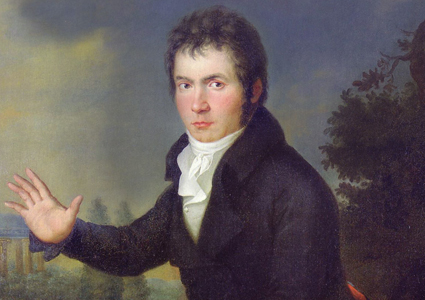
 The young Beethoven in 1804, around the time he composed the “Eroica”: His nine symphonies are still seen as the pinnacle of artistic achievement in music
A few days after the première of my Fourth Symphony at the BBC Proms in the Royal Albert Hall I was given an advanced copy of Lewis Lockwood’s new book Beethoven’s Symphonies: An Artistic Vision (W.W. Norton, £20). My purpose here is not to review the book but to flag up just how vital it turned out to be in my ongoing obsession with the idea of the symphony, past, present and future.
Lewis Lockwood is regarded as one of the major Beethoven scholars and is presently the Peabody Professor of Music Emeritus at the University of Harvard. The bulk of his new book introduces each of the composer’s nine symphonies, all individual and different in their magisterial genius, and paints a vivid picture of the creative context of each. Lockwood recalls much of the political and social upheavals of the time, ranging from revolution and war to the development of European concert life.
Beethoven’s symphonies have come to be seen as the pinnacle of artistic achievement in music. The distinguished art historian Alessandra Comini described Beethoven’s music as having “revelatory dimensions”. The composer himself described his work as a divine art, and Lockwood points out that Beethoven regarded his symphonies as “not merely products of high craftsmanship, but . . . expressions of a moral vision, a deeply rooted belief that great music can move the world”.
The composer saw his life and work as a mission and a vocation, as many artists have done in centuries and generations gone by. The fact that the modern, and now post-modern, world with all its pessimism and scepticism, has nothing convincing to contradict this assessment of the high-minded inspiration behind Beethoven’s greatness points to the unique unassailability of the composer’s achievements and eternal reputation.
The idea of the symphony has had its bar set extremely high by Beethoven and he has inspired the most ambitious composers in the two centuries since. His influence can be detected in all the major composers in the genre, from his immediate contemporaries like Schubert and then through the decades — Mendelssohn, Schumann, Brahms, Bruckner and Mahler. Even the ones who self-consciously and deliberately turned away from prevailing traditional formal patterns towards programme music and the symphonic poem display the mark of the master — Berlioz, Liszt and Richard Strauss. Wagner’s transformation of opera into “music-drama” shows the impact of a lifetime’s study of Beethoven’s instrumental music, and in particular his Ninth Symphony. Lockwood reminds us that “Wagner grew up in the 1830s under Beethoven’s spell, as he openly confessed.”
Like this article? Share, save or print using the icons below:


4:10 PM
10:09 PM
4:09 PM