



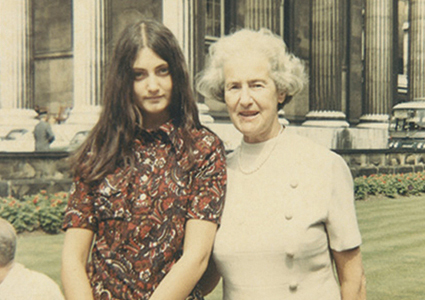
 Dina Gold, with her grandmother: Their family’s quest for compensation required luck as well as determination (photo ©Dina Gold)
If monuments, special museums, educational schemes and annual ceremonies were sufficient to ensure adequate memorialisation of the Holocaust, understanding of its history and a measure of justice for the victims, there would be grounds for solid satisfaction. The existence of several high-profile commemorative initiatives in Britain owes much to Professor David Cesarani. He also played a leading international role as a public intellectual in efforts to promote Holocaust education. He rightly attracted much appreciative comment after his premature death last October.
Unfortunately, the situation is less than satisfactory in at least two ways. Here too Cesarani’s role needs to be noted. First, Holocaust survivors have tended to be marginalised and disrespected — useful as speakers to school groups or as potential financial contributors but for little else. With exceptions such as Sir Martin Gilbert, career historians have often belittled and even resented eye-witnesses to the Jewish tragedy. Some of the most contemptuous have been Jewish historians, Cesarani among them.
Obviously, personal memories are not always reliable. But neither are documents, especially if many have been lost so that it is not always possible to assess the meaning and relevance of the ones which remain. Professional historians must be prepared to use a whole variety of sources. Their frequent reluctance to engage in detail with survivors has reflected a guild mentality. I remember all too vividly the authoritarian manner in which a number of well-known Jewish historians, including Cesarani, put down Hungarian survivors when they challenged the speculative, arguably biased interpretation given by a prominent Israeli historian of Rudolf Kastner’s controversial deal in 1944 with Adolf Eichmann. It happened at a meeting organised by Cesarani, then the young director of the Wiener Library in London, to mark the 50th anniversary of the Hungarian deportations. The failure of many historians to engage in sufficient depth with survivors has meant the loss of potentially invaluable sources of information and understanding.
Second, a prevailing academic interpretation of the causes of the Holocaust has come to pay excessive attention to convenient theses by such German scholars such as Hans Mommsen, who promoted the view of the Holocaust as (in Cesarani’s words) “cock-up” and without significant historical roots.
In Final Solution: The Fate of the Jews 1933-49 (Macmillan, £30), Cesarani’s posthumously published 1,056-page book, he provides a digest and interpretation of recent research into the Holocaust. It will be widely welcomed as a work that demonstrates the author’s detailed knowledge of the recent output of academic colleagues and, as he acknowledges, the resources of three major Holocaust libraries: the US Holocaust Memorial Museum in Washington, Yad Vashem in Jerusalem, and the Wiener Library. Whether it will be seen as a masterly synthesis or as a work of lesser significance remains to be seen. In the immediate aftermath of his early death, it is hard to make a dispassionate judgment.
Obviously, personal memories are not always reliable. But neither are documents, especially if many have been lost so that it is not always possible to assess the meaning and relevance of the ones which remain. Professional historians must be prepared to use a whole variety of sources. Their frequent reluctance to engage in detail with survivors has reflected a guild mentality. I remember all too vividly the authoritarian manner in which a number of well-known Jewish historians, including Cesarani, put down Hungarian survivors when they challenged the speculative, arguably biased interpretation given by a prominent Israeli historian of Rudolf Kastner’s controversial deal in 1944 with Adolf Eichmann. It happened at a meeting organised by Cesarani, then the young director of the Wiener Library in London, to mark the 50th anniversary of the Hungarian deportations. The failure of many historians to engage in sufficient depth with survivors has meant the loss of potentially invaluable sources of information and understanding.
Second, a prevailing academic interpretation of the causes of the Holocaust has come to pay excessive attention to convenient theses by such German scholars such as Hans Mommsen, who promoted the view of the Holocaust as (in Cesarani’s words) “cock-up” and without significant historical roots.
In Final Solution: The Fate of the Jews 1933-49 (Macmillan, £30), Cesarani’s posthumously published 1,056-page book, he provides a digest and interpretation of recent research into the Holocaust. It will be widely welcomed as a work that demonstrates the author’s detailed knowledge of the recent output of academic colleagues and, as he acknowledges, the resources of three major Holocaust libraries: the US Holocaust Memorial Museum in Washington, Yad Vashem in Jerusalem, and the Wiener Library. Whether it will be seen as a masterly synthesis or as a work of lesser significance remains to be seen. In the immediate aftermath of his early death, it is hard to make a dispassionate judgment.
Like this article? Share, save or print using the icons below:


More Features
- Euphoric Labour won’t win power led by a pied piper
- Don’t be ‘difficult’ — try ‘formidable’, Mrs May
- Enough is enough of terror — but also of our self-doubt
- Iraq’s Christians pray for help that never comes
- The Atlantic alliance may be broken beyond repair
- Catholic tastes: both English and European
- Brexit as myth: Exodus, Reckoning, or Sacrifice?
- A Decent Woman Betrayed By Her Gruesome Twosome
- Can Macron Save France — Or Is He Its Undertaker?
- Europe's Revival Is At Hand, Thanks To Brexit
- Is This The Most Important British General Election Since 1979?
- The New Europe Must Be About More Than Money
- Our Best Brexit Policy Is All-Out Free Trade
- The Bursting Of Our 'Kabubble' Fantasies
- Gambling On A Greater More Gracious Britain
- Xi Versus Trump: The Emperor And The Tycoon
- Can Trump Square The Circle On Fiscal Reform?
- Donald Trump And The Dividing Of America
- Theresa May Emerges From Thatcher's Shadow
- Not Tweets And Anger But Redoubled Vigilance
Popular Standpoint topics

- Time To Revisit The Two Cultures
- Opposites meet in the land of Scrugletopia
- The Battle Against The Philistines Never Ceases
- How The EU Elite Paved The Way For Populism
- Anything Dennett Can Do, Scruton Does Meta
- Why France Is Revolting Against The Ancien Regime
- Can Macron Save France — Or Is He Its Undertaker?
- A Decent Woman Betrayed By Her Gruesome Twosome
4:02 PM