



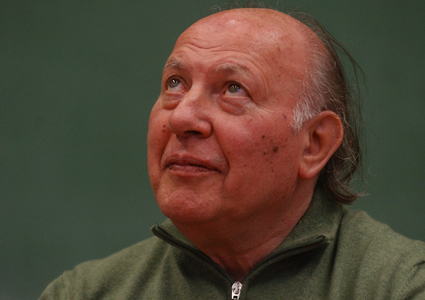
Imre Kertész: A bit of a lark, then the horror of Auschwitz (Csaba Segesvári CC BY-SA 3.0)
Imre Kertész is dead. Another door has closed. Kertész, the only Hungarian ever to win the Nobel Prize for Literature, was a survivor of Auschwitz, Buchenwald and subsequently decades of Communist rule in his native country. There was a very special reason why I so wanted to meet him. It was not to be. The Hungarian author was 86 years old when he died in March.
I felt it more urgent to fix an interview with the 96-year-old Lord Weidenfeld to ask him some frankly awkward questions about his dealings in the early 1950s with the notorious SS Sturmbannführer Wilhelm Hoettl, whose potted autobiography he published. But Weidenfeld too died this year, before we could meet again. In a much earlier conversation, I had felt it impolitic to raise my doubts but wished to give him a chance to address them before the curtain of death descended. Hoettl was in Budapest at the time of Kertész’s deportation from the city at the end of June 1944. Hoettl had been the Nazi intelligence officer responsible for south-east Europe. His memorandum of March 11, 1944, was the immediate reason why the following day Hitler signed the order for Operation Margaretha I, the “restricted occupation” of Hungary. A week later, Adolf Eichmann was in Budapest. In less than four months more than 430,000 Jews had been deported, almost all of them to Auschwitz. Yet documents declassified by the CIA show that Hoettl in 1944 was already in touch with Allen Dulles, head of the CIA’s precursor, the OSS, in Switzerland. The United States was interested in using the Nazi intelligence apparatus against Stalin after the war. Weidenfeld’s dealings with Hoettl less than a decade later are intriguing, to say the least.
Coming back to Kertész, it was the journalist and author Sarah Helm who stimulated my determination to take advantage of the last chances to speak in detail with Holocaust survivors. While she was researching her fine book on the concentration camp for women at Ravensbrück (If This Is A Woman, Abacus, £10.99), she had contacted a French former doctor who had been an inmate. The lady urged her to come soon since she was in her nineties. Following Helm’s example, I have talked with extremely elderly people, including some already suffering from loss of memory about the here and now, and found them to be founts of information about their wartime experiences. Memories which they previously had suppressed or deliberately hidden now came to the fore. They spoke with a new openness about intimate secrets.
To Kertész, a central point of his teenage life and a key part of his main novel, titled in translation Fateless or Fatelessness, was his mordant description of his deportation from Csepel Island in Budapest to the brickyard in the northern suburb of Budakalász. After a few days there, he was packed onto a train bound for Auschwitz. As he acknowledged in a later “self interview”, the hero of the novel was a version of himself.
Imre Kertész is dead. Another door has closed. Kertész, the only Hungarian ever to win the Nobel Prize for Literature, was a survivor of Auschwitz, Buchenwald and subsequently decades of Communist rule in his native country. There was a very special reason why I so wanted to meet him. It was not to be. The Hungarian author was 86 years old when he died in March.
I felt it more urgent to fix an interview with the 96-year-old Lord Weidenfeld to ask him some frankly awkward questions about his dealings in the early 1950s with the notorious SS Sturmbannführer Wilhelm Hoettl, whose potted autobiography he published. But Weidenfeld too died this year, before we could meet again. In a much earlier conversation, I had felt it impolitic to raise my doubts but wished to give him a chance to address them before the curtain of death descended. Hoettl was in Budapest at the time of Kertész’s deportation from the city at the end of June 1944. Hoettl had been the Nazi intelligence officer responsible for south-east Europe. His memorandum of March 11, 1944, was the immediate reason why the following day Hitler signed the order for Operation Margaretha I, the “restricted occupation” of Hungary. A week later, Adolf Eichmann was in Budapest. In less than four months more than 430,000 Jews had been deported, almost all of them to Auschwitz. Yet documents declassified by the CIA show that Hoettl in 1944 was already in touch with Allen Dulles, head of the CIA’s precursor, the OSS, in Switzerland. The United States was interested in using the Nazi intelligence apparatus against Stalin after the war. Weidenfeld’s dealings with Hoettl less than a decade later are intriguing, to say the least.
Coming back to Kertész, it was the journalist and author Sarah Helm who stimulated my determination to take advantage of the last chances to speak in detail with Holocaust survivors. While she was researching her fine book on the concentration camp for women at Ravensbrück (If This Is A Woman, Abacus, £10.99), she had contacted a French former doctor who had been an inmate. The lady urged her to come soon since she was in her nineties. Following Helm’s example, I have talked with extremely elderly people, including some already suffering from loss of memory about the here and now, and found them to be founts of information about their wartime experiences. Memories which they previously had suppressed or deliberately hidden now came to the fore. They spoke with a new openness about intimate secrets.
To Kertész, a central point of his teenage life and a key part of his main novel, titled in translation Fateless or Fatelessness, was his mordant description of his deportation from Csepel Island in Budapest to the brickyard in the northern suburb of Budakalász. After a few days there, he was packed onto a train bound for Auschwitz. As he acknowledged in a later “self interview”, the hero of the novel was a version of himself.
Like this article? Share, save or print using the icons below:


Post your comment
More Features
- Euphoric Labour won’t win power led by a pied piper
- Don’t be ‘difficult’ — try ‘formidable’, Mrs May
- Enough is enough of terror — but also of our self-doubt
- Iraq’s Christians pray for help that never comes
- The Atlantic alliance may be broken beyond repair
- Catholic tastes: both English and European
- Brexit as myth: Exodus, Reckoning, or Sacrifice?
- A Decent Woman Betrayed By Her Gruesome Twosome
- Can Macron Save France — Or Is He Its Undertaker?
- Europe's Revival Is At Hand, Thanks To Brexit
- Is This The Most Important British General Election Since 1979?
- The New Europe Must Be About More Than Money
- Our Best Brexit Policy Is All-Out Free Trade
- The Bursting Of Our 'Kabubble' Fantasies
- Gambling On A Greater More Gracious Britain
- Xi Versus Trump: The Emperor And The Tycoon
- Can Trump Square The Circle On Fiscal Reform?
- Donald Trump And The Dividing Of America
- Theresa May Emerges From Thatcher's Shadow
- Not Tweets And Anger But Redoubled Vigilance
Popular Standpoint topics

- Time To Revisit The Two Cultures
- Opposites meet in the land of Scrugletopia
- The Battle Against The Philistines Never Ceases
- How The EU Elite Paved The Way For Populism
- Anything Dennett Can Do, Scruton Does Meta
- Why France Is Revolting Against The Ancien Regime
- Can Macron Save France — Or Is He Its Undertaker?
- A Decent Woman Betrayed By Her Gruesome Twosome