


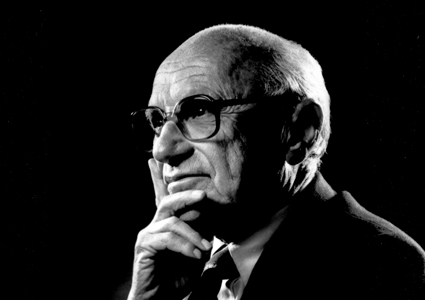
Milton Friedman (1912-2006): Economists shouldn't make jokes (Friedman Foundation, CC01.0)
Helicopter money sounds wonderful. The state builds a printing press and hires a helicopter; the printing press prints notes and the helicopter drops them randomly on the population at large; people pick them up, spend them in the shops and — in the immortal words of the Keynesian textbooks — thereby “boost aggregate demand”. Everyone lives happily ever after.
The idea is attributed to Milton Friedman, who mentioned helicopter money in a recondite 1968 academic paper on “The optimum quantity of money”. In current discussions about monetary policy Friedman’s authorship is often noted and then used to endorse a proposal for outright money-printing. However, any sensible reader of the 1968 article can see — or ought to be able to see — that Friedman was joking. In order to discuss the article’s important concern (that is, the optimum quantity of money), Friedman assumed an economy quite different from that found in the real world of today. In his “hypothetical simple economy”, the population, capital stock and technology are given, and — crucially — “lending and borrowing is prohibited and the prohibition is effectively enforced”. If it cannot have lending and borrowing, Friedman’s hypothetical economy cannot have a commercial banking system or a central bank. The tendency of contemporary advocates of helicopter money to call on the central bank to organise the printing of the notes and their drop on the citizenry is therefore absurd.
Friedman posited his simplified economy precisely because the 1968 paper was theoretical; it was a large-scale thought experiment to stimulate the imagination. He did not want to become bogged down in the institutional complexities of modern monetary policy-making. The 1968 paper appeared as the title essay in a 1969 collection which included other contributions that were far more practical. For example, its 1963 article (co-authored with Anna Schwartz) on “Money and business cycles” was concerned with the American economy from 1867 to 1960, particularly with the instabilities that might arise from accidents in the commercial banking system and blunders committed by the central bank.
The 1963 article offered “a tentative sketch” of how changes in monetary policy might be transmitted through the economy. It analysed “an unexpected rise . . . in the rate of change in the money stock” attributable, in the situation to be analysed, “from an increased rate of open-market purchases [of securities] by the central bank”. The sellers of the securities might be either commercial banks or non-banks, but both would “seek to readjust their portfolios”. The 1867-1960 evidence persuaded Friedman and Schwartz that “sizeable changes in the rate of change in the money stock are a necessary and sufficient condition for sizeable changes in the rate of change in money income”.
Like this article? Share, save or print using the icons below:


- Opposites meet in the land of Scrugletopia
- The Battle Against The Philistines Never Ceases
- Home from home for the Bolshevik elite
- Can Macron Save France — Or Is He Its Undertaker?
- Why France Is Revolting Against The Ancien Regime
- How The EU Elite Paved The Way For Populism
- A Decent Woman Betrayed By Her Gruesome Twosome
- Last Of The Great Elitists
8:09 AM
8:09 AM