



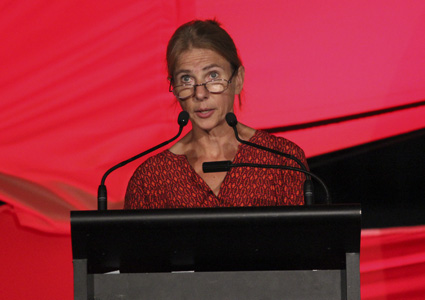
 Lionel Shriver at the Brisbane Writers Festival: She thinks writers should write whatever they want (©Daniel Seed/BWF)
Can there be a culturally appropriate art? There is no shortage of activists arguing for one, and they are arguing for something new and sinister, in free societies at least.
Let me be clear about the stakes. Artists reflect the ideas of their times, and nearly all Western novels and dramas now treat, say, gays and lesbians sympathetically. They are a world away from the thrillers of the 1970s in which the lisping homosexual was invariably the villain. Such stereotypes are not the issue today. Nor is the argument about whether a male novelist can create convincing female characters or vice versa or a white novelist create a convincing black character or vice versa. Readers have always been able to complain that a novelist has produced inauthentic work. Rather than an argument about what is said, we have an argument about what right artists have to speak at all.
As Lionel Shriver put it in a speech at the Brisbane Writers Festival, “Ethnicities, nationalities, races, sexual and gender categories, classes of economic underprivilege and disability are now encouraged to be possessive of their experience and to regard other peoples’ attempts to participate in their lives and traditions, either actively or imaginatively, as a form of theft.”
Yassmin Abdel-Magied, a “social advocate and writer”, walked out, her eyes blurred with tears. Her blog denouncing Shriver was a sensation. The Guardian reprinted it, the New York Times and Washington Post covered it, and she was quoted with approval across social media. Abdel-Magied complained that Shriver was a colonialist and racial supremacist. She alleged the message was, “I don’t care what you deem is important or sacred. I want to do with it what I will. Your experience is simply a tool for me to use, because you are less human than me”. To justify her insults, she advanced what I suppose you could call the “lump of literature fallacy”: because a white writer published on black Africans, black Africans could not get their works into print.
She offered a grotesque misrepresentation of what Shriver had said. But on one point Abdel-Magied was accurate. Shriver thinks writers should write what they want. Abdel-Magied thinks they shouldn’t. Unless you are a black African woman, you should not write about black African women unless you grant them copy approval.
The clarity of this position dissolves, however, as soon as a writer accepts it. Jonathan Franzen said recently that, because he had few black friends, he would not dream of creating a black character. Notions of identity politics and cultural purity lead to segregation. Yet when Franzen acknowledged it, the same type of social justice warrior who criticised Shriver criticised him. None quite demanded that he must create black characters, but, as one said, his reprehensible admission had weakened the fight for “diversity and inclusion” — as if the two were synonymous.
Like this article? Share, save or print using the icons below:


- Why On Earth Should Anyone Study Philosophy?
- The Dying Days Of Zuma's South Africa
- His Master's Voice: Scruton On Wagner
- Why The Most Civilised Of Men Felt Like A Fraud
- Political Misconduct
- Cicero's Analysis Of Decline Offers Lessons For The West
- The Dead End Of Identity Politics
- Trump's Appeal Is More Roosevelt Than Reagan
10:11 AM
11:11 AM
12:10 PM
8:09 PM
7:09 PM
6:09 PM
5:09 PM