


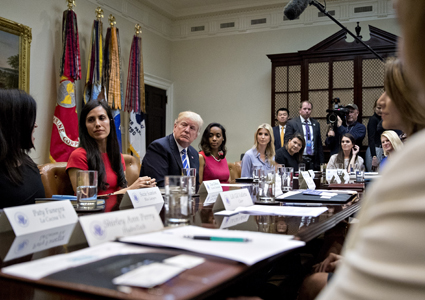
 Donald Trump at a round table for businesswomen last month: Many want a tax overhaul, but the last President to pull it off was Reagan (©Andrew Harrer/Bloomberg via Getty Images)
There are times when the President of the United States, the most powerful man in the world, wishes he were Chancellor of the Exchequer. That British politician retires to muse and consult, emerges with a budget, the details of which have at times been concealed from the Prime Minister, reads it to the House, recommends and receives its approval after answering a few questions from an Opposition politician who has not had the benefit of an advance peek at the policies the budget reflects. The President of the United States, capable of sending 59 Tomahawk missiles at Syria while dining with the President of China, prepares a budget and sends it to the congress which, without reading it, immediately pronounces it DOA — dead on arrival — and proceeds to prepare its own version of national priorities. Let the negotiations begin.
This give-and-take between the legislative and executive branches has its advantages, laid out in detail by the Founding Fathers in The Federalist Papers. But it is at minimum delaying, and at maximum preventing an overhaul of America’s corporate tax code, which is desperately needed, and soon. Here’s why:
• America’s statutory corporate tax rate is 35 per cent, the highest in the industrialised world — 39.1 per cent if state taxes are included. The average for the 35 members of the Organisation for Economic Co-Operation and Development (OECD) is 25 per cent.
• The effective rate, which reflects allowed deductions, is 27.7 per cent for corporations headquartered in the US, according to accountants PricewaterhouseCoopers. That compares to an effective rate of 19.5 per cent for their foreign-headquartered counterparts.
• The high level of the US corporate tax rate is believed by many to be the reason it produces so little revenue — only 10 per cent of the government’s total tax take.
• An American company pays tax on its output whether manufactured in a plant in Michigan or in Mexico; most foreign companies pay tax only on the output of plants located in the taxing country.
• According to a study by the Tax Foundation think tank, the US ranks last among OECD countries in corporate income tax competitiveness.
The results of this competitive disadvantage are a significant drag on economic growth. Several US corporations have fled our shores for the more benign tax environments of Ireland and other lower-tax countries — perhaps soon to include the UK once it successfully Brexits and introduces the 17 per cent rate Prime Minister Theresa May has promised for 2020. Such corporate flight is called “inversion” — buying a small overseas company, then transferring corporate headquarters to that lower-tax jurisdiction. Other gambits include parking intellectual capital (brands, patents) overseas and charging the US company for its use at rates that some claim transfers profits to low-taxing countries.
Like this article? Share, save or print using the icons below:


Post your comment
More Features
- Will Trump's foreign policy revolution fail?
- After Draghi departs, eurozone deluge looms
- The poor need the rich to always be with us
- Is the mental illness epidemic just a myth?
- No need to sell your oil shares just yet
- Can Macron wear the General's uniform?
- Trump prefers energy dominance to Paris
- A spectre haunting Europe: Karl Marx
- The battle for British Muslims' integration
- Did Winnie's crimes open Nelson's eyes?
- Belated revenge of the 1968 generation
- Jean-Paul Sartre: the supernova of the far Left
- Presidents for life Putin and Xi menace the West
- Nation states could save the Middle East
- The Trump Presidency is bigger than the man
- Great power politics means greater dangers
- The new project fear shames Whitehall
- Technology menaces childhood and culture
- The onslaught against the West's moral codes
- The Brexit cringe — Mrs T would say 'No!'
Popular Standpoint topics

- Cyril Ramaphosa's poisoned chalice
- Is South Africa about to fall apart?
- The onslaught against the West's moral codes
- Technology menaces childhood and culture
- Will the genius of the common law survive?
- The Talmudist in the Tower
- Is the mental illness epidemic just a myth?
- Presidents for life Putin and Xi menace the West