


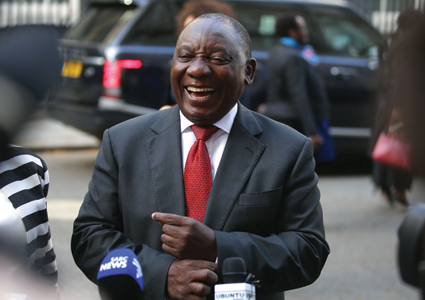
Weak hand: Ramaphosa in London for the Commonwealth Heads of Government meeting (©DANIEL LEAL-OLIVAS/AFP/Getty Images)
“Sorry we didn’t make it to you yesterday,” said the delivery man. “We had to come from the other side of the city and there was all that trouble in Mitchell’s Plain. They were stoning the vehicles on the highway and there was a lot of shooting. There was more shooting due to the bus strike too. Today the trouble seems to have shifted to Grassy Park and Hout Bay — we have heard of shooting in both those places but luckily they’re not on our route.”
I nodded — I’d heard about the Mitchell’s Plain trouble but these days civil strife is so common in South Africa that it often doesn’t make the papers at all, only the traffic news, and nobody bothers any more to say what the cause of the trouble is. Instead, it is all put under the general rubric of “service delivery protests”.
What seemed to be the problem, I asked. “Oh, you know how it is,” says the delivery man, who is Coloured. “Some of them say their housing conditions are bad, others are demanding houses or land to build shacks on. That’s what it’s like in the new South Africa, hey? Some people think they will be given property if they just make enough trouble.” A black workman, overhearing this, tells me more bleakly: “What’s happening at Mitchell’s Plain is that the Coloured people and the blacks are fighting one another.”
On April 21 the Kaiser Chiefs soccer team played at the World Cup stadium in Durban — and lost. Their angry fans went on the rampage, burning and looting vehicles and committing some Rand 2.6 million (£150,000) of damage to the stadium itself. On April 1 on the main N3 motorway at Mooi River, more than 100 miles out of Durban, protesters had attacked and burnt 35 large trucks and looted and destroyed a considerable number of other vehicles. This was only a small item in the news and no reason was given for the violence. However, a friend phoned me from the scene, describing a situation of utter chaos. The protest had been against the employment of Zimbabweans as truck-drivers — there is usually a xenophobic element to such troubles — but once the vehicles had been successfully stormed an army of looters joined in. My friend said that the police were just standing watching. When he asked them why they made no move to stop the looting, they had explained that it wouldn’t be safe — some of the looters had guns. This complete passivity on the part of the police is also part of the new normal — it had been just the same at the soccer riot.
President Cyril Ramaphosa had to cut short his attendance at the Commonwealth conference in London to rush back to deal with a huge wave of civil violence in Mahikeng (the old Mafeking) and throughout the North West province, all aimed at trying to get rid of the province’s hated Premier, Supra Mahumapelo. Ramaphosa held meeting after meeting, failed to push Mahumapelo out, and immediately faced a further wave of rioting and arson as a result. Again, it was notable that shops owned by Pakistanis, Somalis and other foreigners were particularly targeted.
Elsewhere land invasions are common and often end in violence with the police using rubber bullets and stun grenades against groups loosely labelled as “protesters”. Land is, indeed, often the heart of the matter — not white-owned agricultural land, despite all the rhetoric about it, but urban land wanted for residential purposes. For many years people have been patient as they hoped for houses. They are patient no more.
How to understand such strife? The sources are complex. Everywhere in independent Africa a small successor elite grabbed all the key political and bureaucratic positions and used them as a source of personal enrichment. There was no parallel in the pre-colonial situation for the gross inequalities that this produced: Leopold Senghor, the President of Senegal, owning a French chateau, Krobo Edusei, one of Nkrumah’s ministers in Ghana, owning a solid gold bed, the Congolese dictator Mobutu becoming one of the world’s richest men. This was achieved, moreover, in bone-poor countries. But when the ANC elite came to power in South Africa they were taking over the richest country on the African continent. The result has been a feeding frenzy which no Senegalese, Ghanaian or Congolese could ever have dreamt of. In a nutshell, the South African black elite has been involved in a vast, continuous party for the last 24 years.
Take, as a very small example, Gengezi Mgidlana, the Secretary to Parliament (i.e. to the Speaker) who, it is now revealed, used his position to acquire a large cash bonus, a study bursary for which he was not qualified, expensive clothes for his wife and himself, and business-class travel for himself and his wife. These he used on a number of foreign trips, most of which seem to have been nothing more than luxury holidays and shopping expeditions, in which he, his wife and friends stayed in top hotels and, at home, enjoyed chauffeured travel in luxury cars, often with blue lights flashing and outriders to emphasise his elite status.
Mgidlana was just a minor functionary, nothing more, but in effect he stole many millions of Rand — such were the resources available that even a minor functionary could steal for years without detection. And every cent of it has gone on conspicuous consumption, thus proving what a Big Man Mgidlana is or was. This is a perfect microcosm of what has happened with the South African black elite. Among the many billions thus peculated perhaps the most shocking thing is how few assets have been acquired.
The corruption took off under Nelson Mandela, accelerated under Thabo Mbeki and reached its current apogee under Jacob Zuma. What was different about Zuma was that the President himself set out quite openly to enrich himself and his family, that in return for kickbacks he allowed the state to be captured by an Indian immigrant family, the Guptas, and that corruption became systemic. Every town, every city, every province, every nationalised industry and every government department became a patchwork of interlocking rackets and patronage networks, often criminally enforced. Those brave enough to blow the whistle on what was going on were, quite normally, assassinated. But the fruits of office were universally known so that not infrequently even figures as lowly as town councillors were murdered by rivals eager to get their hands on contracts and tenders. Even the teachers’ union regularly sold teaching jobs, and the whistleblowers there too were sometimes murdered, for a thriving hit-man racket has sprung up and “contracts” to terminate witnesses are relatively cheap.
Take, as a very small example, Gengezi Mgidlana, the Secretary to Parliament (i.e. to the Speaker) who, it is now revealed, used his position to acquire a large cash bonus, a study bursary for which he was not qualified, expensive clothes for his wife and himself, and business-class travel for himself and his wife. These he used on a number of foreign trips, most of which seem to have been nothing more than luxury holidays and shopping expeditions, in which he, his wife and friends stayed in top hotels and, at home, enjoyed chauffeured travel in luxury cars, often with blue lights flashing and outriders to emphasise his elite status.
Mgidlana was just a minor functionary, nothing more, but in effect he stole many millions of Rand — such were the resources available that even a minor functionary could steal for years without detection. And every cent of it has gone on conspicuous consumption, thus proving what a Big Man Mgidlana is or was. This is a perfect microcosm of what has happened with the South African black elite. Among the many billions thus peculated perhaps the most shocking thing is how few assets have been acquired.
The corruption took off under Nelson Mandela, accelerated under Thabo Mbeki and reached its current apogee under Jacob Zuma. What was different about Zuma was that the President himself set out quite openly to enrich himself and his family, that in return for kickbacks he allowed the state to be captured by an Indian immigrant family, the Guptas, and that corruption became systemic. Every town, every city, every province, every nationalised industry and every government department became a patchwork of interlocking rackets and patronage networks, often criminally enforced. Those brave enough to blow the whistle on what was going on were, quite normally, assassinated. But the fruits of office were universally known so that not infrequently even figures as lowly as town councillors were murdered by rivals eager to get their hands on contracts and tenders. Even the teachers’ union regularly sold teaching jobs, and the whistleblowers there too were sometimes murdered, for a thriving hit-man racket has sprung up and “contracts” to terminate witnesses are relatively cheap.
Zuma’s South Africa resembled a feudal kingdom with the monarch at its head. Beneath Zuma served the great bosses of the cabinet and the nationalised industries, each of whom controlled lucrative patronage networks. Political control was assured by what was known as “the Premier league”, the Premiers of KwaZulu-Natal, the North West, Mpumalanga and the Free State. Exactly like a feudal monarch, Zuma would maintain each of them in office in return for tribute and their solid support at party conferences. The Premiers would then be free to loot their province and to exercise patronage networks of their own, running down to the mayors of all their province’s towns, who in turn would be free to loot their towns provided they repaid the Premier with tribute and solid political support. Naturally, the Premier league was in bed with the Guptas as well.
One could see the results of this system not only in large cities like Johannesburg or Pretoria, where hundreds of ANC activists would be on the municipal payrolls but never came in to work and where contracts, tenders, pension funds and appointments would all lie within the patronage system, but even in the smallest country towns and districts. In the bone-poor towns of the Eastern Cape, for example, one finds over and over again that almost the whole of the municipal budget is spent on the salaries and perks of the mayor and councillors, comfortable men driving around in Mercedes, while nothing is left for capital expenditure or even for maintenance. The result is that these towns are visibly falling to pieces.
This blight now affects large parts of rural and small town South Africa: one finds potholed roads, water and electricity shortages as infrastructure is allowed to decay, and polluted rivers and lagoons because corrective measures are no longer applied. Everywhere the money for infrastructure and maintenance has simply been stolen.
A friend who owns a hotel business on the KwaZulu-Natal south coast told me how he had approached his bank to secure a loan to expand his thriving business. The bank refused, quoting their own confidential intelligence that the entire infrastructure of the lower south coast would collapse in around five years. My friend responded by tarring his own road, installing huge generators and building his own fresh water reservoir — just in time, as power cuts, water cut-offs and potholed roads have since become endemic in the area. Rival hotels in the area have been badly hit, but he continues to thrive only because he has become almost completely self-sufficient. The same situation now applies in much of rural South Africa, but few can afford such self-sufficiency.
The black bourgeoisie has been so caught up in this frenzy of enrichissez-vous that for all its notional ideological commitment to the ideas of the Left, the interests of the mass of the population have simply been ignored. In large areas of life things have gone backwards. Even former anti-apartheid activists agree that the state schools were better under apartheid, as were the hospitals, that law and order was much better maintained and there was a lot less corruption. Perhaps most striking of all, when the ANC came to power in 1994, their posters proclaiming “Jobs, jobs, jobs”, there were 3.7 million unemployed. Today there are 9.4 million.
Inevitably, the always very unequal society of the apartheid era has become a whole lot more unequal as the black elite claims more and more resources for itself. Nobody regrets the demise of apartheid and certainly no one wants it back again. But the sad truth is that its successor regime has not just failed to govern well: it has failed to preserve its own sense of national purpose from dissolving into a vast myriad of contending local and personal interests.
On the ground the result is that after 24 years of empty promises the black and Coloured rank and file have simply had enough. For the last five years per capita incomes have been dropping while poverty, inequality and unemployment grow. People feel enraged at the sight of elite corruption and they have also inherited the struggle tradition: if you feel angry, march, stone vehicles, burn tyres, burn buses — it’s the one certain way to get people’s attention. But such activity is now almost invariably accompanied by looting. Any large-scale protest march by strikers, by the trade union or by Julius Malema’s Economic Freedom Fighters now resembles a medieval army, with a following host of scroungers eager to pillage the battlefield once the fighting is over. In the modern South African case large demonstrations will inevitably have a tail of street people who loot and vandalise as they clean up behind.
It’s hard to interpret this situation. It feels as if the country is beginning to unravel, that it is slipping towards ungovernability. Perhaps it can still be pulled back together but nothing is certain. One should not forget that the different territories which make up this country were only forged into one by dint of the British force of arms: South Africa was not, so to speak, a natural country. Its future national unity cannot be taken for granted.
Enter Cyril Ramaphosa, stage right. He is in a weak position, coming from a small minority tribe, and without a significant base. He was elected by only the slimmest of margins because David Mabuza, alleged to be one of the most corrupt bosses of the Premier League, came over to his side at the last moment — and was rewarded with the deputy presidency. Ace Magashule, the equally controversial Premier of the Free State, became the ANC’s secretary-general. So Ramaphosa is hedged in on both sides by some of the worst elements of the old Zuma regime.
Under that regime, Premiers were like feudal barons, free to loot their fiefdoms. Only if they went too far and caused a peasant insurrection against them, would the king step in. And that is pretty much what has indeed happened in the North West province where the corrupt and oppressive Premier, Supra Mahumapelo, is clearly about to be forced out. Ramaphosa would doubtless have liked to see him gone some time ago but the leadership group around him are worried that this might start a chain reaction in other provinces. Magashule has deliberately hindered the investigation into Mahumapelo (the consultative meetings with local officials were often held in remote and sometimes lion-ridden places, gatekeepers kept many relevant people out, etc) and also openly opposed the VAT increase just decreed by the government. Ramaphosa seems powerless to discipline him.
One could see the results of this system not only in large cities like Johannesburg or Pretoria, where hundreds of ANC activists would be on the municipal payrolls but never came in to work and where contracts, tenders, pension funds and appointments would all lie within the patronage system, but even in the smallest country towns and districts. In the bone-poor towns of the Eastern Cape, for example, one finds over and over again that almost the whole of the municipal budget is spent on the salaries and perks of the mayor and councillors, comfortable men driving around in Mercedes, while nothing is left for capital expenditure or even for maintenance. The result is that these towns are visibly falling to pieces.
This blight now affects large parts of rural and small town South Africa: one finds potholed roads, water and electricity shortages as infrastructure is allowed to decay, and polluted rivers and lagoons because corrective measures are no longer applied. Everywhere the money for infrastructure and maintenance has simply been stolen.
A friend who owns a hotel business on the KwaZulu-Natal south coast told me how he had approached his bank to secure a loan to expand his thriving business. The bank refused, quoting their own confidential intelligence that the entire infrastructure of the lower south coast would collapse in around five years. My friend responded by tarring his own road, installing huge generators and building his own fresh water reservoir — just in time, as power cuts, water cut-offs and potholed roads have since become endemic in the area. Rival hotels in the area have been badly hit, but he continues to thrive only because he has become almost completely self-sufficient. The same situation now applies in much of rural South Africa, but few can afford such self-sufficiency.
The black bourgeoisie has been so caught up in this frenzy of enrichissez-vous that for all its notional ideological commitment to the ideas of the Left, the interests of the mass of the population have simply been ignored. In large areas of life things have gone backwards. Even former anti-apartheid activists agree that the state schools were better under apartheid, as were the hospitals, that law and order was much better maintained and there was a lot less corruption. Perhaps most striking of all, when the ANC came to power in 1994, their posters proclaiming “Jobs, jobs, jobs”, there were 3.7 million unemployed. Today there are 9.4 million.
Inevitably, the always very unequal society of the apartheid era has become a whole lot more unequal as the black elite claims more and more resources for itself. Nobody regrets the demise of apartheid and certainly no one wants it back again. But the sad truth is that its successor regime has not just failed to govern well: it has failed to preserve its own sense of national purpose from dissolving into a vast myriad of contending local and personal interests.
On the ground the result is that after 24 years of empty promises the black and Coloured rank and file have simply had enough. For the last five years per capita incomes have been dropping while poverty, inequality and unemployment grow. People feel enraged at the sight of elite corruption and they have also inherited the struggle tradition: if you feel angry, march, stone vehicles, burn tyres, burn buses — it’s the one certain way to get people’s attention. But such activity is now almost invariably accompanied by looting. Any large-scale protest march by strikers, by the trade union or by Julius Malema’s Economic Freedom Fighters now resembles a medieval army, with a following host of scroungers eager to pillage the battlefield once the fighting is over. In the modern South African case large demonstrations will inevitably have a tail of street people who loot and vandalise as they clean up behind.
It’s hard to interpret this situation. It feels as if the country is beginning to unravel, that it is slipping towards ungovernability. Perhaps it can still be pulled back together but nothing is certain. One should not forget that the different territories which make up this country were only forged into one by dint of the British force of arms: South Africa was not, so to speak, a natural country. Its future national unity cannot be taken for granted.
Enter Cyril Ramaphosa, stage right. He is in a weak position, coming from a small minority tribe, and without a significant base. He was elected by only the slimmest of margins because David Mabuza, alleged to be one of the most corrupt bosses of the Premier League, came over to his side at the last moment — and was rewarded with the deputy presidency. Ace Magashule, the equally controversial Premier of the Free State, became the ANC’s secretary-general. So Ramaphosa is hedged in on both sides by some of the worst elements of the old Zuma regime.
Under that regime, Premiers were like feudal barons, free to loot their fiefdoms. Only if they went too far and caused a peasant insurrection against them, would the king step in. And that is pretty much what has indeed happened in the North West province where the corrupt and oppressive Premier, Supra Mahumapelo, is clearly about to be forced out. Ramaphosa would doubtless have liked to see him gone some time ago but the leadership group around him are worried that this might start a chain reaction in other provinces. Magashule has deliberately hindered the investigation into Mahumapelo (the consultative meetings with local officials were often held in remote and sometimes lion-ridden places, gatekeepers kept many relevant people out, etc) and also openly opposed the VAT increase just decreed by the government. Ramaphosa seems powerless to discipline him.
For the reality is that the ANC is still honeycombed with corrupt placemen entirely willing to fight their corner to keep their rackets going and Ramaphosa is far too weak to carry out the general purge that many would like to see. Indeed, in the ANC’s biggest province, KwaZulu-Natal, Zuma has dug in and is playing the Zulu card for all it is worth, with his supporters angrily protesting against the fact that their leader will soon be brought to trial for corruption. They blame Ramaphosa for having forced Zuma’s resignation and angrily insist that they will force Ramaphosa out too before long. Some are even suggesting secession from the centre by the KwaZulu-Natal ANC.
Faced with this sea of troubles Ramaphosa’s main initiative has been to launch a campaign to attract $100 billion in foreign investment. He is certainly right to see economic growth as the essential means to get out of the current mess, the other necessary elements being a thorough purge of corrupt elements and a large programme of infrastructural investment.
The trouble is that foreign investors are hardly clamouring to pour their money into a country that is in such a mess and which, according to the US State Department, is among the world’s top ten most anti-American countries, judged by UN votes. Most businessmen would like to see evidence of some tough-minded market-friendly reforms before risking their cash. But Ramaphosa is too weak to carry out such reforms even if he wanted to.
At present he is trying to talk up the economy — which, as Larry Summers argued some time ago, is the very cheapest form of economic stimulus. Most predict that this will only produce growth of 2 per cent or less, in which case the country will drag along much as now. The sad irony is that Ramaphosa is probably the best President that the ANC has yet produced. But he has taken power at a juncture when the cumulative mistakes and squandered opportunities of ANC rule have not only become a crushing burden but have largely worn out the patience and public support on which the party has depended until now.
Faced with this sea of troubles Ramaphosa’s main initiative has been to launch a campaign to attract $100 billion in foreign investment. He is certainly right to see economic growth as the essential means to get out of the current mess, the other necessary elements being a thorough purge of corrupt elements and a large programme of infrastructural investment.
The trouble is that foreign investors are hardly clamouring to pour their money into a country that is in such a mess and which, according to the US State Department, is among the world’s top ten most anti-American countries, judged by UN votes. Most businessmen would like to see evidence of some tough-minded market-friendly reforms before risking their cash. But Ramaphosa is too weak to carry out such reforms even if he wanted to.
At present he is trying to talk up the economy — which, as Larry Summers argued some time ago, is the very cheapest form of economic stimulus. Most predict that this will only produce growth of 2 per cent or less, in which case the country will drag along much as now. The sad irony is that Ramaphosa is probably the best President that the ANC has yet produced. But he has taken power at a juncture when the cumulative mistakes and squandered opportunities of ANC rule have not only become a crushing burden but have largely worn out the patience and public support on which the party has depended until now.
Like this article? Share, save or print using the icons below:


More Dispatches
- Beirut: Hariri — An Assassination Too Far
- New York: A ‘Post-racial’ American vs an Old Coot
- Pristina: Kosovo's Liberal Islam
- Oslo: Courage and Cowardice in Scandinavia
- ONLINE ONLY: Washington, D.C.: It's Not Rocket Science!
- La Hague: Recycling the French Model
- Jerusalem: No Via Media for Anglicans
- ONLINE ONLY: Beirut: Blood Holiday
- Rome: Arrivederci Roma
- Darfur: Panic at the Palace
- ONLINE ONLY: Letter from Bamian
- Caucasus: Diary, August-September, 2008
- ONLINE ONLY: South-East Asia: The Demons of Ignorance
- New York: Diary
- Ypres: Never Say Never Again
- New York: A Cousin in the White House
- Caracas: Chávez's Secret Fan Club
- Prague: Diary
- Park City, Utah: Movie that Pulls Aside the Veil
- Beirut: Blood on the Streets
- India: Tariq Ali's Plan for Pakistan
- Berlin and Cologne: A Tale of Two German Cities
- Mumbai: On the 'Slumdog' Trail
- Budapest: Screwed Left, Right and Centre
- Paris: Mayhem in the Marais
- Stanford, CA: Intellectual Life Under Obama
- Colombia: A Nation Reborn
- Paris: Prisoner of the Barbarians
- United States: The Path to Rome via San Francisco
- ONLINE ONLY: Black Russian
- South Africa: The ANC'S Health Lesson for Obama
- Lisieux, France: Relics of Thérèse
- Germany: Heidegger - Being, Time and Place
- Moscow: Putin's Empire Strikes Out
- Connecticut: My Battle Against Google
- Montana: Home From Home on the Range
- Siberia: In Search of the Gulag
- Rio's Heart of Darkness
- Mogadishu: Armageddon on Steroids
- Havana: The Castros Will Not Be Absolved
- Kaliningrad: Russia's Outpost in Europe's Heart
- Bishkek: Bloodsoaked Revolution
- Bishkek: Downfall of a Dictator
- Oslo: Signing OFF on Human Rights
- Bajaur: A Talk with the Taliban
- Bahrain: Women Drivers Welcome Here
- Tajikistan: In Search of the Yeti
- ONLINE Only: Ankara's Proxy
- Johannesburg: Hard Pressed
- Istanbul: Press Freedom Alla Turca
- Xinjiang: Taming China's Wild West
- The Lesson of Oz
- The Surge is Working — So Far
- A Tale of Love, Bulls and Goats
- Old-order Collapse
- Egypt's New Dawn Chorus
- From Carthage to Kasserine
- After Gaddafi: A New Libya Emerges
- To the Polo Saddle Born
- The Settlements: Life Between the Lines
- Exposed: Carnita's Cover Story
- "At last, I feel proud to be Libyan"
- Books Do Furnish a Little Freedom
- Fat Chance for Christie—This Time
- Easy Lies the Head that Wears the Crown
- Putin's Chinese Whispers
- Cain Isn't Able and Newt Defies Gravity
- The Ten Years' War against the Taliban
- We The People Say: Get Out of The Way
- Wanted: A New Ronald Reagan
- Time to Crunch the Numbers
- Who's Really Supreme?
- From Art as Life to Blood and Soil
- Talking Tactics
- The Wagner Family Soap Opera Rolls On
- Winning the Veepstakes
- Romney Takes a Risk with Ryan
- Window Brothels Get the Red Light
- Can Romney Spring an October surprise?
- Canada's Crusader for Conservatism
- No-Go Areas on the Campaign Trail
- Republicans Must Avoid Civil War
- Norway's Problem with Anti-Semitism
- Turks, Arabs and Jews: The Middle East in Crisis
- Nations United in Hypocrisy
- Siberia: Shamans, Spies and the Secret Police
- Barracked by Obama's Oratory
- Women Come Last in Syrian Refugee Camps
- The Dawn of Obamageddon
- Americans Know Her True Worth. Do We?
- Hapless Hollande’s French Farce Flops
- Save the NYPD So It Can Save the City
- Obama's Secrets Start Unravelling
- Syria Isn't Bosnia: Don't Arm the Rebels
- Who Can Stop Hilary in 2016?
- Teaching China's Anglophiles
- On Pilgrimage with the Hasids
- From Eastern Europe to the East End
- True Grits
- The Rise and Rise of Marine Le Pen
- Cold Comfort On Global Warming
- Hunting the Lynx with the Old Believers
- High-tech Israelis Aim For The Moon
- The Russians Are Coming
- The Turbulent Minister is Right
- Bad Times for Good Samaritans
- This Expat Paradise is a Woman’s Nightmare
- Two Generations Lost to Communism
- Strangers in their own Holy Land
- The Isles are Full of Big Noises
- The Kurds: Israel's not so Improbable Allies
- Islam and Innocence: Canada’s Predicament
- The Fifth Republic’s Darkest Days?
- Let's Make Putin's London Cronies Sweat
- The Global Politics Of Netanyahu's Victory
- A Grim Prospect For South Africa's Jews
- No End In Sight To The Exodus From Libya
- Undeterred, Erdogan Usurps Ataturk's Legacy
- Gaza Withdrawal Symptoms
- Red Flags Flying Over Parliament Square
- Mutinous Talk In The Highlands
- Our Principles Are All We Have
- Why The Swedes Have Had Enough
- Canada's First Nations Come Last
- Islam and the French Republic
- Unconventional Convention
- The Dying Days Of Zuma's South Africa
- Capitalist rebirth of Hoxha's hellhole
- Cyril Ramaphosa's poisoned chalice
- Trump's big gamble on North Korea
- Catalan myths must now confront reality
- Is South Africa about to fall apart?
- Refugees are big business for the UN
- Saving Europeans isn't the Italians' job
- Enter the Professor, Putin's Balkan stooge
- The Merkel era ends in angst and anger
- I'm Not Antisemitic, But...
- The ELM, Dispatches and Awlaki
- A Larger Than Life Predator
Popular Standpoint topics

- Cyril Ramaphosa's poisoned chalice
- Is South Africa about to fall apart?
- The inevitability of Fortress Europe
- In Corbyn’s mind, there is no place for the Jews
- Presidents for life Putin and Xi menace the West
- How Monet created motion pictures
- Is the mental illness epidemic just a myth?
- The battle for British Muslims' integration
2:08 PM
1:07 PM
10:06 AM
2:06 PM
12:06 PM