



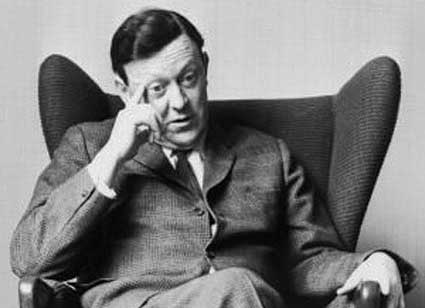
In 1997, the Irish novelist Colm Tóibín was asked by the New Yorker to write a piece about the possibility of Seamus Heaney running for President of Ireland in succession to Mary Robinson - a popular but unsubstantiated rumour at the time. Tóibín wrote, inter alia, that Heaney was so popular that he could even survive being endorsed by Conor Cruise O'Brien, which normally meant "the kiss of death" in Ireland. The legendary New Yorker fact-checking desk, unable to let a single statement go uncorroborated, found out Cruise O'Brien's Dublin phone number and rang to inquire if his approval meant the kiss of death in his native country: they then telephoned an astonished Tóibín and reproachfully told him: "Mr O'Brien said: ‘No, it didn't'."
It was the kind of anecdote that gathered around Conor, and which he relished. But his answer was the right one, as was usually the case. At his funeral mass last Christmas, the officiating priest described him as "a prophetic figure", inhabiting the somewhat lonely spaces that prophets often do. "It is I think in the nature of prophets to be prickly, awkward, angular, contrary in every sense, saying things we don't always want to hear and calling for us to change our way of thinking in building a world based on truth and justice." It was well said, though Conor a few years before had vigorously denied feeling "isolated" because "my views are not everyone's cup of tea", he wrote in the introduction to Passion and Cunning (Simon & Schuster, 1988). "I live and move in the best of company." He deserved no less, and he lived to see many of his stances vindicated. There was also, at the end, some honour in his own country.
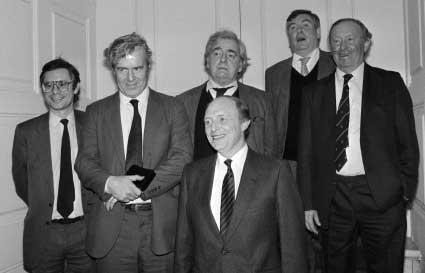
O'Brien (right) with (from left) Simon Hoggart, Geoffrey Owen, George Gale, Neil Kinnock and Ian Aitken (PA Photos)
Conor Cruise O'Brien was the pre-eminent Irish intellectual of his generation (and a few others). In his numerous books and essays, profound reflections and an astonishing range of cultural references were expressed in a lapidary style, replete with implications and often horribly funny. He could be uproariously good company, in every sense. If he was a great faller-out with political colleagues, his enduring friendships spanned an unlikely and distinguished spectrum. But he also aroused controversy throughout his diplomatic career in the 1950s and 1960s, at the UN and in Africa, and drew down the wrath of the Church for one kind of defection or another. He eventually decided, though, that given the choice of Cathleen Ni Houlihan or Holy Mother Church, he would choose "Holy Mother Church, every time". And above all it was his recantation of the pieties of Irish nationalism in the early 1970s, and his repeated inquiries about where the Ulster Unionist presence fitted in to the traditional Irish shibboleth of "reunification", that conferred demonic status on him in the eyes of "official Ireland".
Venial sins of "arrogance" and "opportunism" were also imputed. But the major transgression was to say the unsayable, in a simple and memorable way. "The official ideology of the Republic fully legitimises the IRA's ‘war' in Northern Ireland and so helps that ‘war' go on and on," O'Brien wrote in the New York Review of Books in 1982. "The people of the Republic do not endorse that ‘war', very far from it...But our history, our ‘idealistic' pretensions and our fatal ambivalence have stuck us with an ideology that is warlike and anti-demo-cratic, and calls increasingly for further human sacrifice. Our ideology, in relation to what we are and want, is a lie. It is a lie that clings to us and burns, like the shirt of Nessus."
By the time of that New Yorker inquiry, even Sinn Féin were moving towards an acceptance that their war of liberation had been largely built on wishful thinking, at the cost of thousands of deaths. The diplomatic ballet of the next few years would choreograph a structure within which they could climb down and come to rest as ministers of a local power-sharing government of the kind that they had fought against when it was floated decades before, by the short-lived Sunningdale arrangement of 1973-4. O'Brien had been a government minister at that time, and a signatory of the Agreement, but felt that its imposition of an overarching Council of Ireland would alienate Unionist support - as it did. He knew that the Northern republicans, in their current mood, would never allow a chance to a cross-party devolved government, in which their moderate-nationalist enemies the SDLP were strongly represented, if they could help it. (As it happened, Ulster Workers' Council bully-boys and pusillanimous Labour politicians did most of their job for them.) Twenty-five years after the negotiations at Sunningdale, the Good Friday agreement reran the formula, with Sinn Féin participation (and the concomitant effect of administering a dose of euthanasia to the SDLP). By then, O'Brien's hostility to everything about republicanism was so dyspeptic that he could hardly countenance the idea of them in any kind of position of power at all. But they, like everyone else, had been in an odd way his pupils.
As an historian, and a student of human nature and public life, he might not have been surprised. As an historian, too, he might have noted how clearly Irish government papers released under the 30-year rule have vindicated the O'Brien analysis of public attitudes and private doublethink in the 1970s. Southern politicians dreaded and feared the awakening of the northern Kraken, civil servants in Dublin wrote pungent memoranda about the damaging hypocrisy of anti-partitionist propaganda and the need to build reassuring relationships with Northern unionism, but in public politicians danced through the steps of the traditional Reunification Reel. The parallels with the governing hypocrisies about speaking the Irish language were obvious - another of O'Brien's pet subjects. "The Gaelic Revival Movement," he wrote in the Irish Independent in 1991, "failed to revive, and its only movement was backwards. But it did generate a huge amount of political hypocrisy and - what was worse, because more insidious - a habit of listening to official nonsense, in an approving sort of way, as you might listen to the prattle of an innocent child."
What made such statements all the more infuriating to the Irish bien-pensant was that he was uniquely qualified to make them. He was a fluent Irish-speaker, married to Máire Mac an tSaoi, one of the most distinguished poets in the Irish language and his doughty defender in many a battle. His own family background was saturated in the values of the Revival. His father Francis, who died when Conor was ten, was a brilliant nationalist journalist, and his mother Kathleen came from a prominent nationalist political dynasty, the Sheehys. James Joyce was a Sheehy family friend and Kathleen supplied the model for Miss Ivors in Joyce's greatest short story, The Dead, while Conor's grandmother appears by name in Ulysses. His aunt, Hanna Sheehy Skeffington (who seems to have terrorised his youth) was a significant figure in the history of early-20th-century Irish feminism and republicanism. A strain of secularism and mild anti-clericalism within his own family impelled his parents to send him to a non-denominational school, and then Trinity College, though both Conor and his older cousin Owen Sheehy-Skeffington (a key early influence) maintained firm nationalist attitudes in the face of occasional West British survivals around them. At the same time, through his first marriage to Christine Foster he knew the world of middle-class Northern Protestantism (albeit in its most liberal vein). And for his doctoral subject he chose the then unfashionable subject of Parnellite politics - looking back to the era of constitutional nationalism before the 1916 Rising changed everything utterly.
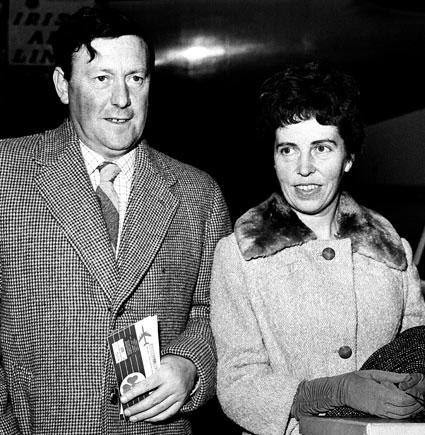
O'Brien with his wife Máire Mac an tSaoi (Getty)
The book that emerged from this, Parnell and his Party, remains an indispensable classic half a century after its first publication. It supplies a profound analysis of power and charisma in democratic politics, owing more to Pareto and Weber than its first readers perhaps expected. It also gave serious attention to W.B. Yeats's contribution to the creation of political myth, thus anticipating a later interest (and another controversy). But O'Brien did not enter academe, though he went on writing coruscating literary and political commentary under the pseudonym of Donat O'Donnell. He joined the Irish Department of External Affairs, at one point serving under the Machiavellian Sean MacBride as Foreign Minister: MacBride's pretensions and prejudices, like those of his mother Maud Gonne, supplied Conor with rich satirical copy for the rest of his life. He then became a member of the Irish delegation to the UN in the late 1950s, where his opinions were considered dangerously left-wing. But the secretary-general, Dag Hammerskjöld, liked what he saw and was responsible for O'Brien's secondment to the recently-independent Congo.
It was a poisoned chalice: he got into severe trouble for taking a forward line in ordering UN forces to combat Tshombe's secessionist campaign in Katanga. His involvement there, and his denunciation of British and Rhodesian policy, along with upheavals in his private life, led to his severance from the official diplomatic world - a parting made permanent by his scorching apologia, To Katanga And Back. (Simon & Schuster, 1962. It became known in the Thurber-reading Cruise O'Brien household as "The Year The Bed Fell On Father".) But his role in the debacle was largely vindicated by time and went down well in some quarters: the Observer under David Astor, for instance, and several new African states. Kwame Nkrumah invited him to become vice-chancellor of the University of Ghana, an association where neither side (like Hammarskjöld a year or so before) quite realised what they were getting. O'Brien relinquished it with some relief after three years. His subsequent career involved prestigious university posts, an interlude as a front-rank politician (Irish Labour Party TD, and Minister of Posts and Telegraphs in the Fine Gael-Labour coalition government of the early 1970s), some years as editor-in-chief of the Observer, and a continual stream of books, essays, articles, lectures and journalism. His political interventions were controversial (notably in censoring republican spokespeople on RTE) but he did not possess the gladhanding camaraderie (or simple tact) required for Irish politics, and his influence was limited. His op-ed columns for The Observer, on the other hand, were classics and helped create the genre as we know it. He also wrote polemical drama, and I suspect there must be a draft novel in a drawer somewhere; if so, it would be more like Orwell than Sartre. Nevertheless, the position he held was that of a public intellectual, very much in the French mould - a syndrome with which he was intimately familiar, as the author of a series of luminous essays on Catholic writers and politics, published as Maria Cross. It is a métier less familiar in the English-speaking world, though perhaps more comprehensible in Dublin than London. But his fellow-countrymen (like his employers in various spheres) never knew quite what to do with him.
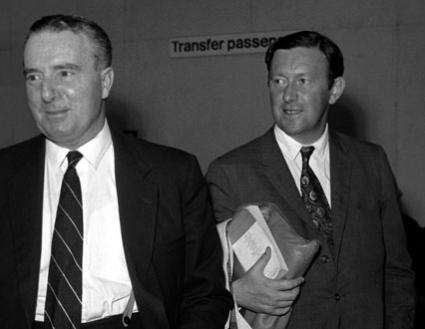
O'Brien the diplomat in Katanga (Getty)
They took refuge, as so often, in a nickname, "The Cruiser" - coined by a brilliant but vitriolic political journalist who subscribed to more unreconstructed and Anglophobic beliefs than Conor's. The sobriquet was meant to denote opportunism and unpredictability, but to his admirers it suggested a more apposite image: a threatening warship, covering the territory of Dublin Bay, its big guns trained on the flimsy defences of official piety. Nor were his targets merely politicians. Early on, he zoned in on the political attitudes which often underlie aficionados of the "post-colonial" interpretation of Irish culture, enjoying some rough fun with a book published in 1985 and unwisely titled The Irish Mind. Its editor, O'Brien remarked in the Times Literary Supplement, seemed to want to establish that Irish people can think: "A curious, even an abject thing to want to prove, but there it is." He went on to point out that Burke and Berkeley were, in fact, intimately associated with the colonial enterprise that the volume's contributors claimed generated only "servile discourse" from those not intellectually liberated like themselves. Thus Conor only could conclude that "intellect seems to do better in captivity". Finally, those big guns opened up: "The politics, now defined as ‘anti-colonial', and larded with Third Worldly quotations from the school of Frantz Fanon, is really good old Catholic Irish nationalism, in trendy gear. These cultural nationalists are the latest generation of what used to be called ‘the literary arm of the movement' - a term formerly employed, with genial derision, by the military leaders of the movement in question, the IRA."
O'Brien had read Fanon earlier and more closely than most of those who invoke him. States of Ireland (Hutchinson, 1972) includes a biting critique of Fanoniste criteria as inflicted upon the Emerald Isle. His range of literary reference was wide and unpredictable: on another occasion he wrote a mordant open letter in Harper's in 1981 to four prominent US Senators, telling them that if they actually got the reunited Ireland they claimed to desire, they would be in the position of the bereaved parents in the ghost story The Monkey's Paw, who summon up their dead son after a ghastly factory accident, but fail to stipulate that he be alive and whole when he appears. He was a major intellectual by international as well as Irish standards, whose work on a variety of literary and political subjects (Burke, Yeats, Catholic novelists) will endure. But unlike most intellectuals, he possessed a mastery of contemptuous rhetorical style in his journalism akin to H.L. Mencken's.
This, with his huge curiosity about politics worldwide and his penchant for slicing down with Occam's razor, could lead to over-reaction. His endorsement of Israeli policy in The Siege (Simon & Schuster, 1986) owed much to the equivalence he perceived between the PLO and the IRA, and does not look prescient nowadays - though his writings on South Africa pre-Mandela were farsighted and realistic, as is the case with much of his work on Africa, which he knew well. The weight and range of his critical, political and historical essays cannot be addressed here. But his ability to raise awkward questions in criticism as in politics was early demonstrated in his 1965 essay on Yeats's sympathies with fascism, Passion and Cunning. The critic Terence de Vere White remarked that he read it in such a rage that "the print swam before my eyes". It has provoked a large secondary literature, and continues in many respects to hold the field. More obtuse commentators have failed to attend to O'Brien's emphasis on the intermittent nature of all of Yeats's political activity, or to contextualise the poet's position as sensitively as O'Brien. But the essay is at once suavely insinuating and brazenly offensive, in his characteristic mode:
"During Yeats's life, the English Government gave him a Civil List pension, and the Athenaeum Club the signal honour of a special election. Since his death, the British Council has presented him to the world as one of England's glories. There is therefore some irony in the thought that there was something in him that would have taken considerable pleasure - though not without a respectful backward glance at Shakespeare - in seeing England occupied by the Nazis, the Royal Family exiled, and the Mother of Parliaments torn down. Meanwhile in Ireland, one would have expected to see him at least a curious participant, or ornament, in a collaborationist regime."
The print swims a bit, even now. Passion and Cunning was written before the North blew up but rereading it one can trace the lineaments of the saeva indignatio, and the eye for exposing the less attractive side of Irish nationalist commitment and instinctual Anglophobia that would produce States of Ireland seven years later.
While politics and journalism claimed more of his time than academe, his scholarly preoccupation with Edmund Burke grew with time, and kept pace with his own odyssey from the Left. The Great Melody: A thematic biography of Edmund Burke (Sinclair-Stevenson) appeared in 1992 as the final instalment of a process that had begun with his seminal introduction to the 1968 Penguin Classic edition of Reflections on the Revolution in France. It is impossible not to sense O'Brien's emotional identification with his subject's idiosyncratic Irishness, his Catholic background, his political progress, and his wish to command a world stage; the first person singular intrudes far more persistently than in most biographies. By the time he wrote it in The Great Melody, O'Brien fully identified with Philippe Raynaud's definition of Burke's stance regarding the Revolution: "à la fois libérale et contre-révolutionnaire." This identification unbalances the book's structure at some points, and allows obsessive reiteration; it also enhances it as an instalment of intellectual autobiography. The epilogue, placing French and Russian revolutions in direct line, shows how far O'Brien had travelled from the marxisant fashions of his youth. But the achievement of the book is to unite the "liberal" Burke (on India, America, Ireland) with the "counter-revolutionary" Burke on the totalitarianisms bred by abstract theory. In some ways it reads like an anticipation of the Memoir (Profile Books, 1998) of his own life he published a few years later.
If The Great Melody is O'Brien's major academic work, States of Ireland is the one that will endure as a vital moment in Irish intellectual and political history. In the many memorial articles written after his death last December, several of the writers recalled reading it as an epiphanic moment. Such people included Ulster Unionists who suddenly saw "the South" in a different light, and at least one IRA member who began silently to question the verities of the republican cause. It also made the SDLP leader John Hume an enemy for life, and precipitated a motion within the Irish Labour party to expel O'Brien from their membership. It remains a book that should be read at regular intervals by anyone trying to understand Irish history. O'Brien described it as "an enquiry into certain aspects of Irish history, consciousness and society", and it anticipated several of his later books in treating history autobiographically - beginning with his grandfather's reaction to the Parnell Split of 1890-91, and going on to evoke the mind-set of that Home Rule generation on the brink of unforeseen revolution.
The tribal assumptions, class attitudes and confessional undercurrents of the era supply one level of the commentary. On another, he deconstructs James Connolly's Marxist critique of Irish history (which ignored the implications of 19th-century Belfast industrialisation), relishes Eamonn de Valera's serpentine strategies, and provides some toothsome autobiographical detail about his own work in the Department of External Affairs, particularly as Frank Aiken's emissary to the Catholic communities of Northern Ireland. On one occasion, in 1952, he travels with an English Jesuit observer, Father Wingfield-Digby, who is shown the electoral map of Derry by a local Catholic politician, Senator Lennon.
"What he showed us was a classical gerrymander, thorough to the point of pedantry: at one point the city boundary, following the line of a certain terrace, suddenly skipped behind the back-gardens of three houses, homes of Catholics. Gerry Lennon explained these things, with controlled indignation, but at the same time a faint touch of local pride: it was not everywhere you could see the like of this abomination. But Father Wingfield-Digby was simply disgusted by such an example of rustic bigotry. ‘Good Heavens!' he exclaimed. ‘How perfectly stupid!' Gerry Lennon looked sourly at the Jesuit. ‘In the name of God,' he asked, ‘what's stupid about it?'"
Following an idiosyncratic but logical structure, the book leads up to O'Brien's later experiences in the 1960s, supporting the civil-rights movement but sharply conscious of the powerful forces in the wings, and the underlying power of religious identification (denied by so many of the participants). Over and over again, Ulster Unionism is presented as the obstacle rather than British policy - a message that few in 1972 were ready publicly to take on board. The climax of the book brings northern crisis and southern tribal attitudes together, with an excoriating analysis of the 1970 arms trial, where the sacked Fianna Fáil Minister Charles Haughey and others were arraigned for importing guns destined for the nascent Provisional IRA. As early as 1969, O'Brien had been one of the very few to draw attention to Haughey's scandalous land deals in public, and the description of the ex-Minister for Finance in States of Ireland, long before his rehabilitation, roller-coaster ride as Taoiseach and exposure for financial corruption, is unnervingly prescient.
"[By 1970] he had made a great deal of money, and he obviously enjoyed spending it, in a dashing eighteenth-century style, of which horses were conspicuous symbols. He was a small man and, when dismounted, he strutted rather. He patronised, and it is the right word, the arts. He was an aristocrat in the proper sense of the word: not a nobleman or even a gentleman, but one who believed in the right of the best people to rule, and that he himself was the best of the best people...There were enough rumours about him to form a legend of sorts...I thought that, if conditions ever became ripe for a characteristically Irish Catholic form of dictatorship, Charles J. Haughey would make a plausible enough Taoiseach/Duce."
After O'Brien's death, several obituary writers said or implied that he had become regrettably possessed by idées fixes, and that one of them was Haughey. Certainly, through the years of Haughey's ascendancy, he was mercilessly attacked by Conor in the Dail and the Senate - culminating in his brilliant seizure of Haughey's description of a particularly shaky episode as "Grotesque, Unbelievable, Bizarre and Unprecedented". O'Brien's 1982 coinage of "GUBU" became attached indelibly to those Fianna Fail years.
I often wondered if, given Haughey's dictatorial pretensions and his tormentor's love of French culture, he was thinking of Alfred Jarry's Ubu Roi. In any case, he lived long enough to see the vindication of all his denunciations. This was not a recipe for popularity, and he was not particularly interested in saying "I told you so."
What he wanted to do was to project an argument forward to its logical conclusion, and if it annoyed people, so much the better. He also wanted to say things as clearly as he could. Unlike the post-war German philosopher and social critic Theodor Adorno and his disciples, he believed that any profound and important concept should be capable of direct statement. This belief can be traced in his early writings about French intellectuals, and throughout his commentary on Irish and UN politics. He wrote in his Memoir of Hammarskjöld: "The successful wielder of ambiguity has a certain high imperiousness in his attitude to facts and inclines to a magician-like confidence in the overmastering power of language; this confidence is unfortunately contagious." O'Brien possessed an iron immunity to such contagion. His intellectual speciality was cutting through flannel, and it equipped him for the role he took on about the North. "Sometimes travelling from Northern Ireland back to the South," he wrote in his Memoir,
"I have the impression of leaving a turbulent republic of barking, snarling, yelping dogs and entering a kingdom of cats, moving on padded feet, about occasions for which undue publicity is not required. Personally I like the atmosphere of ‘the South' rather better - I was born a cat after all - but I can understand that a born dog might have nightmares about being silently asphyxiated under all that fur."
His own dislike of furry obfuscation was, of course, one of the reasons why his own political career cast him as a Cassandra-figure prophesying doom from the wings. I think it accounted for his immoderate reaction against Peace Process talk from 1998, and his excoriation of the kind of rhetoric that came out of the talks between John Hume and Gerry Adams; weasel words seemed to him too high a price to pay for domesticating Sinn Féin. By the same token, his brief fling in the mid-1990s with Robert McCartney's independent and minuscule United Kingdom Unionist Party (essentially an integrationist feint) seemed, to Conor, simply pursuing the logic of his position. But those of us who believed his influence in the Republic's political debate was essential could only regret the effect of this démarche. His Dublin enemies could now write him off as "only a Unionist all along". In fact, notwithstanding an odd diversion into the idea of repartition, and a short-lived attempt to persuade Unionists that they would do better to make their own terms with Dublin than trust London to do it for them, Conor remained a 26-county patriot. "I was born a cat, after all."
His belief that the outcome of the Good Friday Agreement was a kind of victory of Sinn Féin chimed oddly with the Republicans' own defensive presentation, but was out of line with the realities. In fact, the reversal of the Republicans' position proved him right: they were implicitly giving up the bedrock of the irredentist 32-county case. The only hope for peace lay in a recognition by nationalists that the obstacle to the reunification shibboleth was not British policy, but a million Ulster Unionists, with whom they had to share their territory under conditions that denigrated neither community. If a few more Republicans had reflected carefully on States of Ireland in 1972, many lives might have been spared. But the time was not ripe.
There were larger lessons here. One of his favourite passages from Burke's Reflections deals with what Conor defined as "the versatility of evil". Burke begins by pointing out that history, which "unrols a great volume for our instruction", can be perverted into an arsenal "furnishing offensive and defensive weapons for parties in church and state...reviving dissensions and animosities and adding fuel to civil fury". Beneath the forms and instruments of church and state, Burke continued, lie permanent causes of evil, adopting different pretexts in different ages. Attacking the formal pretexts will not eradicate the permanent evil. "It is thus with all those, who attending only to the shell and husk of history, think they are waging war with intolerance, pride and cruelty, whilst, under colour of abhorring the ill principles of antiquated parties, they are authorising and feeding the same odious vices in different factions, and perhaps in worse." This could be applied to the post-communist world order, the upheavals in the Middle East and inevitably back to Ireland. If we have to some extent diluted rather than revived ancient factions in north and south, the process owes much to O'Brien. The fact that it has eventually happened through stratagems and mechanisms of which he disapproved and even denounced is the sort of historical irony which both he and Burke understood.


- Teeth
- La Buena Muerte
- Judaeophobia
- Cool It
- Rachmones
- From 'Russia'
- 'Going Out' and Five Other Poems
- The Final Edition
- 'The Ship of Endurance' And Three More New Poems
- The Letters Of Hugh Trevor-Roper
- Lighten Our Darkness
- Poetry
- Folie à Dieu
- New Poetry
- Adultery?
- Reece Mews
- Robin
- Two New Poems
- Three New Poems
- Freedoms We Risk Losing

- Conduct Unbecoming: The Classical Commentaries of Norman Lebrecht in Standpoint
- Propaganda Shouldn’t Pay
- The US Can Still Help Save Syria — and Iraq
- A Putrid Pact between Devils
- Strangers in their own Holy Land
- The Taboo of the Tombola
- Putin has his Useful Idiots on the Left and the Right
- Russian Resurgence has Blindsided Nato
3:02 PM
12:02 PM
2:02 PM
3:02 PM