



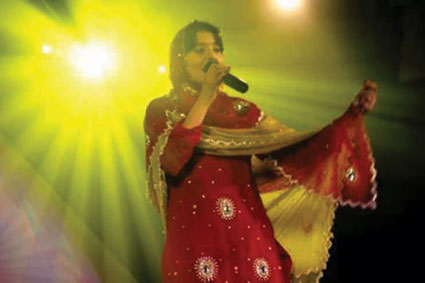
Setara Husseinzada in Afghan Star
Afghan Star's première brought the jaded indie filmmakers to their feet in a cheering ovation, and won both the Best Director and Audience Choice awards at the week-long Sundance Festival.
The director, Havana Marking, takes an irreverent look at the collision between feminism and fundamentalism and paints a surprisingly light-hearted portrait of the country that will be the Obama administration's most serious foreign policy problem.
"Our movie is a revelation, not a revolution," insists producer Jahid Mohseni, and he's right. It pulls aside the veil of war to reveal the witty, engaging, sometimes hilarious inner world of Afghan society.
Guns and Taliban are scarce in this film, a sharp contrast to the grim machinery of destruction I've been watching from choppers and armoured 4x4s on my visits to Afghanistan over the last few years. Instead, Star is all about pop music and twenty-something singers trying to make it big. Like Slumdog Millionaire, which swept the screen awards, Star is set in a TV game-show format. Both films feature gritty third world settings, sympathetic characters and the deft handiwork of quirky British directors. And both films hit hot-button issues with a hammer.
The film spotlights the ethnic fault lines that fracture Afghanistan as deeply as caste divides India. Star also causes major heartburn for the mullahs. Hold on to your turbans. As the film warns early on, "Music was considered disrespectful by the Mujahideen and sacrilegious by the Taliban." Havana Marking says that she handled the risks of threats of violence and kidnapping "with spontaneity and energy in our on-site filming" - evident to the viewer - and also with armed guards, unusual equipment for documentary film-makers.
The film follows four top song contestants chasing a $5,000 (£3,500) prize while being voted on by the Afghan public via cellphone text messages. Rafi Nabzaada is a Tajik heart-throb, from Mazar-i-Sharif in the North. Handsome, dark and grinning, he could fit into any teen boy band. Lema Sahar is a Pashtun woman from Kandahar - a composed, wary singer beneath her veil and conservative silk garb. Hameed Sakhizada is the ethnic Hazara guy, a classical musician turned pop singer. Setara Hussainzada is a Herati, brassy and brave, uncowed by the mullahs and even a public denunciation by the Herati warlord Ismael Khan. Marking's camera follows Setara on a trip home after she's voted off the stage, right into her family compound on a dusty Herat side street, where it captures a teary, emotional reunion with her family on film - something no male director could have achieved.
Voting is a novel notion in Afghanistan. The Afghans pay to vote for their favourites - the cost-per-call of 10 cents (6p) is serious money for people with an average annual income of $400 (£280). Larger-scale organised political activity also emerged during the song competition. Marking's camera follows the four stars around the country as they "campaign" like politicians. Their fellow ethnics (Tajik, Pashtun or Hazara) line up behind them in the campaigns, but the film shows the stars trying hard to appeal across ethnic lines, like politicians striving to attract the median vote after locking in their base. President Hamid Karzai and his rivals are shuffling the same ethnic cards in the run-up to September's scheduled election.
"One result of Star is that the primary ethnic identifier will become less and less relevant over time" in music and politics, predicts co-producer Saad Mohseni. Samuel Huntington said this was the way it was supposed to work in his 1968 classic, Political Order in Changing Societies, but Huntington probably didn't have a pop song contest in mind.
Political scientists know that national identity is forged by a shared sense of community and choice, captured in the phrase "Imagined Community", from Benedict Anderson's seminal book. Anderson theorised that otherwise unconnected citizens reading about the same events in newspapers is what creates national identity, and hence nations. TV shows are an even hotter crucible for creating a national imagined community, especially in a young country like Afghanistan with a 28 per cent literacy rate.
Demographics are the other driver of political change. In a country with 60 per cent of the population under 20 and a median age of 17, Afghan Star engages big segments of Afghanistan in a new collective exercise of choice. "Star is a way for younger Afghans to change the way we do politics in Afghanistan," says Jahid Mohseni. "Until now, it's been the older generations who have been saying what's right and wrong in terms of social conduct."
The Mohseni brothers are young high-octane Afghan entrepreneurs who built Tolo TV into Afghanistan's dominant network with pizzazz and slick programming. Their dubbed Indian soaps deeply annoyed Islamists who took offence at the sight of unveiled females, and then mobilised the government to ban dancing on TV. The sight of an unveiled Setara grooving around the stage while singing her final number on the show - a very modest prance by Western standards - further scandalised the clerical ulama.
"Singing was frowned upon as a profession in traditional Afghanistan," says Saad, "So we wanted to make it more acceptable. We also wanted to ‘home grow' some talent and entertainment."
As sheer entertainment, the warbling Afghan pop songs may not jump to the top of the iTunes charts tomorrow, but most have a foot-tapping rhythm line, as the tabla drums in the soundtrack drive the movie insistently forward. Star's Dari and Pashtun ballads have their roots in classic Persian poetry, usually love songs, many surprisingly sensual. In her final number, Setara belts out an evocative lyric, "The bend of your eyebrow is like the sting of a scorpion" - probably not the favourite line of Taliban chief Mullah Omar in his hidden mountain lair. He could well have been listening. After one competitive round, Lema coyly observes: "I'm a Pashtun and the Taliban are Pashtun too. I'm sure some of them are voting for me."
As in Slumdog, the game show format nicely lends itself to the classical film plot flow of hero begins quest, hero encounters adversity, hero finally triumphs. Marking lets the singers do the talking, acting and singing with just enough superimposed text to clue the viewers into Afghanistan's bloody history without banging them over the head with it. "Viewers are drawn into a compelling story about real people in a real country," says media executive Jason Hirschorn, CEO of Slingblade Media, who was wowed by the première. "The history and the war stuff are introduced gradually and skilfully." Some viewers were taken aback by the opening shot of a blind boy chanting an Afghan melody, but the tone is otherwise light-hearted; the grimmer overtones are folded in later by the visual narrative, not by a narrator.
The movie was based on a third TV season of the show. The fourth is currently being filmed in Kabul, on a brightly lit stage erected inside the Markopolo Wedding Hall. The Markopolo lights up like a Christmas tree at night, a rare glimpse of gaiety in a sombre war-worn capital with little electricity and frequent blackouts. As we drove past the building on a chilly evening, my otherwise laconic Blackwater guards gestured at the Markopolo through the bullet-proof windshield: "They got more lightbulbs in that 'polo building than any place in this whole damn country."
I recall being struck by that brief glimpse of normality, thinking how appealing it would have been to drop by the Markopolo rather than my usual Kabul digs in the fortress-like US embassy or the military's Camp Eggers - the target of a deadly suicide bomb attack that killed one American soldier and wounded six others.
The big networks and movie studios were on the prowl at Sundance, and several have indicated serious interest in bidding on Afghan Star, particularly after it garnered the two festival awards. "This movie could be a real winner," says Tom Freston, the MTV founder who, as head of Viacom, plucked Al Gore's Inconvenient Truth from obscurity and helped it win an Oscar. "The social impact of Afghanistan's media explosion has been overlooked by journalists and policy-makers. I think Afghan Star lights up the whole country and perfectly captures, not just the power of music, but the deep yearning for normalcy and joy among the people."
If Freston is right and Star's awards enable it to break out of the crowded field of documentaries, it will energise the debate over the war in Afghanistan, just as the US and Nato allies are debating the size of their commitment and the effectiveness of their strategy. European publics are tired of the place: a recent FT poll showed a clear majority in Britain, Germany, France, Italy and Spain believe their government should not send more forces to Afghanistan, even if pressed to do so by President Obama. Star may provide a timely antidote to "donor fatigue" by putting a human face on the travails and talents of the Afghan people.
One viewer buttonholed Daoud Siddique, Star's host, after the première as the excited crowd spilled out into Park City's freezing night air. "My son is serving in the US Army in Afghanistan," he said. "I feel better about what we're doing over there having watched your movie." When Afghan Star reaches TV stations and cinemas in the rest of the world, a lot of people may feel the same way.


Post your comment
- Beirut: Hariri — An Assassination Too Far
- New York: A ‘Post-racial’ American vs an Old Coot
- Pristina: Kosovo's Liberal Islam
- Oslo: Courage and Cowardice in Scandinavia
- ONLINE ONLY: Washington, D.C.: It's Not Rocket Science!
- La Hague: Recycling the French Model
- Jerusalem: No Via Media for Anglicans
- ONLINE ONLY: Beirut: Blood Holiday
- Rome: Arrivederci Roma
- Darfur: Panic at the Palace
- ONLINE ONLY: Letter from Bamian
- Caucasus: Diary, August-September, 2008
- ONLINE ONLY: South-East Asia: The Demons of Ignorance
- New York: Diary
- Ypres: Never Say Never Again
- New York: A Cousin in the White House
- Caracas: Chávez's Secret Fan Club
- Prague: Diary
- Park City, Utah: Movie that Pulls Aside the Veil
- Beirut: Blood on the Streets
- India: Tariq Ali's Plan for Pakistan
- Berlin and Cologne: A Tale of Two German Cities
- Mumbai: On the 'Slumdog' Trail
- Budapest: Screwed Left, Right and Centre
- Paris: Mayhem in the Marais
- Stanford, CA: Intellectual Life Under Obama
- Colombia: A Nation Reborn
- Paris: Prisoner of the Barbarians
- United States: The Path to Rome via San Francisco
- ONLINE ONLY: Black Russian
- South Africa: The ANC'S Health Lesson for Obama
- Lisieux, France: Relics of Thérèse
- Germany: Heidegger - Being, Time and Place
- Moscow: Putin's Empire Strikes Out
- Connecticut: My Battle Against Google
- Montana: Home From Home on the Range
- Siberia: In Search of the Gulag
- Rio's Heart of Darkness
- Mogadishu: Armageddon on Steroids
- Havana: The Castros Will Not Be Absolved
- Kaliningrad: Russia's Outpost in Europe's Heart
- Bishkek: Bloodsoaked Revolution
- Bishkek: Downfall of a Dictator
- Oslo: Signing OFF on Human Rights
- Bajaur: A Talk with the Taliban
- Bahrain: Women Drivers Welcome Here
- Tajikistan: In Search of the Yeti
- ONLINE Only: Ankara's Proxy
- Johannesburg: Hard Pressed
- Istanbul: Press Freedom Alla Turca
- Xinjiang: Taming China's Wild West
- The Lesson of Oz
- The Surge is Working — So Far
- A Tale of Love, Bulls and Goats
- Old-order Collapse
- Egypt's New Dawn Chorus
- From Carthage to Kasserine
- After Gaddafi: A New Libya Emerges
- To the Polo Saddle Born
- The Settlements: Life Between the Lines
- Exposed: Carnita's Cover Story
- "At last, I feel proud to be Libyan"
- Books Do Furnish a Little Freedom
- Fat Chance for Christie—This Time
- Easy Lies the Head that Wears the Crown
- Putin's Chinese Whispers
- Cain Isn't Able and Newt Defies Gravity
- The Ten Years' War against the Taliban
- We The People Say: Get Out of The Way
- Wanted: A New Ronald Reagan
- Time to Crunch the Numbers
- Who's Really Supreme?
- From Art as Life to Blood and Soil
- Talking Tactics
- The Wagner Family Soap Opera Rolls On
- Winning the Veepstakes
- Romney Takes a Risk with Ryan
- Window Brothels Get the Red Light
- Can Romney Spring an October surprise?
- Canada's Crusader for Conservatism
- No-Go Areas on the Campaign Trail
- Republicans Must Avoid Civil War
- Norway's Problem with Anti-Semitism
- Turks, Arabs and Jews: The Middle East in Crisis
- Nations United in Hypocrisy
- Siberia: Shamans, Spies and the Secret Police
- Barracked by Obama's Oratory
- Women Come Last in Syrian Refugee Camps
- The Dawn of Obamageddon
- Americans Know Her True Worth. Do We?
- Hapless Hollande’s French Farce Flops
- Save the NYPD So It Can Save the City
- Obama's Secrets Start Unravelling
- Syria Isn't Bosnia: Don't Arm the Rebels
- Who Can Stop Hilary in 2016?
- Teaching China's Anglophiles
- On Pilgrimage with the Hasids
- From Eastern Europe to the East End
- True Grits
- The Rise and Rise of Marine Le Pen
- Cold Comfort On Global Warming
- Hunting the Lynx with the Old Believers
- High-tech Israelis Aim For The Moon
- The Russians Are Coming
- The Turbulent Minister is Right
- Bad Times for Good Samaritans
- This Expat Paradise is a Woman’s Nightmare
- Two Generations Lost to Communism
- Strangers in their own Holy Land
- The Isles are Full of Big Noises
- The Kurds: Israel's not so Improbable Allies
- Islam and Innocence: Canada’s Predicament
- The Fifth Republic’s Darkest Days?
- Let's Make Putin's London Cronies Sweat
- The Global Politics Of Netanyahu's Victory
- A Grim Prospect For South Africa's Jews
- No End In Sight To The Exodus From Libya
- Undeterred, Erdogan Usurps Ataturk's Legacy
- Gaza Withdrawal Symptoms
- Red Flags Flying Over Parliament Square
- Mutinous Talk In The Highlands
- Our Principles Are All We Have
- Why The Swedes Have Had Enough
- Canada's First Nations Come Last
- Islam and the French Republic
- Unconventional Convention
- The Dying Days Of Zuma's South Africa
- I'm Not Antisemitic, But...
- The ELM, Dispatches and Awlaki
- A Larger Than Life Predator

- Cultural Climate Change
- Opposites meet in the land of Scrugletopia
- The Battle Against The Philistines Never Ceases
- Home from home for the Bolshevik elite
- Can Macron Save France — Or Is He Its Undertaker?
- How The EU Elite Paved The Way For Populism
- Why France Is Revolting Against The Ancien Regime
- A Decent Woman Betrayed By Her Gruesome Twosome