
You are here:   Reputations >  Overrated > Overrated: Nassim Nicholas Taleb


You cannot know the chance of very unlikely events by observing how often they occur. They do not occur often enough for that. But you can still sometimes know their probability. For example, we know that the probability of 100 consecutive coin tosses landing heads is 1/2100, not because we have seen this happen, but because we know that the probability of each toss landing heads is 1/2.

For many other improbable events, however, the matter is not so simple. Not only are they too rare to observe their long-run frequency, but we do not understand their underlying causes well enough. For example, because the causes of weather and of economic events are so varied and complicated in their interactions, meteorology and economics remain inexact sciences, unable to tell us the chances of unlikely, extreme events. 

And because we humans are inclined to certain errors of reasoning, such as seeing patterns where there are none and underestimating the chance of things we have not previously seen, we get shafted by unlikely events more often than is strictly necessary.

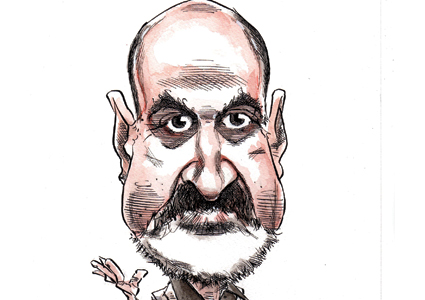
This is a short version of The Black Swan, the 2007 best-seller by Nassim Nicholas Taleb, a (now) 50-year-old Lebanese former investment banker. His Fooled by Randomness, published in 2001, explored similar themes. But it did not enjoy the same success because its timing was not as good: Black Swan was published during a financial crisis that Taleb had predicted. 

He was quickly propelled to stardom. Bryan Appleyard described him in the Sunday Times as "the hottest thinker in the world". He has since added a post at Oxford University's Said Business School to his position at the Polytechnic Institute of New York University, and he is in great demand on the speaking circuit. 

It is ironic that Taleb should be credited with genius on account of the coincidence of Black Swan's publication with a financial crisis he had predicted. It displays exactly the kind of erroneous thinking that he complains of. If the financial crisis were an unlikely "black swan" event of the kind that Taleb discusses, then he could not have known its probability.

Taleb's central hypothesis in Black Swan is right. But it is simple and worth only a chapter rather than an entire book. Taleb inflates its significance with an absurdly combative and grandiose writing style. It is Taleb versus the corrupt fools of the financial establishment; Taleb versus the false mathematical rigour of the academy; Taleb returning us to the wisdom of the ages.

View Full Article
 
Share/Save


nrt1
November 25th, 2012
11:11 AM
For Jamie Whyte to take someone to task for vanity really is Black Kettle rather than Black Swan

Anonymous
November 24th, 2012
7:11 PM
Taleb does not argue that the financial crisis was a black swan. He maintains it was entirely predictable (just a matter of when, not if). But of course, he's arrogant. Let's count a management consultant to provide insight; that's surely a genius move.

John Perez
December 31st, 2011
8:12 AM
I think over three quarters of the Taleb book reviews on Amazon make the same observation about his arrogance as well as the lack of real content in his books. Everyone agrees.

Adam
June 18th, 2011
8:06 PM
A superbly written and very incisive article. Would that Taleb could express himself half as well as this. He appears to regard himself as one of the great thinkers of our time, and yet offers nothing by way of elucidation or entertainment. His Black Swan, at 184 pages in length, was at least 180 pages too long, and even after what I am sure was extensive proofreading and editing, it came across as the work of a very-self satisfied 16-year-old, for whom English was not a second or third language, but possibly an alien one.

Animesh
April 4th, 2011
11:04 PM
One of the worst books I ever read. Same guy who had the fancy idea of solving the financial crisis by converting debt to equity. what exactly is this “equity” of which this fool speaks? In return for lowering interest rates on bad home owners … the banks get “equity” in the form of what? Maybe an option on your bed room. Truth is he is old...and just trying to make up money by spreading news for those who are willing to read crap. I don't hear Jim Simons writing articles on financial modeling.

jim
March 10th, 2011
8:03 AM
I read "Fooled by Randomness." Most educated people could benefit from this book. Just skim or ignore the pompous bits. He lays out a lot of the fallacies that we're susceptible to. "The Black Swan" isn't really necessary if you understood "Fooled by Randomness."

JG
March 6th, 2011
7:03 AM
My struggles with The Black Swan as I was constantly held up by the careless writing and apparently total absence of intelligent editing led me to accept that Taleb was clever but a self-indulgent blowhard who, thank you for encapsulating an important truth Mr Whyte, was worth a single chapter or journal article. More significant is the fact that he rightly gives credit to Benoit Mandelbrot whose 2004 book "The (Mis)behaviour of Markets" - paperback edition October 2008 - is a vastly superior compelling and lucid account of the problems which have arisen from price changes not being Gaussian like errors in astronomical observations and makes time spent on The Black Swan a complete waste. Also, a numerate friend put me on to Leonard Mlodinov's "The Drunkard's Walk" when I wanted something more readable on randomness than Taleb's "Fooled by Randomness". He was right. Mlodinov is the lucid author who teamed with Stephen Hawking to right the difficult but fascinating and readable "The Grand Design". I am glad that some of the blog commenters believe they have spent their time well on The Black Swan but the absence of any reference to Mandelbrot, in particular - whose work by the way give no credit to Taleb, or even mentions him anywhere-, suggests a rather limited background in finance or mathematics or just plain educated reading.

Reader
January 17th, 2011
12:01 PM
This review, I think, misunderstands something basic about Taleb. Taleb does *NOT* think that he has knowledge scientists, economists, doctors, or others do not have. His point -- which is I think is significant -- is that while he knows he does *not* know what will happen, many people (especially experts) think they know. Taleb doesn't claim to have predicted the financial crisis! All he did was to note, before the fact, that those who are so sure they *do* know the markey would *not* collapse might well be wrong. He predicted a crisis is *possible*. That seems like a very easy prediction to make -- when is a massive crisis not possible? -- but it isn't, especially when so many "experts" had so many "proofs" "explaining" how the "rules have changed" and a crisis just like the one that had happened is NOT possible.

Ed L
January 5th, 2011
10:01 AM
Grim book by an unbearable levantine.

Spydermelon
January 4th, 2011
5:01 AM
I'm grateful for the comments on Black Swan -- I couldn't get far into that book or Fooled by Randomness. I found its tone (occasionally arrogant, condescending, egotistical) off-putting. But if you're brilliant, hey why not? and who am I to judge that? Well, I finished his book of aphorisms, and I have to say it has the same faults only mightily condensed. And the aphorisms do not justify the self-satisfied airs of Mr. Taleb. Also, the writing is so bad (honestly) I wondered if it was a bad translation. His "Postface" is a cringe inducing discussion of aphorisms -- cringe inducing because the grandiloquent prophetic claims he makes for classic aphorists like La Rouchefoucauld, La Bruyere, and Chamfort are obviously meant to apply to himself as well. "...with some show of bravado in the ability of the author to compress powerful ideas in a handful of words --" and ".... elements hidden in the texture of reality start staring back at you; then mysteries that you never thought existed emerge in front of your eyes." This may be true of the aphorists Taleb admires;it is not true of Taleb's aphorisms.

Post your comment

CAPTCHA
This question is for testing whether you are a human visitor and to prevent automated spam submissions.