


That week, the Central Committee was meeting and at 6pm on 9 November the daily press conference took place to announce its decisions. We all trooped into a dreary hall at the international press centre in the Motzstrasse. The central committee spokesman was Günter Schabowski, the East Berlin party boss, who spoke for nearly an hour on live television. Most of the questions came from tame East German journalists and the wait for a chance to get the microphone was almost unbearable. It seemed like a non-event. The last seven minutes of the press conference, however, were dramatic in every sense, except that no playwright could have come up with a script that so effectively exposed the colossal confidence trick that the Wall had always been.
At 6.53pm, an Italian journalist, Riccardo Ehrman, asked his question: "Herr Schabowski, don't you think this draft travel law you announced a few days ago was a big mistake?" Earlier this year, Ehrman revealed for the first time that his question was not spontaneous, but that he had been tipped off to ask it by the head of the East German news agency, ADN, who apparently told him it was "very important". This suggests that Krenz intended to use the press conference to announce his new policy — a last throw of the dice to save his own leadership and the communist regime. Krenz had decided to give the people what they wanted: unrestricted travel to the West. But he had no intention of opening the Wall.
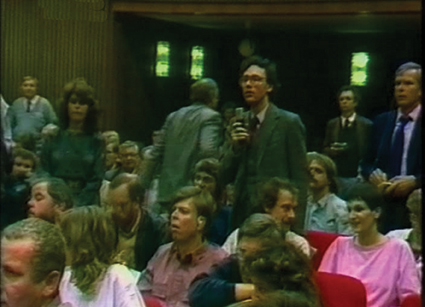
Daniel Johnson (centre, with microphone) asks his question
Schabowski at first prevaricated, but then announced that the Politburo had made a decision that very day. It had just decided to issue a new set of travel regulations which would allow East German citizens to emigrate. Somebody (Ehrman says it was him, but this has been disputed) asked when this new law would come into effect: "Immediately?" Schabowski did not at first reply, but produced a scrap of paper with the text of the new travel law, and proceeded to read sections of it aloud. "The Passport and Registration Departments of the Volkspolizei district offices have been told to issue visas for permanent emigration without delay" and "permanent emigration can occur at any border crossing between the GDR and the FRG". He did not at first mention Berlin. Another journalist (it is unclear who) again asked when the new rules came into force. "As far as I know...immediately, without delay," replied Schabowski. This was a fatal mistake. Krenz had intended the new law to take effect the following day, 10 November, once the border police and officials had been given their instructions. But it did not say this on the document he handed Schabowski, which the latter read out at the press conference. Schabowski's reply gave the impression that the new regulations were already in effect, there and then, that night. But nobody had warned the guards at the checkpoints, or the officials in charge of them, to issue visas or any other instructions.
Another question: "Does this apply also to West Berlin?" Schabowski confirmed that border crossings in West Berlin were included — a new surprise, because Berlin was still governed by the Four Powers. By now, pandemonium was breaking out in the press conference, with reporters rushing out to tell the world. Yet the import of Schabowski's announcement was still utterly ambiguous. Nobody knew what it meant, either in the immediate practical sense — could East Germans just get up and go? — or in the deeper sense of its historical significance. Above all, nobody had mentioned the Wall.


- How Jeremy Corbyn's Coup Hijacked Labour
- Corbyn's Signpost Back To The Ghetto
- Unionists, Don't Despair: Scotland Is Not Lost — Yet
- Britain's Apologists For Child Abuse
- Lift The Fee Cap And Set Universities Free
- The Story Behind One Dead Man's Penny
- Hitler's 'Ecological Panic' Didn't Cause The Holocaust
- Meet The Montalvos: The First Global Family
- Mr Gove, Here Is Our Statute of Liberty
- A British Bill Of Rights
- Something For Nothing Just Won't Do Any More
- Ditch Ed Miliband's Crazy Energy Legacy
- The English Public School: An Apologia
- An Open Letter To Nicky Morgan
- Escape The Heat: Head To London's Crow's Nests
- Collusion Cut Both Ways In The Troubles
- Decline Of The East? The Chinese Say No
- Conservative, Moi? Jamais De La Vie!
- How To Rescue Iraq From Obama's Folly
- Europe Must Never Again Betray Its Jews

12:11 AM
11:11 PM
10:11 AM
8:11 PM
5:11 PM
10:10 AM
12:10 PM