


A turning point came at about the time I arrived in Bonn. On 12 June, 1987, President Ronald Reagan stood at the Berlin Wall to make his second great Cold War speech, following that of 1984 when he described the Soviet Union as "an evil empire". Once again he ignored the conventional niceties — "the boys at State are going to kill me, but it's the right thing to do," he told an aide — and articulated the hopes of millions: "Mr Gorbachev, tear down this wall!"
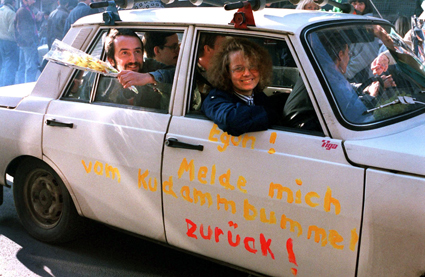
"Ossies" travel West in a Wartburg
My first flash of insight came after the Bavarian Prime Minister Franz Josef Strauss's visit to Gorbachev in December 1987. Although he was already the most popular foreign leader in both East and West Germany, Gorbachev remained an enigma. He certainly did not see himself as the gravedigger of socialism, but rather its saviour. "I never for a moment thought that the transformations I had initiated, no matter how far-reaching, would result in the replacement of the rule of the ‘reds' by that of the ‘whites'," he later wrote in his memoirs. The swashbuckling Strauss (who had fought for the Wehrmacht on the Eastern Front) piloted his own plane to Moscow, met Gorbachev and returned declaring that the Soviets would like to do serious business with the Federal Republic. The outline of a new Soviet-German deal began to take shape: German soft loans to modernise the Soviet economy in return for liberalisation in East Germany.
This was an extension of Willy Brandt's Ostpolitik of the 1970s. But could it go further? What if the Soviet malaise were so profound that the Kremlin would pay any price for German capital? Might the postwar solution to the German Question — "one people, two states" — itself be called into question? I wrote a piece for the Telegraph predicting that German reunification could happen much sooner than anybody was expecting. Nobody believed me.
My growing belief that there was nothing permanent about the division of Germany — and hence the division of Europe — was based as much on an inner conviction as on empirical evidence. The attempt by Gorbachev to reform the Soviet Union was having all kinds of unforeseen side-effects outside its borders that spelt doom for the empire Stalin had bequeathed. Against the background of perestroika in the Soviet Union, the signs of dissolution were everywhere to be seen across Eastern Europe. I had visited Poland a couple of times in the mid-1980s, during the grim years that followed the crushing of the Solidarity trade union, when the dissident priest Father Jerzy Popieluszko was murdered by the secret police. I had watched with growing admiration as the Polish people, under the leadership of Lech Walesa and inspired by Pope John Paul II, had forced the communist system to concede an ever-greater latitude to its critics. Hungary, too, had embarked on a gradual relaxation of the despotic regime imposed by Soviet tanks in 1956. Uniquely, this process was presided over by János Kádár, the man who had crushed the uprising. True, such concessions had not yet been granted in East Germany, Romania or Czechoslovakia, where the old dictators Erich Honecker, Nicolae Ceausescu and Gustav Husak still ruled and dissidents (such as Vaclav Havel or this year's Nobel laureate Herta Müller) were still being imprisoned or forced into emigration.


- How Jeremy Corbyn's Coup Hijacked Labour
- Corbyn's Signpost Back To The Ghetto
- Unionists, Don't Despair: Scotland Is Not Lost — Yet
- Britain's Apologists For Child Abuse
- Lift The Fee Cap And Set Universities Free
- The Story Behind One Dead Man's Penny
- Hitler's 'Ecological Panic' Didn't Cause The Holocaust
- Meet The Montalvos: The First Global Family
- Mr Gove, Here Is Our Statute of Liberty
- A British Bill Of Rights
- Something For Nothing Just Won't Do Any More
- Ditch Ed Miliband's Crazy Energy Legacy
- The English Public School: An Apologia
- An Open Letter To Nicky Morgan
- Escape The Heat: Head To London's Crow's Nests
- Collusion Cut Both Ways In The Troubles
- Decline Of The East? The Chinese Say No
- Conservative, Moi? Jamais De La Vie!
- How To Rescue Iraq From Obama's Folly
- Europe Must Never Again Betray Its Jews

12:11 AM
11:11 PM
10:11 AM
8:11 PM
5:11 PM
10:10 AM
12:10 PM