


The Christian world has inherited a wholly negative image of king Herod (74/72-4 BCE), during whose reign Jesus was born (Matthew 2:1, Luke, 1:5). Matthew's legendary account, Nativity plays and Christian imagination have turned Herod into the Ivan the Terrible of antiquity. When the three wise kings, or rather oriental magicians (magoi in the Greek Gospel), arrived at the royal palace in Jerusalem and asked about the recently born king of the Jews, Herod pretended to be helpful and directed them to Bethlehem, the traditional birthplace of the Messiah, on condition that they promised to let him know the whereabouts of the babe. He, too, wished to greet him, he lied, when in fact he planned to murder the potential rival. So when the magi failed to return, he let loose his soldiers on the infants of Bethlehem.
The extensive secular chronicles provide a more nuanced biography, one that is almost as detailed as those of Roman emperors. Our chief informant is the Jewish historian Flavius Josephus (37-c.100CE), who devoted most of Book I of his Jewish War and Books XIV to XVII of Jewish Antiquities to the life and times of Herod. Josephus uses as his main source the universal history of Nicolaus of Damascus, the well-informed teacher, adviser and ambassador of Herod. The fact that Josephus often criticises the king suggests that beside the court historian's pro-Herod chronicle, he had also at his disposal another account sympathetic to the Hasmoneans, the Jewish priest-kings, who from 152 BCE ruled the Holy Land, first independently and after 63 BCE under the aegis of Rome, until Herod took their throne in 37 BCE.
We do not know what Herod looked like. In obedience to Jewish law, he did not allow his effigy to appear on coins. Nor has any statue of his survived away from home. The nearest we come to a Herodian face is through the coins of his more liberal grandson, Agrippa I (10 BCE-44 CE) and great-grandson Agrippa II (27/28-92/93 CE). Josephus depicts Herod as a strong, attractive, and sensual man. He was outstanding as rider, hunter and soldier. Few could match the precision of his javelin or arrow. Extremely ambitious, he wished to be second to none. This eagerness probably stemmed from an inferiority complex implanted in him by two women of royal descent: his haughty wife Mariamme and mother-in-law Alexandra. One of his cheeky sons by Mariamme gossiped that standing beside his father he had to stoop as he was taller than him, and felt obliged to miss at hunting to make Herod appear the better shot. He also let it be known that to disguise his age, Herod was dying his hair black.
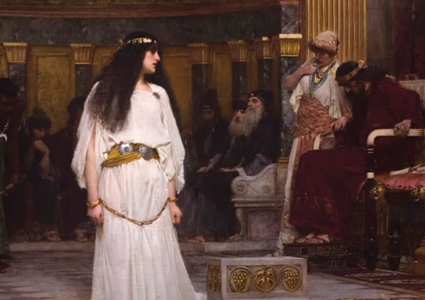
Behind every great man: "Mariamme Leaves the Judgment Seat of Herod" by J. W. Waterhouse (1887)
Gladly availing himself of the Mosaic privilege of extensive royal polygamy, Herod took altogether ten wives. Apart from Mariamme, who was both beautiful and princely, they were all chosen for their looks rather than their rank, according to Glaphyra, Herod's sharp-tongued daughter-in-law, herself daughter of the king of Cappadocia. Family prattle had it that Herod fancied Glaphyra. We learn from Josephus that Herod had at least one male lover, Karos, "a young man of unrivalled beauty", who later came to a sticky end.


- Liberty And Sovereignty
- Art And Public Culture In The 1830s And Today
- The Casanova Of LaSalle Street
- The Writer
- New Poetry
- Cartagena Poems
- A British Subject
- Travels with Betjeman
- Kizerman and Feigenbaum
- Communism’s Comeback?
- Irving Kristol on Jews and Judaism
- The State of Charity
- Teeth
- La Buena Muerte
- Judaeophobia
- Cool It
- Rachmones
- From 'Russia'
- 'Going Out' and Five Other Poems
- The Final Edition

11:01 AM
9:01 AM
4:01 PM
8:01 PM
1:12 AM