


One of my most vivid memories, though, is the weekly visit from "the Arab with the eggs", as we called him. The arrival on our doorstep of this mysterious figure never failed to thrill and terrify me. There he would stand, wrapped from head to toe in layers of what looked like grey blankets, his swarthy face barely visible beneath his Arab headdress. He would reach deep into the folds of his garments, fumbling around in the area of his chest until, at last, he would pull out an egg, covered in bits of straw. Sometimes he produced two eggs. Eggs were a rare luxury in those wartime years, and he would charge for them accordingly.
I spent three unremarkable years at a school in Jerusalem. The children mostly came from the same kind of immigrant families as I did, though there were some who had lived in the city for generations. I made many friends and was even allowed to bring some of them home — though not others. Nearly every day when I came back from school my mother would insist that, when I'd finished my homework, I spent a further hour learning to read and write in German, using the Roman alphabet (as opposed to the Hebrew script taught at school). This seemed to me tyrannical, but it was to make life much easier later.
I don't think my father had much say in my upbringing. Or if he did, he was overruled. The contrast between my parents' characters could hardly have been greater. My father was at all times good humoured and tolerant — I never heard him say a cross or unkind word. Nor did he ever complain about anything. He inspired the loyalty of everyone who had dealings with him. Meanwhile, he put up with my mother's criticism and disparagement with saintly patience.
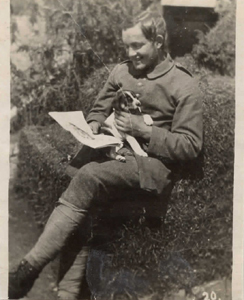
Adored and tolerant: Kurt May in German uniform in the First World War
My parents were never very happy in Palestine. They did not succeed in learning to speak Hebrew fluently, they didn't like the heat, and they both, particularly my father, wanted to resume their legal careers. Above all, they abhorred the terrorist tactics that, since the end of the war, were being deployed by Jewish underground organisations against the British. The bombing of the King David Hotel — site of the British Mandate's military headquarters and central offices — in July 1946, was a turning point. As it happened, this imposing grand hotel had been one of the highlights of my parents' social life — they went dancing there every Friday night.
I had no idea, when we set sail for Europe in 1947 (I was nearly nine), that I was never to return — or not for more than 30 years, as a tourist. Presumably my parents thought that to explain that we were emigrating would upset me too much; or perhaps they feared that I would cause trouble. In any event, I was not given the chance to say goodbye to my school friends or to anyone else. After a brief stay in Switzerland, my parents travelled on to America and to England to look for work and to decide where they wanted to settle. Meanwhile, I was sent to a Swiss boarding school, in Celerina, a small village in the Engadine, where I was overwhelmed by so many new impressions and demands that I soon began to forget my old life — and also the Hebrew language.


- The Writer
- New Poetry
- Cartagena Poems
- A British Subject
- Travels with Betjeman
- Kizerman and Feigenbaum
- Communism’s Comeback?
- Irving Kristol on Jews and Judaism
- The State of Charity
- Teeth
- La Buena Muerte
- Judaeophobia
- Cool It
- Rachmones
- From 'Russia'
- 'Going Out' and Five Other Poems
- The Final Edition
- 'The Ship of Endurance' And Three More New Poems
- The Letters Of Hugh Trevor-Roper
- Lighten Our Darkness

- The Loss Of Faith Made Music Mute
- The Great Betrayal: How Liberals Appease Islam
- Political Correctness Is Devouring Itself
- The New Language Of Political Narcissism
- Why The World Still Loves Shakespeare
- Don’t Listen to Britain’s Designer Demagogues
- An English parliament: the only way to save the UK
- Death By Clickbait
- The Loss Of Faith Made Music Mute
- The Great Betrayal: How Liberals Appease Islam
- Political Correctness Is Devouring Itself
- The New Language Of Political Narcissism
- Why The World Still Loves Shakespeare
- Don’t Listen to Britain’s Designer Demagogues
- An English parliament: the only way to save the UK
- Death By Clickbait
- The Loss Of Faith Made Music Mute
- The Great Betrayal: How Liberals Appease Islam
- Why The World Still Loves Shakespeare
- Political Correctness Is Devouring Itself
- Who Will Lead The Berlin Band?
- Putin and the Art of Political Fantasy
- The New Language Of Political Narcissism
- Inside The World Of 'Non-Violent' Islamism
2:09 AM
2:09 PM