


Our name, May, was carved in stone above the entrance of the shop in three scripts — Roman, Hebrew and Arabic — and the store thrived. Even the Queen of Jordan sometimes shopped there. So did the Emperor Haile Selassie and his entourage, for whom a meal was specially cooked on the premises. Jerusalem was very much smaller in the Thirties and Forties and this large store has now become one of the city's average-sized banks.
Meanwhile, in 1938, when news from Germany became more and more bleak, my father travelled back to his home town to help bring out his brother and his mother. His brother had already been sent to Buchenwald (at that stage known as Ettersberg). He had been warned on the day before Kristallnacht by members of the town's SA (Hitler's brownshirts) — some of whom were husbands or lovers of non-Jews who worked at the store — that something awful would happen during the night. The perpetrators would not be the local SA but members from other areas who did not know the Jews personally. He would not be harmed, my uncle was told, if he offered no resistance. All Jewish men (at this stage only men were targeted) would be put on lorries and transported somewhere. This was exactly what happened.
My uncle, dressed in his warmest overcoat — it was a very cold November — was placed on a lorry and taken to the camp. He later gave his coat to the town's elderly rabbi, who had also been arrested.
But it was still possible to get people out of the camp if one could afford to pay the considerable sum of 1,000 marks. So my uncle was able to come back. He and my grandmother (my grandfather had died some years previously) sailed on the last ship to leave Germany for Palestine.
My mother, too, went on a journey back to Berlin to persuade her parents to leave and live with us in Palestine. They declined, arguing that things would surely improve. She never saw them again. Although she didn't talk to me about it, I know that for the rest of her life she felt that she had not tried hard enough. Many decades later, when she was in her nineties, senile and disoriented, my mother would often suddenly ask: "But where are my parents?"
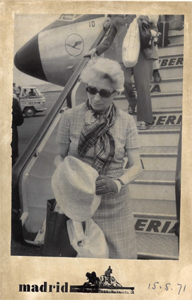
A lifelong regret and a broken promise: Miriam Gross's mother, Vera


- The Writer
- New Poetry
- Cartagena Poems
- A British Subject
- Travels with Betjeman
- Kizerman and Feigenbaum
- Communism’s Comeback?
- Irving Kristol on Jews and Judaism
- The State of Charity
- Teeth
- La Buena Muerte
- Judaeophobia
- Cool It
- Rachmones
- From 'Russia'
- 'Going Out' and Five Other Poems
- The Final Edition
- 'The Ship of Endurance' And Three More New Poems
- The Letters Of Hugh Trevor-Roper
- Lighten Our Darkness

- The Loss Of Faith Made Music Mute
- The Great Betrayal: How Liberals Appease Islam
- Political Correctness Is Devouring Itself
- The New Language Of Political Narcissism
- Why The World Still Loves Shakespeare
- Don’t Listen to Britain’s Designer Demagogues
- An English parliament: the only way to save the UK
- Death By Clickbait
- The Loss Of Faith Made Music Mute
- The Great Betrayal: How Liberals Appease Islam
- Political Correctness Is Devouring Itself
- The New Language Of Political Narcissism
- Why The World Still Loves Shakespeare
- Don’t Listen to Britain’s Designer Demagogues
- An English parliament: the only way to save the UK
- Death By Clickbait
- The Loss Of Faith Made Music Mute
- The Great Betrayal: How Liberals Appease Islam
- Why The World Still Loves Shakespeare
- Political Correctness Is Devouring Itself
- Who Will Lead The Berlin Band?
- Putin and the Art of Political Fantasy
- The New Language Of Political Narcissism
- Inside The World Of 'Non-Violent' Islamism
2:09 AM
2:09 PM