



VN: Can I separate those? The lecture was really very interesting. But I don't think that the issue of women was central to it. He was saying that questions of holy orders are not first-order issues, they are second-order issues. He was much more interested in trying to lay down firmly our shared perception of the mystery of the Church. He was saying that there is much agreement around that broad framework of God's initiative in Christ. That should be the focus of our ongoing endeavours. We can carry a lot of variation and differences in matters of secondary importance. That was his point. One of those was about the ordination of women and another was about the patterns by which primacy is exercised.
The Apostolic Constitution is essentially about papal primacy, not about women or sexual ethics. It's simply a response to those within the Anglican community who have approached the Holy See, who say that they accept the same faith and see the need for unity with the Bishop of Rome, today, now. They want to know how they can do that as groups and what part of their heritage they can bring with them. The premise on which this Apostolic Constitution is founded shows that there is acceptance by the See of Rome now as it is exercised. That's why it is a mistake to read it as some kind of broad appeal to anyone of Catholic sympathies within the Anglican community. It's not that. It absolutely depends on the acceptance of the ministry of Peter as it is now. In the Church of England, for example, I hope that the Anglo-Catholic content will strengthen. That's a very important incentive for our ongoing long-term discussion there. The constitution is much more specific. It is specifically about those who want to accept the ministry of Peter and the jurisdictional oversight that he exercises now. Not all Anglicans agree with that and that's perfectly proper. Archbishop Rowan is one of them. He wants to raise the issue of primacy.
To go back to the lecture, I just wonder whether he was separating out first- and second-order issues too much. My understanding would be that the manner in which the unfolding of the mystery of salvation takes place is much closer to the content of it in a Catholic perspective than Archbishop Rowan is suggesting. And that's why Newman noted in the development of doctrine that what emerges is always implicit, if not clearly present, in the original seed. So there is a very strong line of continuity in a Catholic understanding of the development of doctrine.
It's for that reason that our understanding of the gift of the sacrament of orders is much closer to the core of the Incarnation than I think Archbishop Rowan pictures it. That's probably something to do with the reality of the sacramental dispensation. Christ is really and sacramentally present in the Mass. So there's a very strong link between what happens at the altar and the historical events of the life and death of Jesus. As Newman said: "The Mass is not something that is said, it is something that is done." And the doing is more important than the words. As you go into the Anglican experience it's a bit more symbolic. That sense of reality weakens. It becomes more of a ministry and therefore more of a service that is led. The requirements of it, figuratively and iconically, are less demanding. There are more deep-rooted issues around the question of orders than can be understood if it is just placed as a second-order issue.
So I would not expect the Catholic position to change: that priests are required to be male. I would not expect that to change. While there's an opening for married candidates, it's also very clear that it says "pro-regular". If a new ordinariate comes into existence in the country, as a rule it will be a celibate priesthood. There are strong lines of continuity. The Second Vatican Council is an interesting context and Benedict is right to see it as a continuity and not as a break and a dissonance and a new start. That's the wisdom of his office speaking.
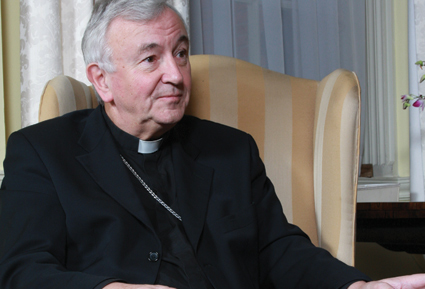
Archbishop Vincent Nichols: "What if people say it's unreasonable to have a crucifix in a Catholic cafe-home?"


- Migrant Crisis? Europe Hasn't Seen Anything Yet
- Why Palmyra Should Matter To The West
- Corbyn's Rise Makes Cameron Redundant
- No, Jeremy: Politics Is All About Borders Now
- Why 'Lady Chatterley' Still Provokes Us
- For Climate Alarmism, The Poor Pay The Price
- Will Putin's Empire Outlast The Soviets?
- British Witnesses To Lenin's Revolution
- Bibliophiles Beware: Online Prices Are A Lottery
- How Jeremy Corbyn's Coup Hijacked Labour
- Corbyn's Signpost Back To The Ghetto
- Unionists, Don't Despair: Scotland Is Not Lost — Yet
- Britain's Apologists For Child Abuse
- Lift The Fee Cap And Set Universities Free
- The Story Behind One Dead Man's Penny
- Hitler's 'Ecological Panic' Didn't Cause The Holocaust
- Meet The Montalvos: The First Global Family
- Mr Gove, Here Is Our Statute of Liberty
- A British Bill Of Rights
- Something For Nothing Just Won't Do Any More

1:01 AM
6:12 PM
1:12 AM