


Any abandonment of Afghanistan, at this stage, will create exactly the kind of chaos in which these movements flourish. It will bring about the conditions where the Taliban and its even worse allies will, once again, not only return the country to the darkest night, but also remove any incentive for Pakistan to engage with its own extremist groups, at least in the border areas. Al-Qaeda and its allies will recover their safe haven where they can regroup and plan whatever further atrocities they have in mind. Even in other parts of Pakistan, those extremist groups which were created by elements in the Pakistani military's intelligence services to infiltrate Indian-held Kashmir will see this as an opportunity to consolidate themselves and to engage in activities not only against India but more widely, and, indeed, against the still-fragile democratic Pakistani government. Not only will al-Qaeda seek to attack Western and other targets but fresh oxygen will be given to those groups training people for terrorist activity in both Afghanistan and Pakistan. It is well known that their training and activity is not limited to South and Central Asia but that they are very capable of exporting extremism and terrorism by radicalising vulnerable young Western Muslims and using them in their own countries. It has been shown beyond doubt that Britain is particularly exposed in this matter.
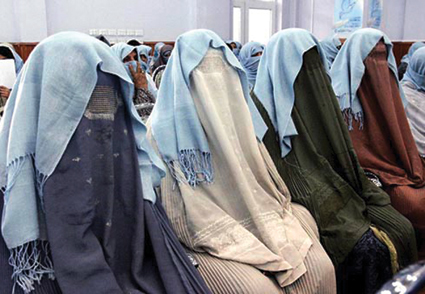
Women in Kandahar province on International Women's Day
It is vital that Western people begin to appreciate that in a globalised and highly mobile world, their interests are not confined to their territorial borders and that "minding their doorsteps" is not enough. In today's world, it would be foolish to be "a little Englander" or a "Monroe American". Western interests have to be defended globally. Usually, this happens diplomatically and through negotiation, whether political or commercial. From time to time, however, the protection of Western interests acquires a "defence" or "military" dimension. It is true that through alliances, agreements and treaties enemies can sometimes be deterred and interests protected. Only occasionally will the defence of such interests require armed intervention. When it is required, however, there should be no flinching from the focused effort, expenditure and, indeed, sacrifice which may be needed.
In the past, the Christian just war tradition provided the moral criteria as to whether a conventional inter-state conflict was justified or not. Now that most such conflicts are likely to be non-conventional and will be undertaken to prevent genocide, to frustrate the attempts of terrorists to perpetrate atrocities or to provide regional security, can this tradition still provide the necessary criteria? I believe it can. It can certainly ask whether the intention is right and whether armed action is being considered as a last resort. For example, is the intention to remove palpable evil or merely to promote the extension of one's advantage over others? Is there proper authority? This could be international authority, such as that of the UN, or a widely-based regional alliance or, indeed, it could be the authority of a nation-state, acting in self-defence, to repel or to pre-empt an attack on it. What about proper proportionality? This is much more difficult to judge: will the evil caused by the intervention exceed the evil it is seeking to remove? Here judgments need to be made not only about the immediate evil being caused but also the scale of possible harm, if the evil is left unchecked.
Similarly, in the conduct of hostilities questions about the protection of non-combatants, about proportionality and the treatment of prisoners have to be asked, even if it is acknowledged that terrorists sometimes deliberately use civilians as a shield for their atrocities and do not recognise mutual obligation. "Winning the peace" is now widely recognised as a necessary accompaniment to a conflict that may be justified. The rebuilding of a country, the restoration of power and water supplies, the maintenance of law and order are all responsibilities that can be expected in the event of success in such non-conventional types of conflict, as they previously were in the aftermaths of more conventional wars. Failure to deliver will certainly result in obscuring the moral case for the action. It may also have adverse political and social consequences. It would be terrible, for example, if Afghanistan were to be left in the ruins in which the West found it. The efforts, therefore, in physical and social reconstruction, in the provision of education, opportunity and employment are as vital as efforts to provide effective security. Such efforts are praiseworthy if carried out by the armed forces and delivered a bilateral basis. In an environment, however, where the armed services are under tremendous pressure to deliver basic security and where there is rampant corruption in the apparatus of state, surely it is vital to involve NGOs, including faith-based ones, in ways that respect their autonomy and do not compromise their integrity and credibility. There must certainly be joined-up thinking about objectives, but this does not mean that agencies should not have a certain amount of independence of action within a common framework.
Religious leaders are neither politicians nor military officers. Their task is not to decide when to undertake a particular mission of this kind and how it should be conducted. Their role is the much more modest one of praying and working for peace, of always asking whether any armed action being contemplated is a last resort and, in the end, reminding ministers and generals of the moral criteria to be used in their decision-making and in their operations. Naturally, there will be conflicts where the actions of one side or another or both will be characterised by injustice, cruelty or oppression. Such actions will need to be denounced by all who affirm basic human values and religious leaders will be among them but they should not seek to usurp what properly belongs to others. Rather, they should seek to pray, to guide, to warn and to encourage.


- How Jeremy Corbyn's Coup Hijacked Labour
- Corbyn's Signpost Back To The Ghetto
- Unionists, Don't Despair: Scotland Is Not Lost — Yet
- Britain's Apologists For Child Abuse
- Lift The Fee Cap And Set Universities Free
- The Story Behind One Dead Man's Penny
- Hitler's 'Ecological Panic' Didn't Cause The Holocaust
- Meet The Montalvos: The First Global Family
- Mr Gove, Here Is Our Statute of Liberty
- A British Bill Of Rights
- Something For Nothing Just Won't Do Any More
- Ditch Ed Miliband's Crazy Energy Legacy
- The English Public School: An Apologia
- An Open Letter To Nicky Morgan
- Escape The Heat: Head To London's Crow's Nests
- Collusion Cut Both Ways In The Troubles
- Decline Of The East? The Chinese Say No
- Conservative, Moi? Jamais De La Vie!
- How To Rescue Iraq From Obama's Folly
- Europe Must Never Again Betray Its Jews

5:06 AM
2:01 PM
6:01 AM
3:01 PM
11:12 AM
1:12 PM