


It is earnestly to be hoped that our decision-makers have taken these moral considerations into account in the conflict in South and Central Asia. If so, what should be the objectives of Western involvement there? These must include preventing Afghanistan and, now more and more, Pakistan from becoming a viable base for extremists bent on waging jihad against the West, its global interests and its allies. We should not forget that their aim is also to destabilise and if possible, overthrow moderate governments in the Islamic world itself. Never again should this area be allowed to become a base for the planning and execution of terrorist attacks in the West and elsewhere. It should be made impossible for the so-called madrassas to train young people from the West in terrorist activity against their own country and people. These must be the basic aims of involvement. The achievement of these aims depends very much on closely coordinated policy and action between the forces in Afghanistan and the Pakistani army. It must be understood clearly that the problems in Afghanistan will not be resolved if similar issues are not addressed on the other side of the border. I am glad this is beginning to happen, but there is a long way to go. It is perfectly reasonable to ask what Pakistan is doing, not only with regard to the Pakistani Taliban and other home-grown jihadi groups but against al-Qaeda itself.
It must be a legitimate aim of the involvement to protect the people of Afghanistan and Pakistan from the extremists' barbarity. What the Taliban did in Afghanistan, when they were in power, is too well-known to need repetition. During their short-lived occupation, however, of the beautiful valley and people of Swat in north-west Pakistan, one of their "signatures" was the blowing up of a girls' school which had been run by Christian nuns largely for the benefit of Muslim pupils and parents. It will not say much for a Western commitment to fundamental freedoms and basic human rights if women, girls and non-Muslims are consigned to virtual captivity just because electorates in the West are perceived not to have the stomach for a drawn-out conflict. The result of this intervention must be the empowerment of such groups and they cannot again be left at the mercy of extremists.
One of the reasons why so many in the population cannot cope with the casualties in the conflict is that there is no longer a common narrative within which people can place such tragedies and which can help them in making sense of the loss. A "me" culture of personal fulfilment and gratification leaves no room for service, selflessness and sacrifice. Although the US is enduring many of the same pressures being faced by Britain, it is instructive to see how, in many cases, the Judaeo-Christian tradition is still, if not intact, at least surviving there and how it provides a framework for making sense of loss.
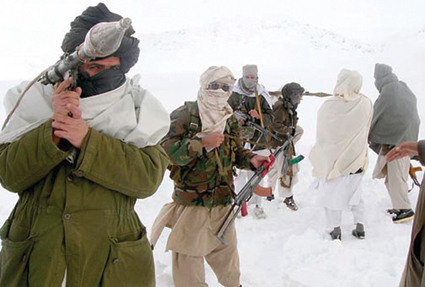
Taliban fighters and their Russian-made weapons
The other reason which is given most often for withdrawing from the conflict is that it is alienating Muslim opinion. We have seen already that the extremist agenda is not caused by various "grievances" in the Muslim world but it does feed on them. Generally speaking, Muslims have welcomed UN or Nato-led military interventions, as in Bosnia or Kosovo, when they have been undertaken to protect Muslim communities at risk. I cannot see, however, why such interventions are acceptable when Muslims are the oppressed party but unacceptable when it may be Muslims who are the oppressors (often of fellow-Muslims). We cannot have double standards here and, if armed intervention is to be allowed at all, there must be commonly-agreed criteria for it, regardless of whom it may protect or against whom it may be directed. One element in interfaith dialogue today must be about how different religious traditions see the justification (or not) of armed conflict. We have noted what the Christian Just War theory has to say about it. Is it possible for the notion of jihad, for example, to be removed from extremist rhetoric so that Muslims can use it to reach agreement with Christians and others about the conditions under which armed intervention may be justified? Such agreement, or even convergence, would be of great assistance to the international community when it comes to making difficult decisions about particular cases.
Finally, the conflict in Afghanistan must be seen as one directed against radicalisation of the region as a whole. We have seen its implications for Pakistan already. Since the Islamic Revolution, Iran has had its own brand of Shia radicalism, which shows no signs of abating in spite of international pressure and internal dissent. China must take serious account of its own western flank and the increasing dangers of extremism in Xinjiang province. India, obviously, has an interest in making sure that it is not destabilised because of the situation in its neighbourhood. In this connection, it may be worth saying that a final settlement of the Kashmir dispute seems to be in everyone's interests: India would gain security from militant groups seeking to infiltrate not only its part of Kashmir but more widely than that. The Pakistani army would be released from its eastern front and able to redeploy against extremists in the west and north. This would also assist Afghanistan and the international forces in making sure that militants under pressure on one side of the border do not flee to the other. With the dangers of militancy removed, there is also a greater chance for a semblance at least of democracy to emerge in the new Central Asian republics. These are important gains and we must not lose sight of them.


- How Jeremy Corbyn's Coup Hijacked Labour
- Corbyn's Signpost Back To The Ghetto
- Unionists, Don't Despair: Scotland Is Not Lost — Yet
- Britain's Apologists For Child Abuse
- Lift The Fee Cap And Set Universities Free
- The Story Behind One Dead Man's Penny
- Hitler's 'Ecological Panic' Didn't Cause The Holocaust
- Meet The Montalvos: The First Global Family
- Mr Gove, Here Is Our Statute of Liberty
- A British Bill Of Rights
- Something For Nothing Just Won't Do Any More
- Ditch Ed Miliband's Crazy Energy Legacy
- The English Public School: An Apologia
- An Open Letter To Nicky Morgan
- Escape The Heat: Head To London's Crow's Nests
- Collusion Cut Both Ways In The Troubles
- Decline Of The East? The Chinese Say No
- Conservative, Moi? Jamais De La Vie!
- How To Rescue Iraq From Obama's Folly
- Europe Must Never Again Betray Its Jews

5:06 AM
2:01 PM
6:01 AM
3:01 PM
11:12 AM
1:12 PM